LDCs adopt 16-point Dhaka Declaration
Star Report
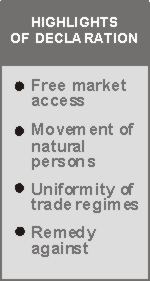
Trade ministers from the least developed countries (LDCs) yesterday unanimously adopted the 16-point Dhaka Declaration amid worry and disappointment over tardy implementation of commitments by developed nations and declining market share in global trade.Binding commitment on duty- and quota-free market access for all products from LDCs, temporary movement of natural persons and demand for urgent remedy against subsidies on cotton provided by developed countries figured prominently in the declaration. Commerce Minister Amir Khasru Mahmud Chowdhury briefed journalists about the declaration at a city hotel. High officials of the LDCs agreed upon the declaration on Sunday night and it was adopted by trade ministers yesterday with the insertion of a new clause. The clause included by the ministers read: "-- emphasizing the importance of increased coherence of policies pursued by multilateral institutions on matters of trade." It calls for bridging the gap in policy regimes between the World Bank and the International Monetary Fund (IMF). Adviser of the commerce ministry Barkat Ullah Bulu, Commerce Secretary Suhel Ahmad, Bangladesh Permanent Representative in Geneva Dr Toufiq Ali were present at the press briefing. The Second LDC Trade Ministers Meeting opened in Dhaka on May 31 with the participation of 39 countries and 24 trade ministers. Of the 16-point declaration, 13 specific demands were made under the lone clause no: 14. The declaration expressed concern over the non-implementation of issues in favour of LDCs as pledged during different WTO's ministerial meetings. The 13 specific demands are: Binding commitment on duty- and quota-free market access for all products from LDCs on a secure, long-term and predictable basis with realistic, flexible and simplified rules of origin to match the industrial capacity of LDCs to raise their market share in world trade. The declaration demanded resolution of all implementation-related issues and concerns, and all special and differential (S&D) proposals by the Cancun meeting to strengthen them and make them precise, effective and operational as mandated by the Doha Declaration. It also called for expanding and binding special and differential treatment provisions to reverse the continued marginalisation of LDCs. The declaration demanded temporary movement of natural persons, particularly unskilled and semi-skilled service providers, to the market of developed countries, recognition of professional qualifications and simplifying visa procedures. Other highlights of the declaration are; Allowing the LDCs flexibility in making commitments and undertaking obligations consistent with their individual development, financial and trade needs or their administrative and institutional capabilities. Substantial increase in technical and financial assistance to the LDCs for their development, strengthening and diversifying their production and export base as well as for institution and capacity building. Strengthening of the Integrated Framework (IF), with enhanced funding, to meet the needs of the LDCs, particularly for overcoming their supply side constraints and for the diversification of their export base along with simplification of procedures to improve access to financial resources. Exemption of the LDC exports from anti-dumping, countervailing and safeguard measures. Devising appropriate compensatory and other mechanisms to fully address the erosion of preference margins due to lowering of Most Favoured Nation (MFN) tariffs. Expeditious and full implementation of the guidelines for accession of LDCs adopted by the WTO General Council. Continuing with the technical work and studies to clarify the implications of the Singapore issues for the development aspirations of the LDCs. Developing the mechanism to help the LDCs address the inherent problems of very small size, land-locked state, remoteness and extreme vulnerability. Establishing an international mechanism to protect the genetic resources, traditional knowledge and farmers' rights. A legally sound solution for the LDCs who face difficulties in making effective use of compulsory licensing, without restricting coverage of diseases. The commerce minister said the Dhaka Declaration would be a useful tool to protect the legitimate interest of the LDCs at the fifth ministerial meeting of the World Trade Organisation (WTO) at Cancun in Mexico in September this year. "The major achievement in the three-day trade ministers' meeting is the inclusion of the demand for free movement of natural persons in the Dhaka Declaration, from which Bangladesh would be benefited enormously," Khasru said in his remarks. He, however, said the other issues included in the Dhaka Declaration would help the LDCs to negotiate at the Cancun meeting. "Expressing our full solidarity with the African LDCs that are affected by subsidies on cotton provided by developed countries, and strongly supporting actions initiated by some African LDCs in the WTO to urgently remedy the negative consequences of these subsidies that affect millions of farmers" the Dhaka Declaration said on subsidy issue. The Dhaka Declaration also expressed disappointment at the lack of progress in making the Special and Differential provisions operational. It took note of the WTO General Council's adoption of the guidelines for the accession of the LDCs.
|