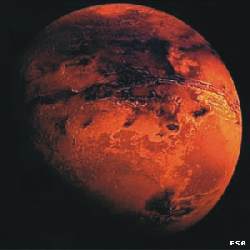
The Red Planet
Europe goes to Mars
BBC Online
The race to find life on Mars was set to begin on Monday with the launch of Europe's first voyage to another planet. Three probes are leaving Earth this summer, starting with the European Space Agency's Mars Express mission. It carries the Beagle 2 lander, which, if all goes well, will become the first British-built craft to touch down on another world. The launch marks the start of a new golden age in Mars exploration. The US space agency (Nasa) is sending two missions to the fourth planet. The first of its Mars Exploration Rovers should leave Earth in a week or so. Another Mars traveller is destined to arrive early next year. Japan's Nozomi craft should reach the planet early in 2004 after a long journey beset by mishaps. There has long been interest in exploring Mars because it is believed to be the planet most likely to harbour life. Clues that Mars once had oceans, lakes and possibly microbes have sparked a "gold rush" to send unmanned space craft to visit the planet. The United States and Russia have spent billions since the 1960s trying to land a dozen or so space craft on the Red Planet. Only three have been successful so far: Nasa's two Viking probes, which landed in 1976, and its Mars Pathfinder, which explored the surface in 1997. Mars Express is Europe's first solo mission to Mars and indeed any planet. Final launch preparations are underway at the Russian Cosmodrome in Baikonur, Kazakhstan. The first opportunity for the craft to be blasted into space was to commence on Monday at 1745 GMT (1845 BST). The orbiter with the lander on board will go up on the Russian rocket that has become the workhorse of the space industry, a Soyuz/Fregat launcher. The space craft will cover a distance of about 400 million kilometres (250 million miles) on the six-month journey to Mars. Its main scientific goal is to detect vast reservoirs of water thought to be trapped under the Martian surface using a ground-penetrating radar. It will also take images of Mars and conduct a geological survey of the planet. Between them, Mars Express and Beagle 2 could answer one of the biggest questions in science: Is there, or was there, life on Mars?
|