Exclusive
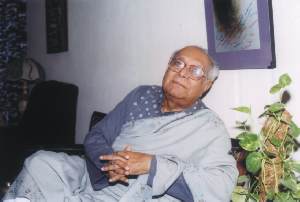
The timeless voice of Kalim Sharafi
Kalim Sharafi responds to the readers of The Daily Star
Fayza Haq
Daily Star Readers: You took an active part in the Quit India Movement during the 40s. How did your artist self cope with your political self?Kalim Sharafi: The Quit India Movement of 1942 which began with Gandhiji's call came about the time when I had just appeared for my Matriculation and Kolkata had been attacked by the Japanese during World War 11. All the Kolkata schools asked the students who were appearing for the exams. to shift to different centres and I went to Suri. Later, I went to my village home when the movement began. I was not a professional singer but people came to me asked me to sing during the political meetings to invoke anti British feelings. I sang patriotic songs composed by Nazrul and Tagore and even today we find that both the Indian and Bangladeshi national songs are by Tagore. I was eventually arrested under the Defence of India Act as the World War was on, I was tried and sent to jail for 14 months. While I was in prison, there was the Great Famine of Bengal, which I feel was artificially created as it was found in Bengal alone. Being politically motivated I was compelled to do something for the starving people. After my release I did relief work. It was so bad that dogs and vultures fought for the human flesh. About 50 lakhs of people died and in a group we tried to help as much as possible by collecting rice from those better off to help the poverty stricken. DSR: How were you involved with the theatre and is it true that you were refused admission at Santiniketan? KS: As people said that I had a good voice, when I was still quite young, I joined the theatre called IPTA (Indian People's Theatre Association). While I was in jail, I had come into contact with some people who were arrested from Santiniketan, people like Pronob Guhothakurda whose sister Arundhuti was also a singer plus a famous actress some time later on. I got a taste of Tagore songs from him and being encouraged by him I got into singing Rabindrasangeet. At this point I was interested in getting admitted at Santiniketan but I was refused because of my Leftist leanings, as the principal Professor Anil Chandra was the conventional type. However, at Kolkata, coming into more contact I had enough impetus to sing progressive songs like Nai Nai Bhoi Hobe Hobe Joey, JBandh Bhegey Dao before large audiences. We sang anti British songs like Sonu Hind Ke Rehne Wale Suno Suno and Na Na Manbona Koti Mrittu Ke Kiney Nibo Bhoer Rajje Thakbona. Later on one of the IPTA leaders, Shombho Mitra, one of the renowned actors, organized a group called Bohurupi and I got associated with him. In fact, I lived with his family in an apartment in Kolkata when he came from Mumbai. DSR: Tell us something about the Nobu Jiboner Gaan. KS: This is a series of songs composed by the incomparable Botuk Da, known as Jotindra Moitra by all, a renowned poet and musician.He had set to tune the numbers he bunched as Nobojiboner gaan, songs of new life This depicted famine and freedom fights of the 40s in India. I used to sing it and recorded it eventually in Bangladesh in the mid 90s. DSR: How did you go in for Rabindrasangeet in a serious way? KS: Suchitra Mitra, Hemanta Mukherjee and Debabrata Biswas known for their rendering of Tagore songs used to be in IPTA and that's how my interest in this genre was spurred on. I did have a guru and he was Shubho Guhothakurda. DSR:What kind of hurdles did you face as an artist in Pakistan ruled Bengal? KS: At that time the Government permitted functions with the approved list of artistes only. I sang ' Abak Prithibi Jonmeyee Dekhi Khubdho Shodesh Bhumi" at the residence of the Director of Intelligence, a choice that proved to be fatal. I was banned from singing over the radio.We organised a Shahitya Sammelan even under Martial Law and received overwhelming public response. I participatated in a Swadeshi Ganer Ashar at Chittagong to protest against their cultural policies. It was an offence under section 93A. To evade arrest I went into hiding. DSR: Could you explain what the Rabindrik style of singing is? KS: I am myself quite unsure of what the word signifies. But it is more or less the distorted, artificial and obscure way of presenting Rabindrasangeet, no doubt about that. Over the last century eminent artistes have presented Rabindrasangeet in a standardised way and that is acceptable to all. The artificial way of presentation is very much unplesant to listen to. DSR: How long is it that you are singing Rabindrasangeet and have you performed overseas? KS: Whenever I have gone overseas it has not been to perform but visit my family or friends. As for singing I've now done that for about 50 years now. If I'm requested to perform I do so even now. DSR: What other songs do you sing apart from Rabindrasangeet? KS: Mostly patriotic songs. DSR: How do you evaluate the present practice of Rabindr-asangeet? KS: Some young men and women have specialized in Tagore songs at Santiniketan and they have come back to perform. There are a few schools that teach this particular genre such as Chhayanot, Surerdhara and Sangeet Bhaban as well as Bulbul Academy. DSR: Who would you say are the good teachers of Rabindrasangeet? KS: Nowadays there are many who have returned from Santin-iketan and are teaching students here. DSR: The copyright of Rabindr-asangeet does not exist any more. How does this effect the general practice of Tagore songs? KS: If you really respect Tagore you will not distort his works. Those who sing Tagore songs have great regard for Tagore, I believe. I don't believe that his songs can be twisted or manipulated.
|