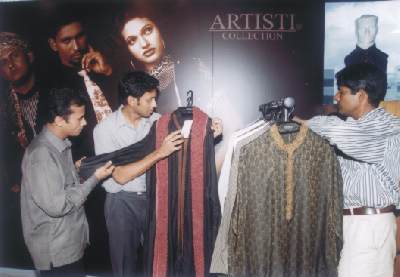
Artisti bandwagon rolls on brand concept
Shahnila Azher
High quality products and unique marketing strategies can make a venture successful in business in a short period of time. Artisti has proved this true in its seven years' journey. Artisti, a shop specialising in men's wear, began its journey with a maiden shop on Kemal Ataturk Avenue in Dhaka in 1996 at a time when the brand concept in men's clothing was still in its infancy in the local context. After seven years and launching of two more outlets, the initial vision of the company has undoubtedly grown much stronger - as demonstrated by its average revenue growth rate of 35 per cent. And now the brand name Artisti is no longer limited to the country, the company is boldly moving ahead with plans to sell its products internationally under its own label. Artisti products include casuals, formals and ethnicwear for men, with shirts being the prime forte of the chain. Although common perception of Artisti products is that of a premium label, actually there are clothings at different price points to cater to various customer segments. Current offers of Artisti generally start from up-end and extend up to premium but plans to produce an economy range are in the offing, company officials said. The business model followed by Artisti along the way has been simple it sources fabric from countries like Thailand, Indonesia and India, and produces most of its outfits locally using its own designers. Production has not been made fully automated yet considering the required size of investment but quality control plays a crucial role in the entire process. "Workmanship is very important to deliver the consistency expected of a brand," Artisti Managing Director Tariqur Rahman said. Marketing strategies used by the store has been unique in some ways. Other than the usual press ads and billboards, the company has extensively used a customer database that it has itself developed to send personalised greetings and information. Such direct mail campaigns have been enormously successful with success rates as high as 65 per cent. The other tactic Artisti has adopted is the use of a brand ambassador a novelty in Bangladesh's marketing field. A popular musician has been appointed an "ambassador" to represent the brand in various ways. The idea also proved to be a successful one. The clothing segment of retailing is certainly not an easy business. Even after designs and quality are completely in tune with customer needs, investment in inventory has to be as high as 200 to 250 per cent of the desired sales. But from the beginning, Artisti had one vision: to demonstrate that a Bangladeshi brand can be as good as an international one. To enter the international domain, at present, Rahman is experimenting with trial shipments to Canada and Australia and expecting to go full throttle from next year to other markets as well. However, Rahman who has his feet solidly on the ground, realizes the challenges ahead in trying to take a Bangladeshi brand in international markets having stiff competition. The company has to gear up its design and production processes to satisfy the medium-end international fashion industry, he thinks. Conventionally, when retailers like GAP or Walmart buy from Bangladesh, they supply the manufacturer everything from fabric specifications to design and eventually sell the finished goods under their own labels. The exporter, in turn, captures very little of the value chain and cannot command high prices. Artisti, in contrast, is embarking on a different model. Rahman plans to use his own designs and processes to produce a range that will be sold under his very own Artisti name at retail level. By cutting off intermediaries and through branding, he hopes to be able to charge a higher price, for instance, place shirts in the $15 range against the current average prices of $3 to $5. For marketing support, Artisti is now working on possible partnerships with existing branded outlets for shelf space and tie-ups. The plan is, no doubt, ambitious but Indian manufacturers have already followed this strategy and succeeded. For years, Bangladeshi firms have worked on a cost-plus basis with foreign buyers and retailers taking the larger chunk of margins away. With more players like Artisti willing to take the plunge with their own brands, maybe that situation will soon change.
|