Currents and crosscurrents
Malaysia's Mahathir
Assessing an enigmatic Asian leader
M. M. Rezaul Karim
People have witnessed a number of celebrated leaders in Asia in the past century. They were mostly national leaders, war heroes and founding fathers of their countries. Under this category one can name Mao Ze Dong, Kim Il Sung, Soekarno, Gandhi, Nehru, Jinnah, Nasser, Lee Kwan Yew and others. Dato Seri Dr. Mahathir Bin Mohammad belongs to a different category. He never waged a war of liberation nor became a founding father. Yet, he has become a great leader of the Malaysian people. Nay, he has emerged as a leader of Asia and of the developing world. Mahathir's contribution to the all-round development of Malaysia is phenomenal and outstrips that of any of his predecessors, who were also illustrious. He led his party, the United Malayas National Organisation (UMNO), and also ruled the nation for the past 22 years. One of the longest in history and, undoubtedly, in his country. Political leaders would generally like to nurture a vision and would like to implement it as well as possible. Most fail. Those who succeed are limited in number. Mahathir is one of those who succeeded. The Malayan Peninsula, like many other parts of Asia, was colonised by European powers. Firstly, it was done by the Portuguese in the early16th century, followed by the Dutch and finally by the English. The colony got independence in 1957 and became Malaysian Federation in 1963 under constitutional monarchy followed by accession of Singapore, Sabah and Sarawak to the Peninsular Malayan states. Singapore seceded in 1965, without the mainland feeling any qualms about it. The government was not unhappy, as it secured good riddance of the overwhelming Chinese population of Singapore. The Malayans are very particular, rather obsessed, with their ethnic purity or superiority. They are the original inhabitants, Bhumipatra, and constitute a majority of the population. They regard the other two ethnic races, the Chinese and the Indians, with a degree of caution, if not distrust. The inter-racial marriages are few and not particularly encouraged. The country is endowed with rich natural resources -- tin, rubber, palm oil, timber and the black gold. Out of the 13 constituent states nine have traditional monarchs, wielding limited authority. But these monarchs assume the position of Supreme Ruler of the Federation through election. After the mysterious death of a golf boy in the company of the Sultan of Johor, the then Supreme Ruler, Prime Minister Mahathir clipped many of the royal privileges by legislation. The abundant natural resources of the country were not properly exploited till years after independence. The Malayan people had generally lived a life of bliss and loved to maintain the tradition of ease and comfort in an atmosphere of self-complacency. After independence, the educated Malayan youth took up government service as the most desired profession. Meanwhile, the others, particularly the Chinese, occupied most of the business and added to the prosperity of their community. Mahathir proved to be an excellent manager of the national resources. His efforts were directed to the creation of adequate infrastructure on which a solid industrial base could be established. Investment, both domestic and foreign, abounded, due especially to the remarkable peace and stability enjoyed by the country. More so now when many of the rich Arab investors are looking for a secure and prosperous Muslim country to invest in. The skyscrappers in downtown Kuala Lumpur, the tallest twin-towers in the world in particular, pose rightfully as objects of pride for the Malaysians. Mahathir strived hard and worked relentlessly to make Malaysia, with its 25 million people, as a developed nation and a model in the developing world. But a prime feature of Mahathir's endeavours constituted in his encouraging and giving special facilities to the ethnic Malayans. He knew that national progress and individual prosperity can be achieved not merely out of agriculture but through business, commerce and industry. He, therefore, aimed at creating a class of enterpreneurs, financiers and business people among the Bhumiputras. This is one of the landmarks of his success for which ethnic Malayans, as a race, are indebted to him for providing them with a better and more prosperous life. As for his party, Mahathir manifested extreme devotion to the cause of fulfilment of the objectives of the UMNO, which has led the ruling coalition and others that governed the nation since independence. UMNO is primarily an ethnic party with a strong Islamic base. It pursues a policy, which can be generally described as right of the center. But even Mahathir had to encounter troubles brewed by his trusted lieutenant, Anwar Ibrahim. Anwar Ibrahim had a long and upbeat political career from his student days and practically became heir apparent to Mahathir. But ambition, impatience and personality clash caused Ibrahim's downfall and detention in jail on what are generally regarded as minor offences. Anwar Ibrahim also has many followers in UNMO who described Mahathir's action as autocratic. His wife is leading the movement to free Ibrahim with a view to securing political restoration for her husband. Mahathir has been in focus on the global arena in the recent past. That was because of his free and frank views boldly expressed to the surprise of many. Asian stock market, which had been flourishing beyond people's expectations, collapsed in post-1997 era. Mahathir came out with scathing criticisms against those, who had mishandled and manipulated the financial crisis. Since then, he became a more ardent advocate of the poor and the oppressed, and basically sought to uphold interests of the developing world. In the process, his frequent articulation of topical though sensitive global political and economic issues annoyed the West. But the latter could not bridle him, because Mahathir's nation no longer depended much on the West and could not be influenced like many other developing nations. The last annual general session of the UMNO, held in Kuala Lumpur on 19 and 20 June, was of special significance. Mahathir further elaborated, and more strongly this time, his customary criticisms of the West's double standard and hypocrisy with the Third World. Besides, it was the last session that Mahathir attended as President of the UMNO as well as Prime Minister of Malaysia. With deep emotion, a tearful Mahathir declared that he was going to relinquish the reins of his party and the government later this year. This voluntary abdication after 22 years of undisputed leadership became a shining example to those, who are in his shoes. Perhaps, Mahathir could continue longer, but not without criticisms. He has chosen the wise and just step. When I asked him about his future plans, he gave a smile -- a meaningful smile. I went on further to say that he had been far too long in politics to stay away from it totally even after retirement. I also ventured to ask him whether he would like to assume the role of a Lee Kuan Yew or a Gandhi. Mahathir's grin spread. "Not a Senior Minister in the Cabinet (like Lee Kwan Yew), but I don't know for certain what I would do after retirement," chuckled the Prime Minister. Whether he writes, preaches or simply oversees or guides his people, Mahathir, now 78 and in good health, will certainly wield an enigmatic influence not merely on his country but also on the developing, particularly Asian, nations for as long as he lives. M.M.Rezaul Karim, a former Ambassador, is a member of BNP's Advisory Council.
|
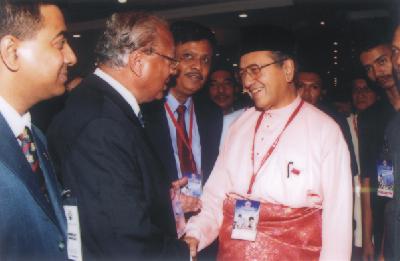
Prime Minister Dr Mahathir with the writer and others at the UMNO conference. |

