Light and shade
An exhibition with a difference
Anisur Rahman's display at the Press Club
Fayza Haq
Anisur Rahman, a staff photographer of The Daily Star, whose two-day exhibition of 53 photos of acid victims began at the National Press Club on 3rd July, said, "This is my collection of four years and I admit that this exhibition is different from what one sees normally. During my routine work I often go to DMCH and there I was accosted by a patient who gave me Tk 30, a slip and asked me to get him some medicines. I eventually found that the medicines cost over Tk 400 and I decided from then on that I would help the sick people in some way or another. I decided that through my photography I would somehow raise funds for the needy and deprived. In this exhibition I've raised funds, Tk 60,000,, which I have donated to the DMCH."When told that the type of photographs that he had taken were normally of the quality that would frighten and intimidate the viewer, Anis said, "While the photographs that one normally sees pleases the mind, I feel that these pictures heighten one's awareness about the suffering of others. In my exhibitions are pictures of acid victims ranging from children to mothers and friends. This includes Majida, the first publicized victim in Bangladesh. She had been attacked by her husband for dowry and she is seen with her child. In another picture you can see an EPZ garments worker, called Nupur, who had acid thrown at her by her rejected suitor. In the photo you see that her face is hidden by layers of cloth and from between the protection of the cloth she peers at her reflection in a mirror. "Another photo brings in Nasima and her baby. Nasima had acid thrown on her by evil men who wanted to grab her property when she was seven months pregnant. Yet another picture shows Eka Rani, a child who has had acid thrown on her. Her mother was suspected of revealing a love affair. When the affair became public, the mother Asha Rani was attacked with her child. Other pictures show acid victims being rehabilitated by the Acid Survival Foundation. Also seen are Surma and Fatima from Comilla. "I am delighted with the response to my exhibition. What I was afraid of was that the acid victims would react adversely to having their pictures seen by one and all but this was not the case. They have come up to me and asked me to give them copies of their photos. "True I've had to struggle to gather all the pictures. Sometimes I've had to arrange them and get the victims to pose such as when I've tried to show that a victim like Majida is now happy with her neighbours in the village." Asked about his life as a photographer, Anis, "My profession is undoubtedly a risky one. When I go out to work, I know that I can even die in action. I hope that during my life time I'll be able to do some worthwhile projects. I've been in photo journalism for 14 years now, having worked for The Daily Star for 12 years and for two other newspapers before that." Talking to some of the acid victims whose photographs had been taken and who had gathered there that morning for the opening of the exhibition, one was even more aware of the suffering and determination of these women. Some spoke of having been in Europe and having had treatments. One of them, a 17-year-old student, spoke of having been in Spain and said that she wanted to fight against the evil even though she herself was a victim. Reba Yasmeen, who finished her college studies is now on the lookout for a job.
|
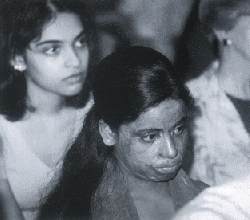
Two women of two different lives participate in a rally against acid crime. |

