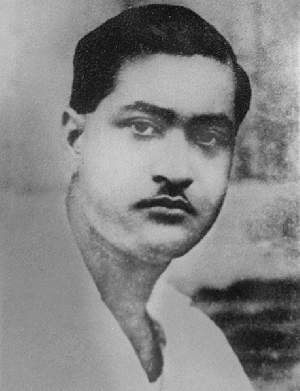
Exclusive
Kamal Das Gupta
The legend lives on
Shafin Ahmed
During 1930s to '50s it was like a proverb in the music arena that "No matter where and how much you try, in the end you will have to go to Kamal Das Gupta to find success." Among many artistes who found recognition through Kamal Das Gupta's compositions were Juthika Roy, Jogonmoy Mitra, Shanta Apté, Hemant Mukherjee, Talat Mahmood, Shubhalakshmi, K. Mallik, Indubala, Angurbala, Mrinal Kanti, Satya Chowdhury and of course Feroza Begum, the finest Nazrul Sangeet artiste. The total number of songs composed by him is an astonishing number of over 8000 of which about 400 are Nazrul songs.The 29th death anniversary of the sub-continent's greatest music composer/director Kamal Das Gupta will be observed today. Early DaysAt the age of only eighteen, my father joined His Master's Voice (HMV) as a music director. His full name was Kamalprasanna Dasgupta. My grandparents were in village Kalia of Jessore district, although it was in Kuchbihar, when the family had moved there, where my father was born on 28th of July in the year 1912. His schooling started in Kuchbihar, and he graduated as an engineer from the Bengal Engineering College in Shibpur. My grandparents Taraprasanna Dasgupta and Kaminiranjan Dasgupta were both well trained in classical music and hence a musical environment existed at home. My father would say that because of the disciplined training in music at home five/six out of the ten brothers and sisters could record songs at HMV at very early ages, and three brothers excelled as music directors, including his eldest brother Bimal Das Gupta and his younger brother Shubal Das Gupta, who composed many memorable songs. The two brothers Kamal and Shubal would sing kawali in the radio as Chand-Suraj Kawals. Kamal Das Gupta had his first formal training in music from his elder brother. Then he devoted three/four years for learning and practicing mainly Sargam in the company of the famous singer Sri Krishna Chandra Dey, who was blind. But, it was the renowned Ustad Zamiruddin Khan who was Kamal Das Gupta's true Guru. Kamal Das Gupta was already getting busy as a promising music director at HMV. It did not take time for the Ustadji to notice the extraordinary talents of this young man who had already mastered the basics. Kamal Das Gupta learned all he could from the Thumri king Ustad Zamiruddin Khan, and like an expert craftsman brought out the deepest secrets of Sur to compose his immortal tunes. His composition was first released as a record in 1932 in the voice of Satyaboti. Music StylesKamal Das Gupta has worked with various styles of music. He composed Geet and Bhajan in Hindi, he did Urdu Naat, Thumri, and Ghazals. His Raaga based songs were truly wonderful. Bhairabi was probably one of his favourites, because he composed several hundred songs in Bhairabi, a few famous ones are Jaani Jaani Akdin Bhalobeshechilé More; More Na Mitité Aasha Bhangilo Khela; Ami Bhorer Juthika; Jetha Gaan Theme Jaé; Ghari Ek Na Suhabé Piya. His unique application of rhythm can be found in many instances. About four to five hundred of his songs are indeed special in this respect and could be analysed deeply. Let me mention just a handful of such songs, which have delighted those who have followed Kamal Das Gupta's songs Jodi Bhalo Na Lagé to Diona Mon (film: Jogajoge); Ami Chanchol Jhorna Dhara; Ami Bonophul Go (Kawali rhythm); Shopné Dekhi Ekti Notun Ghar (Dadra played in half time); More Mon Cholé Jaé Shei Deshe Go (Dadra mixed with Jhumur). Geets like O Preet Nivané wali; Kitné Dukh Bhulaya Tumné in the voice of Hemanta Mukherjee are worth mentioning here. After the second World War, around the mid-1940s, one would find expressions of rebellion and protest in some of his songs. An unique blend of romance and revolution are found in these ever popular songs Prithibi Amaré Chaé; Jegé Aachhi Eka Jegé Aachi Karagaré; Ami Duronto Baishakhi Jhor; Jaader Jiban Bhora Shudhu aakhijol; Shotek Borosho Poré. All of these songs have resonated for years throughout Bengal. Kazi Nazrul and Kamal Das GuptaIt is a long chapter in the life of Kamal Das Gupta. He is recognised as the foremost composer of Nazrul songs besides Kazi Nazrul Islam himself. My father had worked closely with Kobi Nazrul for long eleven years from 1934 to 1945. It is indeed an important chapter in the history of Bengali culture. The two spent many busy mornings, tired afternoons, vibrant evenings and late nights in the company of each other. Readers might find it interesting to know how a typical day in the lives of these two great men was, as narrated by my father himself: "A lot of hard work was put in by the two of us each day. At 8 in the morning Kazi Da would start writing lyrics and melody in the HMV rehearsal room for the first artistes to come. Some lyrics he would pass on to me to tune, while I would be busy making other songs. By 9 AM the first group of singers would arrive for their training. One hour was allotted for them. The second group of singers would then come for their training and so on until 3 PM. We had no break up to that time. After 3, we would start preparing songs for the next day, which would end at 6 PM. This afternoon session was between just the two of us. Sometimes I would be in his room, sometimes he would be in mine. Kazi Da would leave at 6 PM. Kazi Da and I have spent years and years without having a day-time meal. Often, food were arranged to be brought from home, but it would remain untouched. There was no time." Films and Kamal Das GuptaA vast expanse of Kamal Das Gupta's glorious career covered films. He made music for more than forty films during the period 1936 to 1967. Those were in Bangla, Hindi, Tamil, and English documentaries. Kamal Das Gupta's first film was Pandit Moshai (1936) and the last one was Bodhubaran (1967). I believe he will always be remembered for his songs in such movies as Gormil, Shesh Uttar, Jogajog, Gobindodas, Bhagaban Sri Krishna Choitanyo, Meghdoot (Hindi). Kamal Das Gupta and Feroza BegumThe finest ever Nazrul Sangeet singer met Kamal Das Gupta as early as in the 1930s. Feroza Begum's incredible talent took her beyond the boundaries of Faridpur district to Kolkata at an early age. It was her strong desire to learn music that brought her in contact with Kamal Das Gupta. They tied the knot of marriage in 1956. Kamal Das Gupta took special care in training Feroza Begum realising her potential to become a great artiste. For correct manifestation and for exposing Nazrul's songs to the wider world, the Kamal-Feroza pair's contribution is simply unassailable. Last Days in DhakaMy gloriously successful father left us all forever, on the 20th of July 1974 at the P.G. Hospital in Dhaka. We had moved to Dhaka from Kolkata in 1967. But the small horizon of Dhaka's music and the government of the time made the giant feel caged. After the independence of Bangladesh, my father was given the citizenship of Bangladesh and was later offered the position of Chief Music Director of the Transcription Service of Bangladesh Betar. He had lamented that six years of inactivity had done him a lot of harm and they should take from him whatever they could. He had planned to develop an orchestra, a concert hall and teach training methods, short hand notation and several other projects for the Transcription Service. My father had a strong personality, but he was polite. He was generous, he felt for the poor. During the famine of 1950 in Kolkata, My father fed a hundred people everyday for months. As a growing up child I used to be thrilled to hear that my famous father owned an American built gorgeous Buick car in those days in Kolkata. My father was a big follower of Cricket, perhaps the reason why we three brothers have always been keen on Cricket. Tahsin and Hamin actually played top level Cricket, and Hamin had made it to the Bangladesh National Team. Memories of winter mornings on roof top, listening to Cricket commentary together on the radio, coming from far away Australia or England are all so vivid. I also remember the first time my mother bought us a guitar, which Hamin and I were trying to play. My father hearing from the next room, told us how to first tune the six strings of the guitar on EADGBE, and how if we knew where Sâ was, we could tune the rest of the strings. The last Nazrul song my father had tuned was appropriately written: Khela Shesh Holo Shesh Hoy Nai Bela....
|