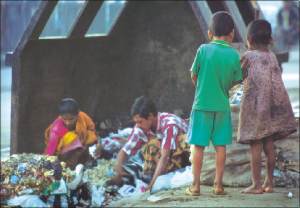
'Bio bags' solution or more waste?
Avik Sanwar Rahman
Dhaka City Corporation (DCC) has finally acknowledged the open garbage problem at roadside primary dumping sites. But the Conservancy Department of DCC has embarked on a plan to introduce imported bags for household garbage disposal, as a solution to the open garbage-dumping throughout the city. In the plan senior conservancy officials are thinking of distributing these bags among the private organisations responsible for household garbage collection so that household waste can be disposed in sealed bags. The bag is called a 'bio bag' as it is made of biodegradable cornstarch. "The 'bio bag' can easily decompose and can be used for dry and wet garbage," said Sohel Farouquie, the chief conservancy officer of DCC. "The plan of introducing the 'bio bag' for house to house garbage collection is still at its nascent stage. We will first discuss the possibility of the uses of 'bio bags' with the community based private organisations and NGOs," said Farouquie. The Planning Department of DCC began the pilot project of house to house solid waste collection by private organisations in 2002, in 49 wards of the city. The private collectors are responsible for house to house garbage collection and dumping beside the roadside open containers. DCC workers are then responsible for shoveling the garbage into the open containers. However, the organisations voiced the need for a better technique as the open garbage creates environmental pollution and health hazards for city dwellers. "We have asked DCC to remove the roadside open containers," said QM Iqbal Zaidee, secretary of Mission for Rural Urban Development (MIRUD), who got the job of garbage management in Uttara from DCC. Crude dumping without separating organic and inorganic waste, or hazardous waste from organic and recyclable matter is creating further problems. "There are more than eighty hospitals in Dhanmondi and toxic and hazardous clinical wastes are dumped with organic waste in open containers", said Zaidee. Thanks to the thousands of tokais who have traditionally separated inorganic and organic waste from the primary dumping sites at least 50 per cent of recycle materials are recovered. But DCC says that this is illegal and therefore tokais should not have formal access to dumping sites. Though DCC has urged that organic and inorganic wastes should be separated within the household, the private collectors failed to implement the decision because of lack of costing and people's awareness. "There are many people don't want to pay for garbage collection. People are not even aware of the hazards of waste. Organic waste like kitchen garbage and inorganic waste like can, tin, glass and paper are kept in the same bucket," said Nurul Huda of Bangladesh Integrated Environment Development Forum. The overall method of waste management has been criticised by Waste Concern. "Nowhere else in the world are open containers kept at the roadside for primary dumping. We need to transfer stations to certain empty places where household waste could be dumped directly from van to container. The design of the container is also faulty," said Iftekhar Enayetullah, director of Waste Concern. It is also a common concern expressed by people working in the garbage sector that bags made of jute should be used for sealed garbage dumping, to utilise our own raw materials, rather than unnecessary imports from other countries.
|