News-makers
A meeting of minds
Journalism to uphold cultural heritage
Sadya Afreen Mallick
A steaming bowl of rice and gravy made from Mourola fish, (a small boney fish variety) is what the people of our country still dream about", said the eminent cultural personality Mustafa Zaman Abbasi. Referring to the participants as Cultural Ambassadors, he expressed his concern at how rapidly the country was losing its grip on its heritage because of lack of preservation of our folk culture."Our culture is a melting pot and a conglomeration of Portuguese, English, French, Turkish and Iranian culture," added Professor Abdul Momeen Chowdhury. Culture, as he defined, was all inclusive of the totality of our lifestyle. Senior journalist and poet Fazal Shahabuddin stressed on the different aspects of journalism. This was the first day of the four day-long workshop from July 26-29, on cultural reporting, at the seminar room of the Press Institute of Bangladesh (PIB). During the workshop, experts and senior journalists from the fields of music, cinema, cine journalism, education and private TV channels shared their experience and ideas with the country's young journalists. The opinions of the speakers were as varied as their background. The participants were exposed to a diverse range of issues including ethics, professional standards, quality of reporting as well as insights into our cultural roots--how it is changing and the role of reporting in upholding the country's values. After the opening speeches, Begum Selima Rahman, State Minister for Culture, joined the afternoon session. She delivered her speech and later invited questions; it turned out to be quite a lively discussion. Dr Rezwan Hossain Chowdhury, Director General, PIB spoke on how the cultural activities of the West differed greatly from that of the East and reasons behind it. He used the gamchha (hand made towel) as an example of our culture and carried on an animated session on the improvement of technology and its influence on culture. "Economic aggression is deeply rooted in cultural aggression", he said. It is due to the influence of advertisements, films etc, that one is driven towards certain market commodities such as cosmetics, cars, dress etc. Our media has to nurture and promote our own folk culture, so that we may face challenges from outside, he emphasized. Saiful Bari, Chief Advisor of ATN Bangla, spoke at the morning session the following day. The journalists put forward questions as to how the electronic media could be controlled so that televising violence could be censored. 'The government should take immediate steps to control the satellite network and thereby enrich our channels," Bari opined. Ahmed Zaman Chowdhury, a senior editor of cine magazine Chitrali was also the guest speaker. He highlighted personalities like Khan Ataur Rahman, Fateh Lohani and Alamgir Kabir, who were the guiding force of the golden age of cinema in the country. Sudhangsu Sekhar Roy emphasised on the legal points and ethical issues one has to bear in mind when reporting. Another interesting session by Sajjad Kadir, Director of PIB on the third day, was carried on from a report of a famous magazine of our neighbouring country. He pointed out about 20 mistakes in a report of about 250 words. The report, based on exporting mangoes to another country, was followed by a plate full of sweet Fazli mangoes offered before tea, to the participants. Jawadur Rahman explained vividly the important techniques essential for reporters. Film Director Chashi Nazrul Islam, came under an intense question-answer session with the participants. Many of the questions centered on how this media was on a self-destructive path through use of vulgarity and obscenity in movies. "Films were the reflection of a country facing ruination whether in ethics or in politics," he said. Even after 32 years of independence there has been a total failure in providing jobs for the educated youth, he added further. People apparently were skeptical about whether FDC stood for Film Development Corporation or "Female Development Corporation". The irony was not lost on the audience. On the fourth and final day, senior journalist Shahadat Chowdhury delivered lecture. He expressed views on how journalists could mould the minds of people, only if they had a definite aim. It was through his magazine Bichitra that he had contributed to the development of the taat shilpo (handloom) to a great extent, he added. Eminent cultural personalities including Director General of FDC, Wasimul Bari, Film director Amjad Hossain, writer and editor Rahat Khan, actor Ashrafuddin Ujjal, danseuse Rahiza Khanam and Shamim Ara Nipa along with folk singer Abdur Rahman Boyatee joined in a colourful discussion session in the evening. Chief guest, Minister for Information, Tariqul Islam distributed certificates among the participants. He said that songs, dance, drama or any field for that matter which do not uphold patriotism is not our culture. "It is important for journalists", he said, "to uphold and thereby create a progressive culture in the country." The workshop was designed to assist the cultural reporters and desks-in-charge, on gathering information and writing techniques. The informal setting, exchange of views with journalists from different newspapers paved the way to unite the thought process and to uphold the rich heritage through their views. Of course, the mouth watering menu was an added benefit to most of the participants!
|
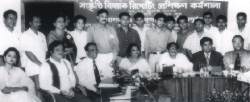
Participants (standing) of the workshop pose for a photo session with the guests. |

