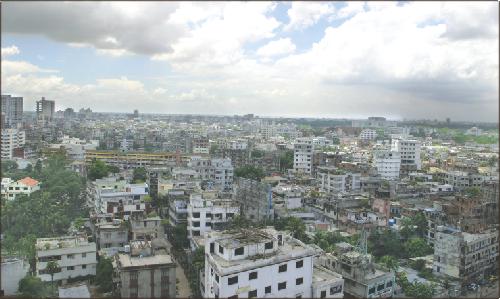
Dhaka a disaster in waiting?
Officials have warned that, "thousands of the city's buildings will collapse like sand castles in case of a moderately strong tremor" measuring about 5.2 on the Richter scale.
Sultana Rahman
An earthquake on a 'moderate scale' could create devastation in Dhaka, with hundreds of buildings collapsing, and rescue workers being unable to launch any effective rescue operation due to the complete lack of supportive equipment, according to sources in the Geographical Survey of Bangladesh (GSB). Officials of the GSB warned that up to 75 per cent of the city's population and over 80 per cent of building structures are extremely vulnerable to tremors, which they say could possibly hit Dhaka at any time. Substandard building materials, deviations from earthquake resistant approved plans, and completely unplanned structures make the situation even more dangerous. ATM Asaduzzaman, deputy director of the GSB said 80 per cent of all buildings in Dhaka have been constructed on weak filling materials on low-lying areas with poor foundations without any regard to the dangers that may lie ahead. However, neither the Department of Disaster Management nor the Department of Fire Brigade and Civil Defense lack trained manpower or equipment to manage any big disaster like an earthquake. "Dhaka is such an urban area where not even the least safety-equipment is available, which an urban area requires to keep its citizens protected during emergencies. The city has not even a single crane that can bear 100 tonnes," said the senior officials of GSB. For years, RAJUK officials have unabatedly approved these buildings in the most unplanned manner without any monitoring whatsoever, according to media reports. Many modern looking buildings constructed recently are visibly deviating from officially approved building rules. Officials have warned that, "thousands of these buildings would collapse like sand castles in case of a moderately strong tremor" measuring about 5.2 on the Richter scale. The Bangladesh National Building Code 1993 includes detailed guidelines for earthquake resistant designs for concrete and steel structures. Unfortunately, the code is yet to be officially enforced or made mandatory. "New structures are being hurriedly built without taking into consideration safety aspects, and this is exposing us to great danger," said Asaduzzaman. The present expansion of the city is towards the low-lying areas, notably in depressions and flood plains. According to experts, these low-lying areas are being filled with "loose organic sediments" such as fine-grained sand, clayey silt, organic clay, even peat and garbage are being used as filling materials. "When we want to construct a building on such a site the ideal foundation of the structure must be much deeper than what is now being practiced in the sector," Director of GSB, Mir Fazlul Karim said. A moderate earthquake was last felt in Dhaka on December 19, 2001. When that tremor, with a magnitude of 4.2 on the Richter scale, was felt many people rushed out from their homes and offices in panic. At the Dhaka Central Jail, the country's biggest prison, some 100 prisoners were hurt in a stampede when they tried to escape the old jail building. The duration of that tremor was just 21 seconds. Meteorological Department sources have said that at least 34 tremors of various intensities have jolted the country in the last six months. The Met sources also claimed that some 162 tremors were felt in Bangladesh between 1996 and 2001. Sajedur Rahman, a former director of the Meteorological Department told Star City, the history of earthquakes around the world suggests that such small tremors may be forecasts of a bigger strike. He cited the example of the disastrous earthquake in Shillong, in the Indian State of Assam, in 1876 that followed a series of smaller jolts in the region. Experts say that Dhaka is one of the earthquake-vulnerable places in the region, with the northwest, northeast and southeast parts of the country being the most risky zones. In the event of a major tremor or earthquake in the capital, the dangers have risen with the skyline, as thousands of multi-storied buildings and high-rise apartments have mushroomed in and around the city, without conforming to the measures for survival in the event of any major earthquake.
|