Exhibition
Printmakers nonpareil
Exhibition of four pioneer artists at "Chitrak"
Fayza Haq
When something as rare as the ongoing exhibition of pioneer printmakers of Bangladesh at "Chitrak" takes place, it is only normal that art lovers will flock to it. The works of Safiuddin Ahmed, Mohammad Kibria, Rafiqun Nabi and Monirul Islam fascinates even senior artists, who had not seen so many excellent examples of print media work at one go before in a private gallery at Dhaka. This is the first time that one had seen ten of Safiuddin's prints at one time in recent days. His works dates back to decades. In "Receding flood" and "Fishing time" one finds a tree in black, filled with leaves and branches that appeared like curled Bangladeshi traditional fans. There is a geometrical harmony and buoyancy in the images, qualities that were undoubtedly nonpareil. The simple use of shades of pink and black lent unusual lyricism. The water in the aquatint cum intaglio word is deep blue. Boats, houses and plants are included in the composition with one image intertwining with another. The lines are definitely incredibly strong. In "Sound of water" the same style and theme are brought and continued. Here we see expanses of black along with contrasting turquoise blue and orange -- all three being basically primary colour. The first impact is that of a sweeping bird which has enfolded the birds. The focus is on the water, net and the boats and this is semi abstract work on embossed paper and you comprehend the subject at the first go. Safiuddin Ahmed, born in 1922 in Calcutta, India, has graduated in Fine Arts from Government School of Art, Calcutta, India in 1946. He has graduated in education from India in 1958 and holds a diploma in Etching and Engraving from the Central School of Arts and Crafts, London. At present he is a part time teacher at the Institute of Fine Arts, DU since 1994. In Rafiqun Nabi's woodcuts one finds representation of life. "It's a difficult media. When I studied fine arts at Athens, my professor was Grammatopoulos, who is famous in Europe, who had inspired me at the outset. I do not imitate but learnt about colour, atmosphere and the fact that you can make a print appear like oil or water colour. It is a media in which the work normally can appear very stiff and from something dead as wood we must create life. I've enjoyed working in this media from 1974. However I didn't learn to do woodcuts suddenly in Greece as I had my lessons sitting in Dhaka from Safiuddin Ahmed and I feel that mine is a development of that." In "Kingfisher" you see a bird which has different colours flecked on it, such as green, blue and black. Surrounding the bird with its sharp beak and legs are scattered horizontal and vertical lines of dull gray, dull green with more colours to balance that while in between are little patterns. "Struggle" brings a goat in black, representing action as seen seldom before in print seen in an animal trying to free itself from the bindings of ropes. "Everything is simplified and yet you see the strength of the lines. I have tried to bring in an element of humour in the composition. Also I've included soft muted mustard, gray and yellow hues in the background. Again, I've played with lines." Rafiqun Nabi was born in 1943 at Chapainawabganj and has graduated in Drawing and Painting from Dhaka in 1964. He has studied print making at the Athens School of Fine Arts, Greece (1973-76). At present, he is a professor of Drawing and Painting at the Institute of Fine Arts DU. To be continued
|
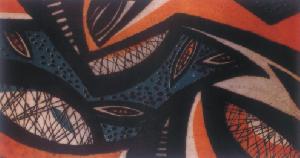
Fishing Time: Softground & Aquatint |

