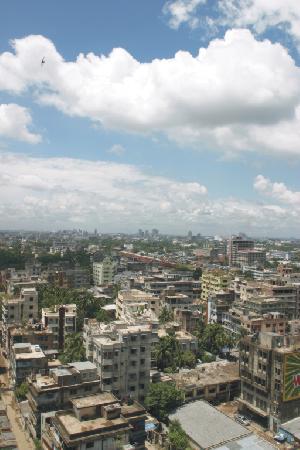
Disaster management a must for city to survive quake
An earhquake on even a moderate scale could cause devastation to Dhaka, with thousands of buildings collapsing 'like sandcastles,' according to experts. At present, rescue workers would be unable to launch any effective operation due to the lack of any comprehensive scheme or supportive equipment. After years of rapid unplanned growth of the city, the government has finally been forced to launch a disaster management programme
Sultana Rahman
The government is launching a comprehensive scheme to contend with damage caused by disasters including earthquakes, as the country is not prepared to manage any post-disaster situation. Meanwhile, Dhaka City Corporation (DCC) has directed its officials to identify risky buildings in the city. DCC's engineering department has instructed the zonal executive engineers to classify and prepare the list. DCC will later take action against the owners of vulnerable buildings following the mayor's approval. DCC's 1983 Ordinance entrusts the corporation with the job of monitoring whether any buildings under its jurisdiction are unsafe. But DCC has not prepared any list of vulnerable buildings since 1983. On the other hand, RAJUK is supposed to approve buildings that are capable of sustaining an earthquake measuring at least 6.5 on the Richter scale. But there are allegations against RAJUK that it has approved 80 per cent of Dhaka's buildings, which all have been constructed in violation of the standard. "Most of Dhaka's buildings are not strong enough to sustain an earthquake of 7 on the Richter scale," said Mir Fazlul Karim, director of the Geological Survey of Bangladesh (GSB). A recent study on the old town, conducted by the BUET (Bangladesh University of Engineering and Technology) has found about 60 per cent of the structures to be non-engineered. "The government should enforce the existing building construction code for high rises to avert serious earthquake damage to cities," said Dr Jamilur Reza Chowdhury, vice-chancellor of BRAC University and president of the Bangladesh Earthquake Society (BES). However, the Comprehensive Disaster Management Program (CDMP), an umbrella project for disaster management, will be launched soon with support from the UNDP and other development partners, said AFL Saiful Islam, director general in-charge of the Disaster Management Bureau. He said a component of the project was Urban Risk Management under which tremors would be tackled. "But there should certainly also be a post-earthquake management mechanism so that authorities can handle the situation and rescue lives," he added. History of earthquakes in Dhaka and BangladeshNorthern and eastern Bangladesh and adjoining regions lie in one of the most seismically active zones in the world. Historical record shows that Bangladesh has been shaken by at least 9 major earthquakes during the past 250 years and at least 159 small to medium earthquakes from 1906-1988.. Dhaka City falls in earthquake zone II of the seismic-zoning map of Bangladesh. The probable maximum intensity predicted for the zone is 6.0 to 6.5 on the Richter scale. Dhaka experienced a maximum earthquake on July 12, 1897. That quake, moved an area of more than 300,000 square kilometres, and did much damage to Dhaka. But luckily it caused comparatively little loss of lives. In the build up to the quake Dhaka experienced six medium to large quakes in 1762, 1775, two in 1812, in 1876 and 1885The 762 earthquake was violent enough that it's effects were felt in Chittagong. The last major earthquake to hit Dhaka was in 1967. Bangladesh is surrounded by regions of high seismicity including the Himalayan Arc and the Shillong Plateau in the north, the Burmese Arc and the Aracan Yoma Anticlinorium in the east and the complex Naga-Disang-Haflong thrust zones in the northeast. The major faults and lineaments of Dhaka cityDhaka city has experienced major and minor faulting, at different times. Some faults and lineaments have been observed in satellite images and aerial photographs by the Geological Survey of Bangladesh and its field surveys. The major faults are: -Along Bagunbari KhaL, trending east-west in the southern part of the city. -Along an abandoned channel, in the Uttara area, across Zia Interna tional Airport, trending north-south in the northern part of the city. -Along the Turag River, in Mirpur near Dhaka Zoo, trending north-south in the western part of the city. The lineaments are: -Along the edge of the depression from Khilkhet to Jatrabari, trending north-south in the central part of the city. -Along the edge of the depression in the southern part of Dakhin Khan, trending south-west in the eastern part of the city -Along the edge of the depression in the western part of Uttara, trending north-south in the northern part of the city. -Along the edge of the depression in the Pallabi area, trending north-south in the northern part of the city. -Along the branch of the Turag River, trending northeast-southwest. -Along Tongi Khal, in the Tongi-Uttar Khan area, trending east-west at the northern limit of the city. -Along the Buriganga River at the southern limit of the city, trending southwest-northeast. -Along the old natural levee, in the Mohammadpur area, trending north-south. Disaster preparednessEarthquake measures for construction are vital if our city is to survive the next large tremor or medium quake It is almost a century since the last major earthquake occurred in Bangladesh, and the specialists speculate that the earth has gathered enough time and strength for the next one. The tiny tremors that we have been experiencing for some years, and intensifying in the last six months, could be signs of just that. So, it is high time to take preventive building measures for the big one that could even hit Dhaka sometime in the near future. Mir Fazlul Karim, director of the Geological Survey of Bangladesh, suggests the following tips and precautions to take to lessen the damage to the city in an earthquake. -Take opinions of experienced/skilled engineers before constructing buildings. -Use reinforced concrete in the foundations. -Carry out geological surveys of the earth by qualified geologists or engineers. -Follow the optimum measures and use the exact approved materials while constructing any building. Quake safetyWhat if a major earthquake occurs in Dhaka? With hardly any disaster preparation on the part of authorities, here is what the experts suggest to minimise risk and injury to oneself during an earthquake: IndoorsExperts suggest that people should duck under a desk or sturdy during serious tremors. They also advise that even during minor jolts or tremors people should stay away from windows, book cases, file cabinets, heavy mirrors, hanging plants, and other heavy objects that could fall and watch out for falling plaster and ceiling tiles. HighrisesIf any one is in a high-rise building but not near to a desk or table, he or she should quickly move against an interior wall and protect head with arms. People should not try to use elevators or lifts during a tremor and should remain indoors. OutdoorsPersons outdoors should move to a clear area away from trees, signboards or hoardings, buildings, electrical wires and poles. If they are on a sidewalk near buildings, they should duck into a doorway to protect themselves from falling bricks, glass, plaster and other debris. DrivingIf one is driving, he or she should pull over to the side of the road and stop, but keep away from power lines, trees and buildings. Drivers and passengers should stay inside the vehicle until the tremor or quake is over. Crowded PlacesIn a crowded store or other public place, one should not rush for exits. Calmly move away from display shelves containing objects that could fall. If people are in a stadium or theatre, they should stay in their seats and protect heads with their arms. They should not try to leave until the shaking is over, and then leave in a calm, orderly manner avoiding panic or stampedes. After any earthquake, you should expect and prepare for aftershocks.
|