US, Canada power outage leaves millions in dark
Looting in Brooklyn, Ottawa
Reuters, New York
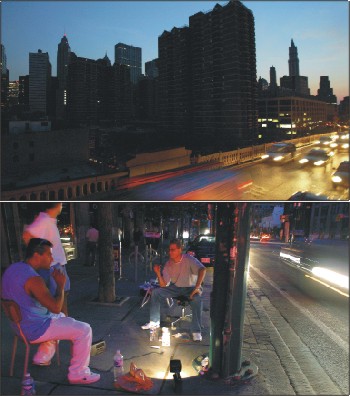
The biggest power outage in North American history blacked out New York and other major US and Canadian cities yesterday, leaving millions of people in the dark and forcing thousands of stranded commuters to sleep in the streets of Manhattan.As the lights went out on Broadway, officials ruled out sabotage, but could not agree on the cause of the blackout. "The one thing I can say for certain is that this was not a terrorist act," President Bush told reporters. The power grid failure spread as far as Detroit and Cleveland, and across the Canadian border to Toronto and Ottawa. In New York, the blackout trapped thousands in crowded subways, forced millions of evacuated office workers onto the streets, darkened Broadway and hit late trading on US financial markets. It briefly closed the city's three main airports and jangled nerves among New Yorkers whose memories of the airliner hijacking attacks of Sept. 11, 2001, are still raw. People could be seen running through the city's downtown financial district. "Everybody just flipped out," said nurse Mary Horan, stranded, with hordes of others, outside Grand Central Station. "Suddenly you start thinking about 9/11." More than 12 hours after the outage much of New York and its suburbs were still without electricity. Scattered sections of the city's electricity grid were slowly coming back on line, but officials could not estimate when power would be fully restored. Authorities reported few blackout related incidents, but there was sporadic looting in Brooklyn, with 20 people arrested after breaking into a shoe store, five arrested for looting an equipment rental center and one for breaking into a phone store, police said. In midtown Manhattan, ordinarily as bright and garish as a carnival, streets were pitch black and eerily quiet, despite huge crowds fruitlessly seeking shelter. Many people were stranded without lodging and forced to make beds of newspaper, cardboard or clothing and camp out on sidewalks, office building foyers, park lawns and parking garages. Near Grand Central station, commuters slept on the sidewalk, their heads on their briefcases. A man walking by said: "Everybody is homeless tonight. Now you get a taste of what homelessness is like." In Ottawa, the darkness brought criminals and vandals out onto the streets. "There is serious looting going on," said city police chief Vince Bevan, reporting break-ins, smashed windows and theft in the Canadian capital. The office of Canadian Prime Minister Jean Chretien said a severe outage at a Pennsylvania nuclear power plant may have caused the massive power blackout that cascaded over an area of 3,600 square miles in the US Northeast and Ontario. Earlier, US and Canadian officials said a fire or perhaps lightning had hit a power plant near Niagara Falls in New York state. Power grid operators said there appeared to have been a failure on the high-voltage transmission lines connecting the United States and Canada. They estimated it was the biggest outage to strike the North American grid, although exact numbers were not yet available. Nine nuclear reactors in four US states were shut down, officials said. Bush vowed the government would investigate what caused the outage and promised to prevent a recurrence. "This was not a terrorist act," Bush told reporters during a visit to California. "We're slowly but surely coping with this massive national problem," he added, saying that he was "confident we can get things up and running." New York Gov. George Pataki said about half of the state's 19 million people were affected by the outage. In Canada, officials said as many as 10 million people were affected. Air traffic into New York's three major airports was affected for several hours before flights began to trickle back in and the Federal Aviation Administration lifted flight bans into New York and Canadian airports. Office workers crowded onto the streets in heat of more than 90 F (33 C), facing a long walk home as buses and trains came to a halt. Streets became gridlocked when traffic signals failed. Thousands of New Yorkers were trapped underground in the dark when rush hour subway trains stopped in their tunnels after the power went out shortly after 4 p.m. local time.
|