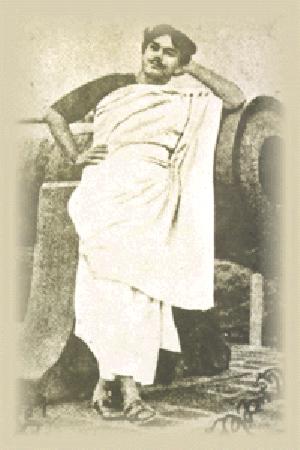
Tribute To Nazrul
The Immortal Rebel with a cause
Obaidul Huq
Twenty-seven years ago on this day (Bhadra 12, 1976) the Rebel Poet and our National Poet Kazi Nazrul Islam left us after prolonged illness. The bereaved nation pays its homage of eternal love, respect and gratitude to the undying memory of the poet whose genius transcends the national frontiers.Kazi Nazrul Islam is not just another poet. He is an incomparable and inimitable poet committed to upholding the supremacy of man emancipating man from all kinds of inequalities and injustices, in short, from "man's inhumanity to man". It is aptly said that poetry is a novel way of seeing life in its totality and saying about it with keener passion and compassion. It is truer in the case of Nazrul who sees life with the keenest emotions and says about it in the boldest terms. He introduced a new and vigorous tone and style with a strange blending of sound and sense and so animated the Bengali poetry that it considerably changed the literary taste of the time. Too creative and inventive to follow the beaten track and be patronised as a humble satellite of the master, poet Nazrul set Bengali poetry on a revolutionary course liberating it from the inhibiting influence of old hackneyed conventions and ideas. He coined and borrowed new words and expressions giving a fresh resonance to them and in the process enlarged the Bengali vocabulary and further enriched the Bengali language, which was already indebted to many other foreign languages. He gave meaning to what is called the "revolution of the word." There is no room for contradiction in the assertion that Bengali poetry did not quite step into twentieth century until the luminous appearance of poet Nazrul Islam on the literary horizon of Bengal. It is absurd to think of Nazrul, the poet, without trying to know Nazrul, the man. In fact, he is to date the boldest, the freest, the friendliest and the most original voice of humanity and liberty in Bengali poetry. His idea of man is that of a fully autonomous being enjoying freedom of thought and expression and dignity of labour which makes a clear difference between service and slavery. Having seen life at its worst, he called art into the service of man unlike those who mince tensile words in the name of serving art. Unlike many tired voice which lacked the courage of conviction and commitment in dealing with human issues, the Rebel Poet Nazrul Islam (which is only one of his many moods) came roaring and boldly expressed the social, economic and political exploitation and injustices perpetrated by the entrenched vested interests and launched literary crusade for the emancipation of the suffering humanity. And unlike the starry eyed, hard-nosed, detached-from-life, escapist 'academic' verse-makers who split up the literary audience into two a highbrow one of so-called intellectual elite and a lowbrow one composed of popular poetry -- and delight in metaphysical exercises, poet Nazrul, the realist and the subjectivist, did not hesitate when needed to nobly employ poetry in fearlessly discharging his social and human obligations. Because nothing human was alien to him be considered poetry as a state of heightened consciousness about the vicissitudes of life including the agonies, the incongruities and the in dignities of it. An uncompromising defender of human dignity and freedom Poet Nazrul called open all to break open the doors of prison cells and liberate the imprisoned multitudes. As a lyricist and composer of music he holds a unique position. Qualitatively and quantitatively speaking he still has no peer. We do not know of any one else in the world of Bengali poetry who affirmed so much so long so passionately and artistically. This is the essential poet Nazrul, the lover and Rebel Poet Nazrul, who will forever be remembered and adored for his crusading commitment to humanity and who practically sacrificed himself to the cause of humanity. A real humanist, his bold espousal of the cause of down-trodden made him a rebel, so far the only one in the realm of Bengali poetry. Naturally the concluding lines of his famous and immortal poem, the Rebel are -- The war-wearied rebel
I'll rest on the day when the wailings of the oppressed
Will not rend the air and skies,
When the tyrant's sword
Will not flourish in the battlefield.
The wailing of the oppressed continue to rend the air and the skies. And the tyrant's sword still flourishes. So the silent and timid majority must return to Nazrul again and again for the courage and vitality that they so badly need for their survival. And also for the intellectual and spiritual nourishment that the poet provides without which we shall not in an enervating state of degradation and degeneration. The author, a renouned journalist, is former editor of The Bangladesh Observer
|