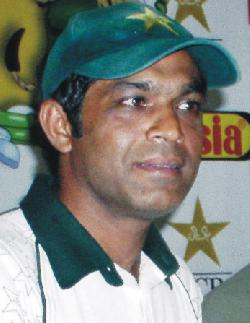
of The Daily Star Sport at the team's hotel on Monday. Following are the excerpts of that interview:Daily Star Sport (DSS): You have been in and out of the Pakistan team since your debut in England in 1992. What made you never give up?
Rashid Latif (RL): I got the motivation from our religion which says 'never lose hope'. And have I've been practising that ever since I was a boy. I believe if you work hard, God will reward you.
The first time, I was dropped from the Pakistan team was in 1995. Again I was recalled in 1996 and was left out in the same year. In 1998 I was made Pakistan captain but a back injury kept me out. I was recalled in 2001 after a three-year absence.
During that period I was running my own cricket academy in Karachi. That kept me involved in the game. While I was out of international cricket, I also started playing in the domestic cricket. My well-wishers said I was still capable of playing for my country.
That gave me a lot of confidence. In 2001, I set four domestic records and when Moin (Khan) became unfit during the New Zealand tour, I was called up for the tour of England in May 2001.
I couldn't do well in the first Test at Lord's. But the second Test at Old Trafford was a memorable one. I scored 71 and 25 runs and then had seven victims standing behind the stumps. Pakistan won that Test and I was made a regular member of the team.
I still believe that it was other reasons and not my performance that kept my out of the team. I'm 35 now. But as long as I have the strength I will continue to play the game with passion.
DSS: When a back injured forced you got out of the Zimbabwe tour in December last year, everybody thought your career was over. How did you manage to make a comeback?
RL: It was an old neck and back injury. When we reached Zimbabwe, both were giving me a lot of pain. The doctors there failed to cure it so I thought my cricket days were over.
But while in South Africa I underwent treatment and returned to Karachi. The doctors at the Karachi Aga Khan Hospital, spent a month treating me. Thankfully they cleared me. My neck injury was related to a problem with my left shoulder and without proper care I could have been paralysed.
DSS: Moin Khan was one of your best friends but he was also your rival for the wicketkeeping spot. Describe your relationship.
RL: He is a good friend of mine. We used to play in separate teams in Karachi at under-19 level. Then when we started our first-class career, we also played for two different teams in the same city. But he got the chance to play for Pakistan first before I did in 1992.
We are still good friends and I will always say that he has contributed a lot to Pakistan cricket. It is tough that only one of us could play as a wicketkeeper in the Pakistan team.
DSS: After the 2003 World Cup, there have been a number of changes in the Pakistan team. Do you think that there were too many senior players in the squad and that led to the team suffering poor results?
RL: Pakistan had the most number of experienced players compared to other teams at the World Cup. Even though we had Wasim Akram, Waqar Younis, Saeed Anwar, Inzamamul Haq, Shahid Afridi and Saqlain Musthaq but still we couldn't perform. The loss against India cost us a semifinal berth. We had bad luck in South Africa despite having a good track-record in one-day cricket.
I thought of retiring after the World Cup. But when we came back, the PCB asked to me take over a team full of youngsters. You know the toughest job in world cricket is leading Pakistan. But I'm always ready to accept new challenges so it was nothing new.
We went to Sharjah and won the tournament. Then we went to England and had mixed fortunes. In Sri Lanka, we reached the final.
The rebuilding process is going on. We are still looking for some more new faces. Now with Bangladesh here it's a good opportunity to test them before we face South Africa next month. Four players made their debut in the first Test against Bangladesh. There might be couple of more when we play the third Test in Multan. Again we could see some more new faces in the one-day series. Our mission is to bracket around 15 players who could serve Pakistan in the long run.
DSS: As captain of the Pakistan team, you know Shoaib Akhtar very well, how difficult is it for you to handle the speedster?
RL: It's not a tough task to handle Shoaib. He is a different person now than what he was in the World Cup. He is fully aware that discipline is a basic requirement to be a member of Pakistan team.
If you look back at the Karachi Test, you must have seen how serious he was though he was unlucky not to get a wicket. So, it shows the transformation in Shoaib. I think he is fully aware that he is not a special person anymore.
DSS: You have praised Bangladesh after the first Test which is unlike any other captain. We find there is a similarity between you and Steve Waugh for being straight about cricket matters.
RL: I always think about the game. I keep watching who is going out and coming in apart from Pakistan because it's good for the game.
If the Bangladesh captain says good thing that is very natural. But if I say the same thing the impact is different. Bangladesh will get better and that's what I want because helping them to become better is our responsibility too.
DSS: Pakistan have never won against India in the World Cup. Do you think that Pakistan get more emotionally involved in those matches and eventually lose?
RL: We always start well but fail at the end. May be your right that we tend to get more emotional. On the other hand it's true that the Indians somehow stay calm on the field.
DSS: The Pakistan team is much talked about for the controversies surrounding it. What is the reason behind that?
RL: Let's put it like this, Pakistan have had many superstars in world cricket and that's why they are often in the spotlight.
DSS: How long you want to continue with international cricket?
RL: I have a contract with the Board until January 2004. After that they will say whether I'm needed any more or not. Of course, it also depends on my fitness also.