N Korea crisis talks begin
China urges calm, N Korea wants non-aggression treaty
AP, Beijing
The United States, North Korea and four other nations began an extraordinary meeting yesterday, working to resolve a dispute over the North's nuclear program even as Pyongyang repeated its demand for a non-aggression treaty from Washington.Around a vast hexagonal table behind the high brick walls of the state guest house of China, the host country and the North's only remaining major ally, diplomats from all six nations shook hands and got down to business."I am very happy the six countries are all here," Chinese Vice Foreign Minister Wang Yi told the assembled diplomats before the meeting was closed to reporters. Russia, Japan and South Korea are also participating. All have a direct stake in both the region in general and the North's nuclear program in particular. China, the host country, called for a "calm and patient attitude" for the meetings. The United States says North Korea must shut down its nuclear program immediately, while Pyongyang demands guarantees of security and economic aid. US Assistant Secretary of State James Kelly and North Korean Deputy Foreign Minister Kim Yong Il were among those shaking hands before the talks began, and then their delegations were seated next to each other for the meeting. As the talks began, North Korea repeated its demand for a non-aggression pact from the United States, saying it would not give up its "nuclear deterrent force" for anything less than that. The United States should "clarify its will to make a switchover in its hostile policy toward the DPRK and conclude a non-aggression treaty with it," Rodong Sinmun, the North's official newspaper, said in a commentary carried by KCNA, the North's official news agency. US officials say they believe North Korea has one or two nuclear weapons, and experts believe it could produce five to six more in a few months. The North has withdrawn from key international agreements in recent months, including the Nuclear Non-proliferation Treaty. In October, according to the United States, North Korea acknowledged a secret nuclear program, beginning the stand-off and war of words that led to this week's talks. Bush already was wary of North Korea, calling it in a January 2002 speech part of an "axis of evil." Pyongyang insists Washington must change its "hostile policy" for the talks to produce any results. Otherwise, it said last week, "We will never give up nuclear deterrent force and settle accounts with the aggressors." Shin Bong-kil, spokesman for the South Korean delegation, said the morning session, which lasted almost five hours, proceeded in a "stable, quiet, smooth way." He said there were "no big deviations" from the expected agenda. Both Kelly's and Kim's addresses, which talked about the history of the nuclear issue dividing them, lasted about an hour, Shin said.
|
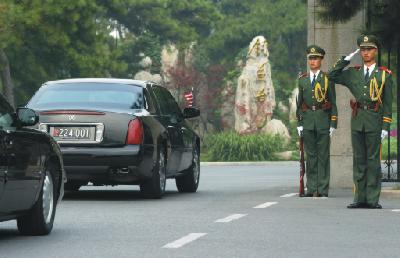
The official car of Assistant Secretary of State James Kelly, head of the US delegation arriving at Diaoyutai state guest house in Beijing yesterday. China called the start of six-nation talks, between North Korea, Japan, South Korea, Russia, the United States on the North Korean nuclear a "big step" in the resolution of the simmering 11-month crisis. Photo: AFP |

