Tribute
The Relentless Rebel
Kazi Nazrul Islam
Sadya Afreen Mallick
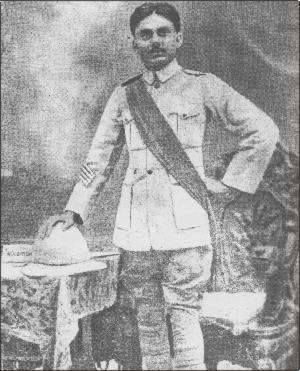
It was one particular day of Aswin. Preparation for Dugra Puja was well underway and there was excitement in the air. The black clouds looked to break into a heavy shower any moment. Late at night while everyone lay in a deep sleep, Poet Kazi Nazrul tossed in his bed.As soon as the first drops of rain splashed on to the roof, Nazrul could contain himself no longer. The poet took a piece of paper and began to write Bolo Bir Chiro Unnoto Momo Shir the first few lines of the poem Bidrohi (The Rebel), the masterpiece that inspired millions. Such was the temperament of Nazrul that earned him the title "firebrand" poet impulsive, inspirational and tireless in creativity. Early in the morning he called his friend and comrade Muzaffar Ahmed and set out for Jorashako, to meet Tagore. Upon reaching, Nazrul called out aloud "Guruji, Guruji, come and look what I have for you." Tagore hurriedly came out of his room and sat with rapt attention as Nazrul read out his work from the night before. This was in 1922 and Nazrul was only 23. In the same year, with hardly Rs.250, Nazrul started a bi-weekly publication. Not surprisingly, he named it Dhumketu (The Comet). When it was launched, Tagore sent a message of blessings: "Come, ye comet Come to build a bridge of fire Across the dark Hoist up your flag of victory" From the very first issue Dhumketu became extremely popular, particularly amongst the youth. Like its name, it sparked the deep rooted patriotic sentiments through stirring writings against colonialism. National revolutionaries hailed it and it became a common voice of protest. On 26 September, that year Nazrul's poem, Anondomoyeer Agamoney was penned for the first time in Dhumketu demanding India's complete freedom from colonial rule. Then came Agni Bina (The Fiery Bina) a collection of poems and rebellious Juga Bani (The Message of the Age) a collection of essays. Both were quickly banned by the British government. Two months later, on November 23, Nazrul was arrested in Comilla and sentenced to a one-year rigorous imprisonment for spreading anti-British feeling through his writings. He was sent to the Presidency Jail, as an under-trial prisoner but was kept there for two months before being produced in court. Later on he was shifted to the Hoogly Jail from Alipur central jail. The imprisonment stoked national outrage even more. To the masses, Nazrul came to be seen as symbol of the resistance, a propagator of freedom. Tagore did not fail to recognize the personal sacrifices of Nazrul, he said "Nazrul has brought spring in the life of the nation. So I have dedicated my newly published play Boshonto, (Spring) to him". In April, Nazrul went on a hunger strike for 40 days to protest the ill-treatment of political prisoners. Novelist Sharat Chandra Chattopadhaya, political leader Deshbondhu Chittaranjan Das requested him to give up hunger strike. Saraat wrote "I am taking the 1 o'clock train to Hoogly, to try to convince Kazi to quit hunger strike. Otherwise I see no other alternative. Kazi is a great poet after Tagore and I see no other as great as he in the horizon". The jail authorities tried in vain to forcibly feed him, give him medication as he had lost 25 pounds during hunger strike. Tagore sent a telegram from Shilong urging Nazrul to give up the hunger strike, but the message was never delivered to the poet. Nazrul was released from jail in December. After a year in 1923, Nazrul married Pramila (Duli) and moved off to Hoogly. His first collection of songs and poems Bisher Bashi (The Poison Flute) and Bhangaar Gaan (The Song Of Destruction) were published, but as before, was soon banned. Nazrul faced hardship in his personal life also. His publishers failed to pay him his dues, and he found it difficult to make ends meet. But he wrote on at a prolific rate penning some 2800 songs, 25 books of poetry, 3 novels, 29 plays, 3 books of translation and much more. In fact, it was at the end of 1926 that Nazrul gradually stepped into the exclusive realm of music. Nazrul's association with the Gramaphone companies began in 1928. He was also involved with Senola, Megaphone, His Masters voice (HMV) and Twin. On December15, 1929 a grand civic reception for Nazrul was held at the Albert Hall in Kolkata. Acharya Prafulla Chandra Ray, an eminent Bengali scientist presided, while Netaji Subhash Chandra Bose, the celebrated leader was the chief guest. Sir Prafulla said that the poets are normally timid and soft spoken whereas Nazrul's writings were fiery. Prison walls or chains did not stop Nazrul from writing for the Bengalee mass and imbuing in them a sense of patriotism and unity. In a way, this was the personality that marked Nazrul as incomparable. In all his work, the one common thread was its diversity. His writings spread from the patriotic to ghazals, from Hamd Nath to Bhajans Kirtaans and love songs. Though a poet at heart, Nazrul was also a dramatist, novelist, lyricist, composer, film director, actor, bard, brilliant public speaker and a maestro in different forms of music. Nazrul wrote like he lived his life, full of vigour and optimism against all odds. And just like he sparked life into words, his work remain as the dhumketu on our horizon, in our minds and in our hearts.
|