'Poor suffer as governance fails'
Staff Correspondent
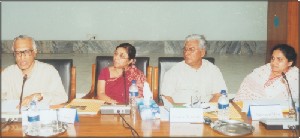
Speakers at a workshop yesterday said lack of transparency, good governance and violation of human rights are taking a heavy toll on the people, specially the poor.They called for a holistic approach from the NGOs and donor agencies to help people come out of the vicious circle. The dissemination workshop on 'Institutional mapping on human rights and governance in Bangladesh: An analytical overview' was organised jointly by Power and Participation Research Centre (PPRC) and Manusher Jonno, an NGO, at the CIRDAP auditorium in the city. PPRC Executive Chairman Hossain Zillur Rahman presented the keynote paper at the workshop while noted economist Prof Wahiduddin Mahmud, lawyer Shahdeen Malik, Ahmed Kamal, Naila Kabir, Salahuddin Aminuzzaman and Nasreen Huq took part in panel discussion. Hossain Zillur Rahman in his paper said implicit political support for illegal income is undermining the efforts for establishing a disciplined market economy and accountable government, frustrating the prospects of a social order based on human rights. He said vested-interest groups including mentors of terrorism and corruption have flourished through a vicious politico-economic nexus. Citing a survey, Hossain Zillur Rahman said a number of development organisations are, however, increasingly focusing their attention to human rights and good governance. He said human rights in Bangladesh suffers from an inherent contradiction as its jurisprudence was inherited from colonial legacy. Shaheen Anam, executive director of Manusher Jonno, in her welcome address focused on the survey findings and said more and more NGOs are becoming concern about human rights issues. She said the combination of development work with human rights and good governance has become a norm at the programmatic level of many NGOs. Shaheen Anam said a total of 184 organisations were surveyed for the mapping exercise and it was found that human rights activism is making significant achievements in the fields of education, health, disaster management and poverty eradication. Prof Wahiduddin Mahmud lauded the role of the NGO's for their achievement in reducing child mortality rate and enrolment of girl students despite Bangladesh being a predominantly Muslim country. He called upon the development partners to help create awareness among the masses to elect honest and efficient public representatives for building a creditable society. Economist Dr Atiur Rahman, and NGO leaders Sultana Kamal, Zakir Hossain, Rezaul Karim Chowdhury and Mobin Zinnah participated in the discussion.
|