Reminiscences
Those carefree, casual and cushy days
Uttam Ghosh speaks of his unforgettable memories of Shantiniketan
Fayza Haq
Uttam Ghosh who won a President's award at India for his performance in drama, and who has a film to his credit, and who aims to do his PhD on Tagore's treatment of women in his works, recalled his carefree and fruitful years at Shantiniketan. Speaking about his wonderful array of warm and sensitive teachers, Ghosh said, "The first teacher that I had the privilege to know was Poritosh Bondhopaddiya, a guru of drama. Then I met others like Tarak Sen Gupta, Debesh Rai Chowdhury and Kumar Rai. My teachers were friendly, sincere and never gave themselves any airs. They didn't ever make me feel that I was a mere student as they appeared like some close friends." Once, after he had been admitted to Shantiniketan, he went to Nilima Sen's house. Sen advised Ghosh to take music as his subsidiary subject. In appreciation he took her a bunch of flowers and she showed her appreciation in a flow of interjection. "Again," Gosh said, "Nilima Di addressed him as me as 'tui' and this naturally made me feel at home at once. She then asked me to come to her to learn whenever I had the time. I learnt 'Rabindrasangeet' from her for the first time and the first song that I tried to master with her was 'Mono jago mongol'. Next I met Mohor Di, Gora Shrobordikari, Rani Chandran and others. I used to go to Rani Di every Wednesday after the prayers at 'Mandir' (the temple where prayers were said by one and all). Also Amita Di, who is the mother of Dr Amarta Sen, the Nobel laureate's mother, also gave me a lot of care and tender affection. Next Shamoli Khastogir and Shuprio Thakur also befriended me so that I seldom felt homesick. Also, my gurus in painting, K Subramanium and Somnath Hor, were yet more mentors who did not keep their students at an arm's distance." Ghosh said that his rapport with his teachers was almost incredible and was something unique and unsurpassed. Ghosh added that he felt that he would enjoy the blessings of his teachers all throughout his life. This experience, said Ghosh was something which will be a part of his existence no matter what other wonderful events he might be lucky enough to experience. He added, "I earlier had the experience of acting with various troupes in Bangladesh but my new colleagues at Shantiniketan were something apart." When 'Tasher Desh' was being enacted there, Poritosh Da selected me as the prince, I didn't know dancing then and was at a loss as to how I could play the part adequately. However, I got help from teachers like Jiten Singh, my guardian, and Lily Islam, from Bangladesh, who was then completing her PhD on 'Rabindrasangeet' also encouraged me. "Every Wednesday, after 'Mandir' attendance, he would make his way to Rani Chandra's house. She would be ready to greet him with cashew nuts and sweet meats along with soft leaven bread for breakfast with the words, "Today you must have a proper meal with me. Our guru Rabindranath fed us in the same manner and we want to make you, who have come from afar, feel at home. You have sung Lalon and other folk songs of your homeland for me and that is enough for me in return." At one time, said, Ghosh, Rani Chandra had lived in Bangladesh. Again, at Amita Sen's house, Ghosh felt totally at home, even though, at that time, she was very sick and all that Ghosh could do for her was to sing a song. He once visited her home when she was 78, and her grand-daughter Nanda (Amarta Sen's daughter) was there and she too befriended him. Again, professors of other departments, though not affiliated to his studies, were also amicable. They had extended their camaraderie to him so that his days there were full of sunshine and laughter and not just acquisition of knowledge and skill. There are many "bhabans" at Shantiniketan, recounted Ghosh, "This includes 'Patobhaban' for students upto Class X and there is 'Uchchoshikha' for Classes XI and XII, after which there is the 'Shikkhabhaban' (Science faculty), 'Hindibhaban', 'Chinabhaban', 'Kolabhobon' (for painting, sculpture, printmaking, design) etc which teaches up till the Masters classes. There is also the 'Sangeetbhaban' (where they teach Rabindrasangeet, classical vocal and instruments) where I studied. There are also the drama and dance departments. There are no session jams there," said Ghosh. As a student of drama, Ghosh participated in many functions at Shantiniketan such as "Paush mela", "Maagh mela", "Buddho Purnima" and "Brikkho Ropon" (planting of trees) where music teachers asked him to perform with others which he did with much enthusiasm and eagerness. Most of the participants here were from "Sangeetbhaban", but others from other faculties also joined in jubilantly. Studies were combined with fun and frolic and one hardly felt the strain of studies. "When I saw the foreign students like the Germans and Japanese taking an interest in eastern musical instruments I felt all the more compelled to concentrate in my studies, getting my inspirations from these visiting students from afar," said Ghosh. On moonlit nights they would meet and sing foreign, Hindi and Bangla songs in some house or the other. They would also dance and exchange jokes. If sometimes, he failed to turn up for classes, the teachers took personal interest, and sent some student to investigate into Ghosh's absence: such was the care and concern. The impact of the Shantiniketan connections were such that Ghosh still keeps in touch with these foreigners with whom he studied at one time. The Shantiniketan days for Ghosh were indeed a time to remember.
|
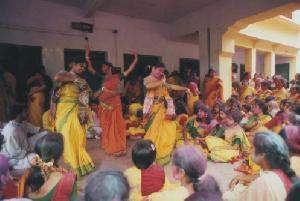
Spring festival:a sequence of spontaneous dance by students. Photo: Dr. Noazesh Ahmed |

