Abduction of businessmen to hurt investment
WB country director tells workshop
Star Business Report
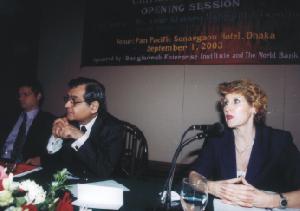
Experts at a workshop yesterday called for removing bottlenecks in the growth of private sector in Bangladesh. They identified power as major infrastructure concern needing immediate improvement to spur investment.But reforms in telecommunications, transport, ports and customs as well as effective measures against corruption will also be critical to get rid of the impediments to development of private enterprises, they said. Addressing the opening session, World Bank (WB) Country Director Christine I Wallich pointed out the recent abduction of several businessmen in Bangladesh and said it will discourage investors. She said it is possible to improve law and order by bringing reform in police forces and jail, and introducing modern management for police administration. "The process proved successful in New York, Johannesburg and Mexico City," she added. The daylong workshop titled 'Improving Investment Climate in Bangladesh' was jointly organised by Bangladesh Enterprise Institute (BEI), a private sector research centre, and the World Bank at Pan Pacific Sonargaon Hotel in Dhaka. Commerce Minister Amir Khosru Mahmud Chowdhury was scheduled to address the opening session while Finance and Planning Minister M Saifur Rahman at the concluding session but none of them attended. The workshop was split into five working sessions on power, telecommunications, port, business friendly regulatory environment and role of civil service. The World Bank country director said inadequate infrastructure facilities, weak governance and financial system retard economic growth most. "Improvement of those are pre-requisites for development of investment climate," Wallich told the opening session. Terming small and medium enterprises (SMEs) the principle contributing sector to the country's economy, the WB country director said government has to facilitate easy access to credit for SME entrepreneurs. Clive Harris of World Bank gave a presentation on Country Framework Report on Infrastructure. BEI President Farooq Sobhan presented a paper on Bangladesh's Investment Climate Assessment at the opening session. He said the government has to keep in mind the situation in post-MFA scenario. The paper was based on a survey on 1,000 manufacturing firms including garments, textiles, food and food processing, leather and leather products, electronics, chemicals and pharmaceuticals located in Dhaka and Chittagong. According to the paper, erratic power supply is the worst hurdle to investment in Bangladesh. Corruption is the next big problem, with the customs and tax departments being the most corrupt. Environmental and labour and social security agencies are also high on the corruption matrix. PDB counts loss due to expensive IPPs Speakers at a technical session on 'Unhindered Power Supply for Sound Investment Climate' observed the costly independent power producers (IPPs) are causing financial loss to the Power Development Board (PDB) which buy electricity from them. They recommended that combined cycle plants of the IPPs should be pursued for increasing electricity generation as the tariff rates of two such projects -- Haripur and Meghnaghat -- are competitive, compared to others. High level of systems loss and low revenue collection are the main constraints hindering private investment in the power sector, they pointed out. Chairman and Managing Director of Delhi Transco Ltd of India Jagdish Sagar made a presentation at the session chaired by former secretary Azimuddin Ahmed. Chairman of Dhaka Electric Supply Authority (DESA), top officials from the PDB and trade union leaders took part in discussion. In order to reduce systems loss over a specified period of time, the discussants suggested disconnecting the lines of consumers who are not paying bills regularly. Besides, they said, private sector should be engaged in more areas to takeover metering and billing services while performance verification audit and remote metering for high-tension consumers may be introduced. Azimuddin Ahmed said the tariff rates of some 800 megawatt power generated at Haripur and Meghnaghat combined cycle plants are very competitive, Tk 2.79 and Tk 2.72 per unit, but around 400 MW power purchased from other IPPs, mainly barge mounted plants, is very expensive. "So, combined cycle plants should be encouraged in future." "PDB is facing a loss of Tk 65 crore only for buying power from IPPs and selling it to other distributors," he said, adding that it is possible to cut the loss by at least half by taking some measures. Azimuddin Ahmed said domestic clients consume around 40 per cent of the total power generation but pay less than the industrial consumers. The rate should be adjusted immediately, he suggested.
|