Exhibition
Chiaroscuro of colours
YWCA women artists' works at the National Museum
Fayza Haq
Young women artists had collected for their last day's show at Novera Hall, National Museum, recently, filled with success and exhilaration --which young amateur artists oftewn feel -- having launched a fairly successful exhibition. They studied once a week at the YWCA and had other occupations such as studying or following up a career. Their paintings, mostly realistic, some experimental, were admirable for the amount of care that had gone to complete all the works.One of the members of the group, "Purbita", Ishrat Ferdousi, a doctor by profession, said that drawing and colouring has been her fascination since childhood, and it had been useful in her medical studies too. She had done a two-year course with YWCA and went in for realism. Ishrat said about one of her water colours, "In order to develop my sense of colour and perspective, I have done this painting in which I have tried to show roots covering a major portion of the space. I feel that the roots of our heritage are vital to us. I had gone to Panamnagar, Sonargaon, where I saw old buildings that were being destroyed due to neglect as seen in my 'Shikorer khoj'. I like the water colour effect as it is somewhat unpredictable." She had other compositions with poster paints and tiles. Ishrat said that she admired Aminul Islam, Hashem Khan and Qayyum Chowdhury and Nasreen Begum most of all. More adnventurous in her vision was Roselyn Gomes who in her "Jugey jugey janki" had brought in the Ramayan myth in her work where she had painted with the colours of sandalwood, coffee, turmeric and vegetable dye on canvas. Roselyn said, "I have beyond the conventional theme and symbolize our Subcontinent women in Janoki (or Sita). Our women get support from the men in the family when the mothers in-law turn tyrants just as Janoki's mother in-law planned Ram's banishment from the kingdom. Each section of the painting has an individual story behind it. I see women in harmony with men, while Ravon has no gender as he is a villain." Fahmida Khatun, the only available artist from the Fine Arts Institute, DU, at the premises, said that she had worked with the theme of flowers. Fahmida said, "Through the flowers I have expressed my innermost thoughts and feelings. I use my own colours to bring forth my conception of prevailing problems in our society. What we say and do are not the same quite often and colours are to be interpreted according to the reality of the changing patterns of our lives." The yellow 'shornochanpa', shown as blue and yellow, is put as a splash in the background in water colour. The blue standws mainly for sorrow. 'Jarul', which is normally a creeper in purple, has been depicted in shades of brown with tempera (using egg yolk and gum). 'Kolboti' has variations of purple, pink and gray. The actual yellow of the flower has purposely been left out in the painting because, as the artist feels, one is often deluded in society. Rahima Haque, a student of Sociology at DU, has done a water colour, and goes in for this medium most often, as she says, "The soft washes best express the tender feelings of the heart and mind." She has studied for three years and in her painting she has used vivid blues, greens, red and brown. She finds painting very relaxing after her routine studies at DU. Rabeya Parween has presented a scene from a vegetable market in oil. Rabeya, who is in the 4th year at YWCA, said, "I've done this in oil as it was a part of our course, but normally I prefer water colour." She has done woodcuts and glass painting too. The teacher of the group, Kazi Muzzamal Hussain, graduated from Art College Dhaka in 1965. He worked with BCSR as a designer, and now works with YWCA for 22 years as its art teacher. He is a PhD student of art at the Jahangirnagar University working on the colour psychology in the poetry of Kazi Nazrul Islam and Jibananda Das. He says, "For my students art is a side interest to which they can devote only a limited amount of time. The 1st and 2nd year students come on Saturdays; the remaining classes work here on Thursdays. There is a theory section too to their studies. They learn oil, watercolour, poster colour, woodcut, etching etc. In other word, the students have a condensed version of the Institute of Fine Arts, DU, syllabus." Twelve of the 90 members of "Purbita" actually participated in the exhibition. This included Fahmida Khatun, Ishret Ferdous, Rahima Afroze, Shakila Haque, Rabeya Parveen, Fahima Chowdhury, Roselyn Gomes etc. The group has been in existence for eleven years and speaks of women's drive for creative work of permanence.
|
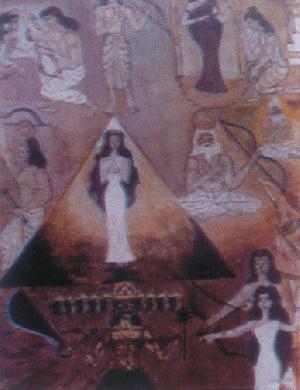
Painting by Roselyn at Novera Hall, National Museum |

