Preparedness is the best defence against an earthquake disaster
Md. Asadullah Khan
Of all the frightening things of the nature, none is so frightful as an earthquake. Report of the devastating Japan earthquake in 1185 now made public has it that in that great quake, mountains crumbled and rivers were buried, the sea tilted over and immersed the land. Not a single mansion, pagoda or shrine could escape the fury. Recalling the recent incidents, Kobe in Japan was rocked by a mega-quake of magnitude 7.2 in the Richter scale in 1995 killing instantly 5000 people and causing property damage to the extent of 30,000 million dollars. Latur quake in Maharashtra, India in 1993 killed about 30,000 people. Gujarat quake of 2001 killed about one lakh people. North western Iran quake of 1990 of magnitude 7.7 in the Richter scale killed 40,000 people. North western Armenia quake of 1988 killed 55,000 people. Most horrific, Tangshan, China quake of 1976 killed 2,42,000 people.Bangladeshis perhaps had begun to feel that they had finally escaped from earthquake disaster because they have had enough of deaths, suffering and devastation caused by other natural calamities like floods and cyclones. Complacency had spread to all, even to administration despite the fact that several small tremors rocked the Chittagong region in recent times. But the earthquake that rocked Chittagong, and the hill district Rangamati on 27 July morning with a magnitude of 5.09 in Richter scale has shattered all such complacence. It rocked the port city and adjoining areas at least four times in a day inflicted considerable damage to buildings causing four deaths and injuring about hundred people. Now, abruptly, all the catastrophic scenarios for Dhaka have taken on a chilling. In Dhaka a quake of Chittagong's scale would be cataclysmic. Seismologists fear that a big quake epicentred near Chittagong hilly region is overdue. If something like that happened in Dhaka, experts say, it would paralyse the Bangladesh economy that is already in a fragile state. This reminds us how vulnerable the country really is. Precisely speaking, Dhaka has little cause for comfort. In the event of any such major quake the biggest problem confronting the city population would be that rescue vehicles will get trapped in the maze of narrow lanes in most parts of the city. More alarming, the city's already overburdened sewer system might rupture unleashing diseases. And in Sutrapur, Islampur, Patuatuly, Nawabpur and Tipu Sultan Road, old buildings would collapse onto teeming streets setting off panic, chaos. devastation and homelessness. Similar turmoil engulfs Lalbagh, Azimpur, Khaje Dewan, Chawkbazar and Rayerbazar area which are very densely populated. For the residents of those areas, it would be such a chilling tragedy that one fails to comprehend. The images of catastrophic or better call it "doomsday scenario" in the high-tech Japan and industrialised Gujarat must move us in to action oriented planning, more cautious and more inward looking approach. In practical terms that means a massive reinvestment in the country's infrastructure. The present signal must awaken the construction authorities and other branches of bureaucracy about the need to restudy the country's earthquake preparedness and inevitably to find ways to shore up key buildings and roadways. Since long Dhaka, Chittagong and Sylhet have been obsessed by the threat of a bigger earthquake. Located in a major fault zone, experts know another quake will come one day. Worse, Dhaka city and Sylhet are located in a flood plain and has been built up over the last 100 years over land reclaimed from swamps and in case of bigger Chittagong from the sea which makes it dangerously vulnerable to tremors. Even Kobe, the most affluent region in high-tech Japan could not handle the 1995 earthquake disaster so effectively and so speedily because it did not have the preparedness to meet it as Tokyo has. In Tokyo, emergency underground reservoirs are in place and special vehicles are ready to deliver clean water if the water mains rupture as they did in Kobe. A computerized command centre stands ready with portable toilets and other emergency services stockpiled to meet any eventuality. Elaborate traffic plans have been made to clear streets for fire engines and ambulances. Ward offices have three days supplies of rice, biscuits and miso paste to prevent the kind of hunger that the people of Kobe suffered. Now the disaster plan focuses on stopping the kind of fires that swept Tokyo after 1923 quake which killed 1,44,000 people other than causing extensive damages worth billions of dollars. Fire is indeed a serious threat in urban areas with old dwellings where flames will be fueled by gas leaks and chemicals spilling from any type of factories. The chilling memories of Gujarat quake in 2001, of magnitude 6.9 in Richter scale that killed 40,000 people in a matter of seconds must awaken us. But with all our advances in science, we can't predict an earthquake for which Gujarat in India, Kobe and Tokyo in Japan, Iran, Turkey, Peru and California in the U.S. had to pay a heavy price. Death by earthquake is one of the worst ways to die. There you are taking your morning cup of tea and suddenly the whole world literally collapses on you. The other aspect is the well-established fact that the first 48 hours after any quake are very critical in saving lives. Even calling in army who have committed manpower may be of no use because they don't have the expertise and equipment to deal with the situation. In Kutch of Gujarat, residents used rudimentary tools like household hammers to chip away debris for rescuing those trapped under rubble. Delay and dilly-dallying is the biggest cause of casualty in an earthquake event. In Ahmedabad, it took nearly three days for the government to bring in cranes and earth movers. Gas cutters, the most essential implement to rescue those trapped in the debris, was available in Ahmedabad after 48 hours. Speed is of great essence in any rescue operation, especially in an earthquake disaster. Understandably, this was lacking in Gujarat. The Swiss team of experts trained in earthquake salvage operation responded to the appeal issued by the government of India in meteoric speed. The team comprising doctors, medical "all rounders", telecom specialists, paramedics, logisticians and nine dogs reached Ahmedabad with 16 tonnes of equipment including sonar vibration equipment, cameras to look through crevices, shafts and holes, devices to detect heartbeat, drillers, and slings to lift concrete. This must be noted here that a quake of similar intensity (6.9 in the Richter scale) either in Dhaka or Chittagong or Sylhet could cause unimaginable devastation. Speaking about Dhaka, in the old town starting from Nawabpur, Rathkhola, Wari, Narinda, Sutrapur to Ramkrishna Mission Road there vast areas are densely populated and it is a common apprehension that buildings in the old Dhaka can't resist quakes of such magnitude. Reports have it that it took less than a minute for towering buildings in Ahmedabad and Bhuj to collapse on 20,000 lives. More importantly, an earthquake itself never kills people, it's the badly constructed buildings that kill. Enquiries revealed that there was little damage to Ahmedabad's 30,000 Gujarat Housing Board flats, even as other prominent buildings like Shikhar Towers and Mansi apartments totally disintegrated. The real tragedy in that case was that the devastation was avoidable. God forbid, if a quake hits our prominent cities in the future, extensive damage may be avoidable if guidelines for earthquake-resistant building construction available in this region since last two decades had been followed. The greatest fear now is the realisation that none of the densely populated cities like Dhaka, Chittagong and Sylhet has regulated earthquake resistant buildings. Seismologists say that Dhaka lies on fault lines and according to experts at least 50 percent of the buildings can't resist quakes. According to report by Bangladesh Human Development Centre (BHDC) made public in a seminar in Dhaka on August 10, about two thousand buildings in the old part of the Dhaka city need demolition as these are highly risky for earthquake. Even many high rise buildings in Dhaka city have been constructed in defiance of "Building Codes" and without any provision for fire fighting arrangement. Earthquake resistant designs have been known to structural engineers since long and the National Building Code of 1993 clearly identifies structural designs in terms of earthquakes and cyclones. For safety's sake these guidelines should be part of building laws. When an earthquake occurs, it causes vibratory ground motion in three different directions that make buildings sway 'drunkenly' which can be fatal to high-rises. The violent ground motion pushes the building rapidly from one direction to another making it difficult for the superstructure to constantly balance its load. Result: while columns can bend, if the swaying motion intensifies they snap like sticks and collapse. What the structural engineers suggest now to prevent collapse of a building in an earthquake is to include "seismic isolation" by incorporating seismic bearings under the foundation that allow buildings to shift several inches with the ground movement. Shock absorber bearings with layers of steel and rubber also absorb the sideway motion. Experts also suggest inclusion of concrete slab raft foundation which is more difficult to sink in an earthquake, as the pressure gets spread over a much greater surface area. During Northridge, the great Californian quake with intensity of 6.8 in the Richter scale that, however, killed only 21 people, one seismically isolated hospital survived virtually untouched but an ordinary one next door sustained $389 million in damage. Similarly two seismically isolated buildings near Kobe reportedly came through unscathed. In another promising technique, engineers use special steel configurations, lead shock absorbers and similar "dampers" to slow a structure's swaying during a quake. Studies of earthquake devastation by experts have revealed that corners of walls are subject to enormous stress. As such a steel bar bound to the edges with concrete allows the structure to withstand it. Most of all concrete lintel beams above doors and windows bind the walls and prevent them from flying out. Other than the government which must enforce the safety laws, public awareness is essential for their enforcement. Most buildings in Bangladesh, even in the cities and towns are designed by the owners and in some cases by the inexperienced engineers and contractors and most do not realise that their homes may become their tombs. Regulating engineers is also the need of the time. The most basic flaw is that engineers in our country have no licencing system, so a novice engineer can legally certify that a building has been suitably built. Two essential factors are -- good design and good construction. The idea is to build structures in a way that can absorb maximum force and still remain stable. As a leading structural engineer in the country says, "If the beams and columns of building are properly joined, 50 percent of earthquake design is taken care of". This means if the building has the tendency to save on concrete or steel, the sturdiness of the building is at stake. Pure geometric shapes like squares, rectangles and triangles disperse the seismic forces equally in all directions and so are safer. For similar reasons, a cantilever or irregular shape results in uneven distribution of force causing such buildings to collapse. Uneven structures can be safe, says a prominent structural engineer, but they have to be appropriately reinforced to resist such forces. Steel cross beams in high-rises are the latest techniques. 'A solid concrete core such as the lift shaft in the centre and shear concrete walls, along with cross beams, are extremely earthquake resistant'. Such structures, it is reported, dominate San Francisco skyline. Building materials are crucial too. For instance, the safest modern building would be all steel as it is an extremely good shock absorber. Tightening building codes, to say nothing of retrofitting, will be no doubt expensive. But probably not as expensive as the billions of dollars in damage that a quake inflicts. Md. Asadullah Khan, a former teacher of Physics, is Controller of Examinations, BUET.
|
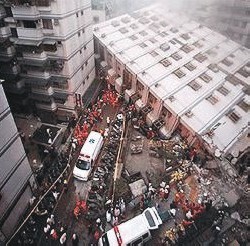
Highrise collapse in Taiwan quake 1999. |

