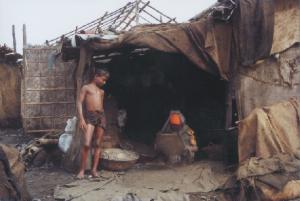
A working policy on child labour
Four NGOs are working successfully to implement the International Labour Organization's project on the elimination of high risk child labour
City Correspondent
Al-Amin came to Dhaka with his family six years ago when their village home was swallowed up by the river. That piece of land lost to erosion was their only possession and almost overnight the family became insolvent. The fight with poverty meant that Al-Amin, who was ten years old then, had to give up his academic aspirations and start working 14 hours a day at a lathe workshop. But now Al-Amin is studying once again thanks to the Multi Purpose Center (MPC). The MPC has brought about a revolution for child laborers like Al-Amin by decreasing their working hours while providing technical and academic education in the time saved. The Dhaka based center is jointly guided by the Ahsania Mission, Unprivileged Children Education Program (UCEP), Resource Integration Center (RIC) and Thangamara Mohila Sobuj Shongha. These four non-government organisations are working together to implement the International Labor Organization (ILO) project titled 'elimination of high risk child labor.' Besides academic and technical education for the children, the ILO also provides loan for their parents, which can be paid back in installments. "This process makes it easier for my son to learn and work at the same time. We can also earn money by doing business with the ILO loan," said Farida Begum, a parent. Among some estimated 63,00000-child laborers in Dhaka City, the project has targetted 20,000. About 7314 of them have been given education through 100 MPCs situated at 89 wards of Dhaka. 3612 children are now studying in various schools after getting a year's training and education under the ILO. Of them 970 have got themselves admitted at UCEP's technical training center. "We organised the program in Dhaka first as an experiment. We have passed only one year since it began. I believe we can prevent child labor in our country if we work together like we are working on this project," said Sharfuddin Khan, co-ordinator of advocacy and awareness program of ILO in Bangladesh. The ILO took the programme on July 2002 following the passage of the convention 182 of prevention of child rights at the International Labor Conference in June 1999.
|