Politics and politicians of the partition era
Sirajul Islam
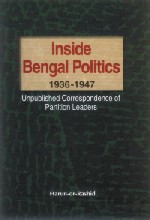
Book ReviewInside Bengal Politics 1936-1947: Unpublished Correspondence of Partition Leaders compiled by Harun-or-Rashid, pp-preface i-xiii+ biographical note 1-5 + Introduction 1-37 + summary of correspondence 38-56, Correspondence 57-158, Appendices 159-174, (University Press Limited, Dhaka 2003), Price Tk 300.This is a book of documents with a difference. With the purpose of making known the contemporary character of Muslim politics and political personalities, Professor Harun-or-Rashid has selected 95 unpublished letters passed during the period, 1936-47, between the major Bengal leaders on the one hand and two central leaders, M A Jinnah and Liaquat Ali Khan, on the other. The Bengal leaders to correspond to the central leaders are A K Fazlul Huq (1873-1962), H S Suhrawardy (1892-1962), Khwaja Nazimuddin (1894-1964), Maulana Akrum Khan (1868-1968), Abul Hashim (1905-1974), Raghib Ahsan (1904-1975), and Hamidul Huq Chowdhury (1901-1992). A few letters were also exchange with Bengal governor Sir Frederick Burrows, Lord Ismay (chief of staff of Lord Mountbatten) and Sir Eric Mieville (principal secretary to Lord Mountbatten). Bengal Muslim politics make the contents of the letters. Leaders were addressing the League president Jinnah and secretary general Liaquat Ali Khan to apply their good offices to clear the mess created by political rat racing and cutthroat factionalism. Every faction leader tried to create an impression among people that he enjoyed the favour of the 'great leader'. All top and even some mid-level leaders are seen to have been engaged in factionalism for consolidating their respective positions within the party and factions. Lucky and safest in the race was one who got the blessings of the 'great leader' Jinnah, the ultimate dispenser of validation. The contents of the select letters mostly deal with relations subsisting between various factions within the Bengal Muslim League. Under the given situation, Jinnah and Liaquat found it expedient to present themselves as neutral and thus maintain their credibility with everybody. Liaquat and Jinnah's strategy was to reply rarely to the craving letters of aspiring Bengal leaders. Rashid's selected letters give the following statistics: 7 from A K Fazlul Huq to M A Jinnah and 2 from the latter to the former; 13 from H S Suhrawardy to Jinnah and three from Jinnah to Suhrawardy; 5 from Suhrawardy to Liaquat Ali Khan and one from Liaquat to Suhrawardy; 7 from Khawaja Nazimuddin to Jinnah and two from Jinnah to Nazimuddin; 2 from Akrum Khan to Jinnah and one from Jinnah to Akrum Khan. So far as the selection of this book is concerned, one Raghib Ahsan, a mid-level Behari leader in Calcutta politics, wrote maximum number of letters to Jinnah and he was also to receive maximum number of replies from the leader. He wrote 28 letters to, and received 6 replies from, Jinnah. The ratio of Jinnah's replies to his Bengal correspondents was one to four. When necessary, Jinnah issued decrees to which the faction leaders quietly acquiesced. They never took it as an offence if their letters were not responded at all. Being unsuccessful in receiving any letter from Jinnah, Suhrawardy is seen to have tried his luck to reach his leader via Liaquat Ali Khan, the secretary general of the League. Even Liaquat was reticent in correspondence with him. To enthuse Liaquat, once Suhrawardy, then prime minister of Bengal, rather bewailed to him, "I know that you never reply to a letter, but if you keep a stenographer around you, you may find time to do so." (p. 80). The smart complaint indicates the absolute command and control that the High Command had established on Bengal leaders who were now simply reduced to their favour-hungry clients. Think again, Prime Minister of Bengal tries to reach Jinnah via Liaquat. It is by no means a natural reticence on the part of Jinnah or Liaquat. It is by no means a natural reticence on the part of Jinnah or Liaquat. It is politics, crude or refined. Bengal letters to High Command usually dealt with factionalism. Jinnah's wisdom prompted him not to play the arbiter in the faction fights prematurely. A precipitate action was thought to make him controversial among the aspiring leaders, which he must avoid. As the Bengal leaders were becoming weaker and weaker through factionalism, Jinnah gained predominance over them progressively increasingly. From the remote centre, he played one faction against another and made them all prostrate before him eventually. While Prime Minister AK Fazlul Huq tried to stand on his own feet politically, Jinnah set all other actions against him. He was forced to resign from his first ministry (1941) and then from his second ministry (1943). In the wake of Huq's resignation from his second ministry, Jinnah remarked gleefully, "...today Fazlul Huq is no more, and I hope for the rest of his life he will be no more.... He has met his Waterloo" (p. 17). The statement was indeed a warning to other leaders to behave. H S Suhrawardy aspired to be the sole caption of the Bengal ship after the fall of Fazlul Huq. But he had the Nazimuddin faction to obstruct him. Thus Suhrawardy tried to win Jinnah's favour by demonstrating his ability as an organiser. But to the Great Leader, organising ability was the secondary consideration for bestowing his favour. His primary consideration was ensuring sustainable loyalty to the High Command, which he always suspected from Suhrawardy. Unwavering loyalty was sure to come from Khawaja Nazimuddin, who thus consistently received support from the leader. Though Suhrawardy never showed any disrespect or disloyalty to Jinnah, and though it was he who took the Muslim League to mass level, Jinnah never took him into confidence. He was never taken into the Central Working Committee of the League, even after he became the Prime Minister of Bengal by his own right. Suhrawardy's letter to MA Jinnah show that initially he addressed Jinnah as Mr Jinnah and communicated with him as one of the equals. From 1942 onward, we find him address Jinnah as "Dear sir", and from 1946 as "Dear Quaid-i-Azam". Interestingly, Nazimuddin, though commonly known as a timid and docile person, had been consistently addressing the leader as 'Mr Jinnah'. He always backed the Nazimuddin-Akrum Khan coterie and never took Suhrawardy into inner chamber of the High Command. But even than he always remained sullenly quiet. Harun-or-Rashid's introduction to this book of documents not only presents the letters in their perspectives but also make a rich contribution to our knowledge about Bengal politics of the last decade of the colonial era. He is an established authority on the eventful decade 1937-47. He has very objectively analysed the faction ridden Muslim politics of the time and his narrative is extremely fascinating. His introduction and the letters evince that politicians of the time essentially stood for themselves. Rashid, however, seems to have a soft corner for Suhrawardy and his ideal for a united independent Bengal scheme. But we seek to know why should he enunciate this great plan as late as February 1947? Was he not aware that the Lahore Resolution was eroding fast after 1942 and the movement was proceeding towards a united Pakistan? Was he not a party to the trend himself? An independent Bengal case could have been really forcefully presented, had it been a product of the secular principles of politics. With 51% Muslim and 49% Hindu populations, Bengal could remain united only under a secular politics, which eroded beyond repair through communal politics of the last decade. Suhrawardy established the Muslim League in Bengal and organised Muslim nationalism in Bengal. He organised the movement to overthrow the Hindu-Muslim coalition ministry of Fazlul Huq. A K Fazlul Huq's second ministry could have been used as a giant step forward towards a united independent Bengal eventually. But what role Suhrawardy played then? Animated by Jinnah, the Suhrawardy faction launched a relentless resistance movement to wreck the coalition ministry. The election campaigns of 1946, which Suhrawardy led, articulated the idea of a single independent Pakistan, though not so openly. Jinnah's communally charged Direct Action directive was faithfully executed by Suhrawardy though its political utility for Bengal was questionable. Suhrawardy's role in wrecking the Hindu-Muslim coalition Ministry of Fazlul Huq and in the events of Great Calcutta Killing and countrywide communal riots in the wake of his Direct Action programme had almost totally alienated him from the Hindu community and sealed all prospects of any Hindu-Muslim accord on the question of independent Bengal. Finally, I must note that the documents in the book make such a fascinating reading that one must feel that as if he/she was reading a successful tragic fiction. In these letters, a reader would never miss to notice the character of contemporary politicians. It seems politicians could do anything to serve their own ends. Mutual relations among politicians assumed so much complexity that, as though all were suffering from paranoia, and all were seeking something at the expense of others, and even at the expense of self-respect. Rashid's introduction and the select letters demonstrate how factions within the Muslim League were formed and re-formed and how blindly the Bengal Muslim League leaders obeyed the High Command, more precisely, Mr. Jinnah. Factionalism was rooted in personal ambition, regionalism, family control, kinship ties, patron-client relation, careerism, corruption, and sometimes ideology. The worst kind of factionalism we notice in the wake of the 1946 elections when the League scored a massive victory. It was really the victory of the Suhrawardy faction. But ironically, soon Suhrawardy and his faction were overtaken by the Nazimuddin faction. Backed by Jinnah, Nazimuddin led the 'divisionists' making the partition of Bengal inevitable and turning the election hero of 1946 into a villain of the tragic partition-drama of the very next year. We congratulate Harun-or-Rashid for unearthing many important but hitherto unknown documents, which shed new light on the nature of politics and political personalities of the partition era. We also thank him for his very illuminating introduction to the book. Professor Sirajul Islam is Chief Editor, Banglapedia, Asiatic Society of Bangladesh and Professor of History, University of Dhaka.
|
|

