Theatre
Tagore's Roktokorobi makes a come back
Culture Desk
Nagorik Natya Sampradaya displayed its 34th production Roktokorobi recently, which is considered as one of the greatest classics in the history of world drama. According to the playwright, Rabindranath Tagore, this play is truth for any time and any place. The play centres around a materialistic world, called "Jaggapuri"(sacrificial ground) where there is only wealth and no touch of humanity. The Leviathan king of that place, according to the mythology, is Kuber, but Tagore calls him Makar-Raj, as the play is not based on myth. One day the young maiden Nandini, symbolising purity of life and emotion, comes to this place in search of Ranjan. She is in love with him. Every man, who is nothing but an element of the society there, wants her, even the King himself. But nobody gets her. As a result, the emptiness of every individual soul turns into cruelty. At last the King breaks down the walls of prejudice only for the girl. A new conflict arises between the subjects and the king. The wonderful dialogues, conflicts, power of emotion and the perceptive analysis of life are the theme of the play. The philosophy of Tagore projected in the play shows his supremacy. The director Ataur Rahman, in his acknowledgement, said that he is influenced by Indian legends Sambhu Mitra and Triptee Mitra in this play. At the same time, he has tried to display relevance to the present situation. In this edited version of the play, the director has successfully displayed the conflict between the materialistic society and the power of emotion. The inhabitants of Jaggapuri are called by number and not by name. This indicates that these lifeless human beings are nothing but elements of the materialistic society. Md. Saiful Islam, the designer, has used realistic set designing in this play. Stairs made of iron and net, and few stones made of hardboard have been used in the set to create the atmosphere of a mine. Nasirul Haque Khokon, the light designer, has proved his worth. The effects and symbolic colours used for composition are magnificent. He is one of the few designers of recent times who can adequately coordinate the cues of lighting and acting. The special sound effect to support the composition sometimes seemed harsh. Costume designing was symbolic as well as realistic. Projection and voice modulation are the basic problems with all the characters except in case of Khaled Khan. It was difficult to catch Ananto Hira's dialogues even from the front row. Boldness, that the king's character demands, could not be depicted adequately by Ataur Rahman. Sometimes it seemed that he was reciting not acting. Aupi Karim could not satisfy the expectation of the audience by her performance as Nandini, who is regarded as one the most emotional characters in the history of drama. Khaled Khan, Gazi Rakayet and Fakruzzaman Chowdury have been very enthusiastic. On the whole, the effort to stage this type of classical play is impressive. We expect that Nagarik Natya Sampradaya, one of the front-line theatres in our country, would display more classics like Roktokorobi to create better audience.
|
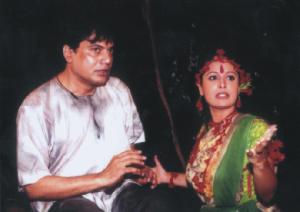
Khaled Khan and Aupi Karim in a scene from Roktokorobi |

