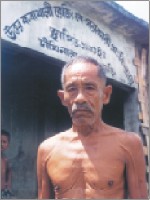
Rootless in own backyard
Odyssey of a displaced highlander
Pinaki Roy back from Khagrachhari
Kripachandra Chakma returned home to Dighinala in Khagrachhari district from a refugee camp in the northeastern Indian state of Tripura in 1997. But his refugee life is still dragging on, in an unceasing odyssey over a decade. The landmark Chittagong Hill Tracts peace agreement between the government and the Parbatya Chattagram Jana Sanghati Samity (PCJSS) in 1997 gave Kripachandra and people from 12,000 other families a chance to return home. They trekked the inhospitable CHT highlands into Tripura leaving behind their homes and relatives to escape the dogged bush war at its height in the hope of peace. But Kripachandra's homecoming was not as happy as many others. He found his homestead and farmland in the capture of Bangalee settlers and his bid to recover them is still on, 11 years into his prolonged struggle. Now he lives as a refugee on his own land where the non-tribal settlers have thrown up a school, Kobakhali Uttor Primary School, along with nine other families. "I want to get back my land. I cannot bear this wretched life any more," said Kripachandra. Kripachandra is not alone. The families of Aruna Chakma, Anil Bikash Chakma and Chikansen Chakma figure on a list of 27 families who have taken shelter to their own lands as landless, rootless people in Dighinala. Seventeen of the families live at a residential primary school and 10 in Uttor Kobakhali Non-Government Primary School. Each family lives in a six by eight feet room, a scant space to accommodate all the members. The 27 families joined some 5,000 others to cross into India on June 13, 1986 in the wake of what they claimed a joint attack by army and Bangalee settlers in Dighinala. They alleged 'the raiders' torched all the houses in an 18km stretch from Kamukhachara to Pablokhali to Changrachari. "After we left the country, the government reallocated some of the land to Bangalee settlers and the rest fell to Bangalee encroachers," Sanshita Chakma Bakul, president of the Internal Refugee Association, told The Daily Star. The indigenous people who returned home after the CHT peace pact are officially termed internal refugees. "The land was allocated to us in 1965 and the peace accord admitted our ownership of the land," Sanshita said. At Dighinala, Bangalee settlers have put up markets, schools, mosques and others establishments on the land of the ethnic people side by side with some army and Ansar camps. Without land and a livable place, the indigenous people are fighting a losing war against hunger and diseases. Terrible privation of food, shelter and medicine are part of their lives, said a local schoolteacher, requesting anonymity. But local legislator Wadud Bhuiyan said he knew nothing of them and would take steps to rehabilitate the indigenous people soon if the claims proved right. On land rights, he said they think all the pastoral land where their ancestors raised farm and pet animals to be their own property.
|