Travel Writing
Part II: Dispossession, Destitution, Descent and Desh...
Manosh Chowdhury
A trip to desolate, poverty-stricken Canning near the Sundarbans in West Bengal, where erstwhile exiles from Bangladesh, like exiles everywhere, are re-making themselves, and where in answer to a question about being able to foot it all the way to the railway station, the reply is 'Yes, even if it was three kilometers. It all depends what you are walking for.'
Over the last decade, travel writing has emerged as a critical new genre of writing within the ambit of a much broader definition of 'literature' (yes, nowadays that particular word, like 'art', like 'beauty', is intensely self-conscious, wearing its quotes like a hotel doorman's fake epaulettes), as part of explorations of self and culture. As we have said before on this page, we invite our readers to submit pieces on travel, particularly those inside Bangladesh. It is time we wrote about our people and places, our selves, in English.
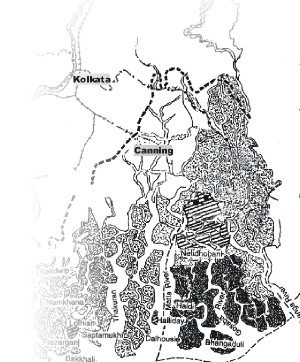
'Won't you catch this train?' The little boy on the platform was curious about me. His voice and eyes were sharp. I was tired then, unable to go through the newspaper pages with which I had been trying to get involved. I had been seriously reading the business and commerce pages of an English daily, The Telegraph. Though I was unable to understand head or tail of the articles there, I had at least understood that something very exciting was happening: Banks these days were trying hard to make 'people' become consumers. Even to my dull sense of economics, it was evident that deposit banking was at an end, that there was to be the new era of 'consumer' banking. How thrilling, I thought. The boy was not familiar with men wearing white pajamas and reading a newspaper--he probably did not care about the difference between Bangla and English papers--especially here, the east-most platform of the crowded southern terminal of Shealdah, practically his home. 'No,' I said, 'I have to take the Canning train.' There came a train just before that. And though the passengers were in a hurry to leave the platform, yet some of them kept looking at us, coming close to listen to our conversation. A bearded man nearby was asking the boy to carry water was looking at us too. Also a pleasant-looking woman. I assumed them to be his parents. It was surprising to see a Muslim 'family' on the platform. The boy was keen on helping me. He suggested: 'But you have to wait for that. And you should go to platform 11.' 'I do know that. I read it on the ticket counter' I replied. He thought a while, and then gently asked 'Are you going to visit your relatives?' 'Yes, I am.' 'So you have relatives in Canning! Where do you live, in Kolkata?' I thought once to say 'yes', but then said 'No, Bangladesh.' His face had a blank look for a few seconds, then a confused smile. I too smiled. Then he walked off. The compartments of the train were packed when I reached platform 11. An old lady, in her 70s, wearing a dhuti, sign of widowhood, sat next to the window. She looked at me, then allowed me to sit beside her. She was reciting her prayers almost in silence. The hardship of these years was apparent in her thin face. Every four-seater was jammed with at least five passengers. When the train left the platform, it was fully packed with people and their belongings-- goods to sell, ordinary domestic items, putlis and water pots. A few well-off passengers were there with water bottles bought from the platform shops, but most of the passengers had brought their water pots with them. It was a two-hour journey, and though I was missing a window seat, I could look out at the countryside. I was supposed to make a phone call from Kolkata to Radhakanta, my cousin in Canning. He has a brick house with a roof, a tiny grocery [mudi khana] shop, and a room he rents out. So he is one of the richer of my family members who migrated to India. And the tenant family had a telephone line. Getting a telephone line costs only 3000 rupees in West Bengal, a fact that was astounding for me as a Bangladeshi. Radhakanta earlier had asked my sister in Kolkata to give a call if I actually would be visiting them. He wanted to receive me at the station. My plan was different. I wanted to go there unannounced and surprise his family. I had last seen him in 1981. My grandfather had died that same year in a remote Bangladeshi village of Pirojpur. Radha and some other cousins had been in Bangladesh at that time and had thought of continuing to live there. But later he left for West Bengal, leaving behind two of his siblings, who are still in that village. So on the train to Canning I had a lot of thoughts in my mind -- how to handle my uncle's (jetha) anger at why I had not visited them over the last twenty years, about so many family members, whom to exclude and whom to meet -- all this and a lot more! The train was a local one and stopped at every station. I tried hard to learn the names of those stations so that I would not have to write them down on my notebook. Already I was the subject of much observation in that compartment. Canning railway station! The platform was full of passengers, small tea stalls, and one magazine stand. The coolies and other working people were eating, dipping the pauroti bread into the tea. It was already lunchtime. Some bi-coloured posters of a Bangla film and a jatra were posted on the wall of the men's urinal. But no photos, only writing. The dark red railway wall gave me a sense of 19th century Bengal. Whenever I come across a red railway station, whether in Bangladesh or in India, I can't help thinking of Jarashandha's Louha Kopaat. Not that I would be able to link it easily--a railway station with a jail, but there is something in the story, about a jail established under colonial administration, which always made me think that the two establishments were similar. This time Canning's small railway station again brought about this feeling. It was the last station on this line and the Sundarbans is very close to this place. As I came to know later, the forest area actually began just after the residential area. Standing there, I had a strong sense that most of its people, if not all, were from the former East Pakistan. My sister couldn't give me Radhakanta's address, or of any other relatives. She had met some of them in some anniversary at a relative's place in Kolkata. But I had the telephone number. Nearby the station, a much more urban show was apparent. Two tailors with glass in front of their shops, a suited male illustrated on the signboard, some shops with locally made electronic goods, small stores with mini-pack strips of paan moshla, shampoo, toothpaste, lotion. And a pay telephone shop with a 'private' booth just in front of me. I went inside and made a call. A female voice, probably somebody from the tenant family, answered: 'Oh, from Bangladesh? You don't need to get accompanied. It's so easy to get here, just ask a vanwallah to bring you to shoshan ghat [cremation ground] road, okay? Near the place is your dada's shop. We will be there on the road.' She was very pleasant. I learnt later she was not a migrant from Bangladesh. 'So, bhai, you have a beard now?' Dada [Radha] said on seeing me, smiling in a teasing way. He did not have the tulsi mala that I had seen him wear in 1981. My family from my father's side belongs to the Vaishnab sect of south Bengal. Almost every married woman had a tulsi mala and the males in their 50s also would wear them. Radha had been the exception, since he had started this custom when he was in his 20s. A mala signified a lot of social-ritual acts. I asked him why he was not wearing the mala. His gave a short reply 'Oh, you remember? I don't wear it these days.' Then said 'Give me khobor of the desh'. At that time, and subsequently, I got the sense that I was seen as a person from Dakurtala, supposedly 'my' village, and not from Dhaka. Or it may be that I really did not know what they meant by 'desh'. Maybe it was something beyond a physical space, beyond the people they had known earlier, and even beyond a newly constituted nation-state. When they talked, when they were enquired about 'desh', I saw shadows in their eyes. Maybe 'desh' is some fragment of their memories, their previous selves. They already had had their lunch. So boudi arranged one for me: An omelet added to the begun and potato fries, lentil soup, and bhetki fish with daal. 'Does this mean we're bongsho?' she asked me affectionately. 'Shouldn't you visit us more frequently? We left our desh, and yet we are seeing each other for the first time.' I thought that it would have been the same even if they were in Bangladesh, but didn't say anything. Their two little girls were sleeping then. Later, when we were sitting on the floor and talking, they woke up, at a loss to find one more uncle they had not seen before. I expressed my priority to dada -- that I would like to visit my uncle [his too], Radha's youngest brother Madhusudan at least, and that I would go as early as possible the next day. The next morning Radha got his bicycle while boudi looked after the shop attached to their house. Usually she did the job with her sewing machine behind the door, keeping an alert eye on the shop and changed from sewing to selling whenever a customer came in. I soon realized I should have asked for another cycle. I was in the carrier behind Radha. And when we got on the muddy road my hip was almost paralyzed with pain. Radha was ever enthusiastic. 'Look at that shop..., our son-in-law... don't you remember? That's the road to... all came from Pirojpur, Bagerhat. You can find a lot of them, even from our village. All are our people...' Once or twice I tried to convince him that I couldn't know, but he paid no attention. 'We may face a very hard life, bhai, we might have left our desh, but you will find more deshis here. If I tell people my brother came from Bangladesh, do you think you could leave within a week? No way.' We reached at my uncle's house. It was on a small piece of marshy land turned into a housing land. Some people, all from Bangladesh, were also there. Excepting the houses and the path, rainwater was everywhere. Kingfishers were diving into ponds. We entered the house, a tin-roofed bamboo house with a mud floor. One of my sister-in-laws [boudi] was there. Yet another first meeting! My uncle was not at home. He had gone to the railway platform. On the way to meet him, again on the bicycle, we rode two more kilometers to see Madhusudan. The railway-owned land had been distributed to some families cheaply and Madhu had bought 2 decimals. His house was almost on the train line. The house was locked, nobody home. We started walking on the line, which was not easy for Radha with a bicycle. I was feeling very nervous as we got close to the station. Nearby to the platform, my uncle, along with others, shared a tin-shaded open space. They bought rice from the bazaar next to Canning, or from the godown, and sold them to regular customers in small quantities. Radha had to introduce me to my uncle. He first gave me a blank look, then burst out, though he had tears in his eyes, 'Your father is an irresponsible one. And you too.' I was convinced that these lines couldn't be read literally. 'You are in our desh. We had to leave. Don't you need to keep in touch?' Then he ordered three cups of tea and loudly informed his neighboring shopkeepers 'bhaaaatijaa!' The tulsi mala on his neck tightened when he spoke loudly. Lighting a biri he asked me: 'You are staying with Radha? Well, he has a brick house.' Radha replied in hurry. 'Did he know where your place was?' Uncle was silent for a moment, then asked 'When will you have dinner at my house?' This time I replied hurriedly, 'Not this time. I will certainly visit you again, and stay at your house, in December.' Then a long pause. I was staring at his face while Radha kept his glance downwards. Soon we had to depart because Radha had to shop for a fancy dinner. And we had to go see Madhu, who worked in a tailor shop. 'You will visit me in December,' my uncle remarked calmly, 'so you are sure that I will not die till then.' I kept silent. The shoshan ghat area was very dark even with electric lights in some of the houses. A space by a little river where the corpses were burnt. I thought of going there, but it was late. The tenant lady spread out a mat on the road in front and neighbors, some of whom had been born in India, came to talk about Bangladesh. A nice starry night. One of the neighbors remarked 'You are not a supporter of BJP. But don't you think their presence is a cause of security for Hindus in Bangladesh?' 'No' I replied. We sat there until boudi called us for dinner. Radha had bought Katla fish, and sweets in honor of me. He had also asked me whether I wanted to have chicken or mutton. But I said no because meat was not eaten in that house. And I was happy at the cordial reception I was getting. Boudi told dada he should have bought at least a pot of curd. Later I lay awake thinking about the whole day, a movie of my feelings, and finally my uncle's words. Very early next morning, I woke up when Madhu's wife came to see me. Though Madhu is not much older than me yet 'boudi' was the right term for her. She had been out when we had visited their house last evening. She knew that I would take the morning train and had walked almost three kilometers after sunrise to meet me. After I had my breakfast and a cup of tea, I asked her to stay so that I might go with her to the station, which was on her way back. The two little girls were sad. Me too. I think all others were sad as well, including the tenant family. 'Will you be able to walk?' boudi asked me as we got on the road. 'The station is almost a kilometer from here.' 'Yes,' I replied. 'Even if it was three kilometers. It all depends what you are walking for.' Manosh Chowdhury teaches anthropology at Jahangirnagar University.
|
|

