Street theatre
Clarion call for Justice
Naila Azad speaks about "Tarpor"
Fayza Haq
Naila Azad directed centre for Asian Theatre's "Tarpor", a street theatre performance about violence and human rights issues recently, at Dhanmandi Mukta Mancha. Although there was no conventional plot -- but rather a stream of consciousness flowing through the play -- nor any development of characters as is often seen on stage, the polyglot mixture of the audience of hundreds sat through the play, despite the rain and the consequential delay of over an hour, and cheered intermittently. Naila Azad speaks about the content matter of the moving and mind-boggling play, sans stage props, change of costumes lighting effects and even about the background music to The Daily Star.Naila Azad is a member of numerous theatres both in USA and Bangladesh, that of Ziggurat Theatre Co., Los Angeles, Santa Monica College, Dept. of Theatre Arts/Dance, Caribbean Dance and Rhythm Co., Los Angeles, and the Centre for Asian Theatre. Between 1981-1989 Azad has been conducting acting and movement workshops for various theatre groups and universities in Bangladesh and India. She has 25 years experience as a performer for the stage, television and film. She is an accomplished director, choreographer and designer. She has a Masters in Acting from the University of California, Los Angeles. The Daily Star: What inspired you to go for this particular play? Naila Azad: Inspiration came later, nearly in the middle of the rehearsal process. When I first accepted to do this project I didn't realize that I would get so involved in it. Once I started doing research, I realized how absolutely important this project was and it was then that I was really inspired. TDS: Was there any reason for doing this play in Dhanmondi Amphitheatre? NA: This was created to be a free, street theatre performance, for the general public. The Amphitheatre might not be the middle of the street, but it is beside a few of them, and it does attract much of the crowd we wanted to play to and for me this space was extremely attractive, as it would be for any theatre person. It is absolutely gorgeous. TDS: What was the theme of the play? NA: The shape of violence in this country. TDS: What did the plot involve? NA: There is really no plot, generally speaking, because the play is not linear, in fact, it is more a performance art piece than a play. It does not have a story as such, only bold images that create a beginning, middle and an end. We tried to establish the beginning of conflict (which leads to violence) in human civilizations, how it has trickled down into this age, into our society, how it has peaked, and how abnormally it is playing an extremely vital role in our day to day lives now. Though the existence of the two classes, viz. the haves the have nots, or, the oppressor the oppressed, or, the violate the violated, is a fact of all civilization we must believe that it is against the human spirit. So in the end we ask the question whether or not we are going to accept this, or are we going to find a solution. TDS: How did you choose the actors, who were they and what experience did they have? NA: They are the regular actors of CAT (Centre for Asian Theatre). Some of them are new with no experience, and some, with whom I have worked on a couple of projects before, have been working for CAT for a few years now and are quite experienced. I did a vigorous physical, vocal, and acting workshop for two weeks and those who survived got to be in the performance. TDS: What were the problems that you faced if any? Does the Theatre have a large following in Bangladesh? NA: One of the two major problems that I faced was actually in the creation of the performance. How does one stage an issue as enormous, and vast, and deep, and fierce, and absolutely extreme as this? I simply had no clue, and found myself drowning in all the information I was getting. Firstly, I thought I would only deal with violence on women, but then the whole picture started to effect me. I was faced with the next problem. It was difficult for the actors to work on a play that had no script (it was being written in the process of creation), no dialogue, and mainly, no story. Performance Art is not a common genre in the theatre world here. Also, I applied some techniques of Commedia del Arte and Butoh Dance (of Japan), which was very new for the actors. This was not looking like a regular street theatre that is generally seen here. This had no story, no song, no cursing, no accusation everyone was worried. Now that it is done I do not know how it will affect the audience, but the actors finally are completely convinced by the piece. Secondly,I will only say that, yes, Theatre does have a large following in Bangladesh. TDS: What are the other experiences working with CAT? NA: As I have worked with CAT before, it was a pleasure coming back to familiar territory. To be able to work as intensely as I do, for a CAT project, completely uninterrupted and focused, is really all a theatre workaholic can hope for. I look forward to working with CAT again.
|
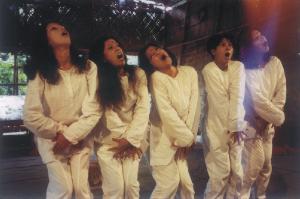
Crying out for vengeance, anguish expressed in "Tarpor" |

