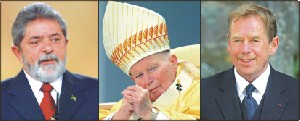
Nobel Peace Prize contenders
AFP, Oslo
The Nobel committee chose Monday the winner of the 2003 Peace Prize amid top secrecy, and while speculation was rife ahead of next week's big announcement, observers said there was no clear favourite this year. Two names thought to be strong contenders for the 10-million-kronor (1.28-million-dollar, 1.12-million-euro) prize were Pope John Paul II and Brazilian President Luiz Inacio Lula da Silva. "We have made a decision and this decision will be announced on October 10," the head of the Nobel Institute, Geir Lundestad, told AFP on Monday as the committee wrapped up its final meeting before the announcement. With a record 165 nominations, the five members of the Nobel committee had plenty of names to choose from this year. The winner is selected by consensus. But unlike some previous years, none of the candidates seemed to be obvious winners, Nobel watchers said. The head of the Peace Research Institute of Oslo (PRIO), Stein Toennesson, said "no political leaders have distinguished themselves in ways deserving of the prize". He said he was putting his money on the pope. "The main reason is his outspoken opposition to the war in Iraq. Because of his position as a religious leader, his opposition has vastly contributed to lessening the potential rift that opened up between Christianity and Islam, and that could have made the Iraq war a 'crusade'," Toennesson said. The fragile health of the 83-year-old pontiff, who has been nominated on numerous occasions, could be one reason why the Nobel committee would choose to honour him this year. Meanwhile, Espen Barth Eide, a researcher at the Norwegian Institute of International Affairs (NUPI), said the choice of the pope would be "a bit strange" unless he were to share the prize with an Islamic religious leader. "But there is nobody within Islam who stands out," he said. Toennesson also suggested that the committee may have chosen the Brazilian president. He "could need support in his attempt to rectify the enormous social injustices on his continent," he said, noting however that "such a result would perhaps come a little premature, as the results of his efforts have yet to be seen." Barth Eide said Lula would be an "interesting" choice "and not totally inconceivable", but pointed out that Lula had distinguished himself more for his socio-economic pursuits than in the field of peace. He said he would prefer to see the UN honoured -- "this would've been a good year to do it, but it already won the prize two years ago" -- or the European Union. "It has been ignored for too long but it would perhaps be more pertinent to honour the EU next year, after enlargement." Other possible winners include Iranian dissident Hashem Aghajari, the Catholic community of San Edigio in Rome or former Soviet dissident Sergei Kovalyev. Giving the prize to Aghajari, who is currently imprisoned in his own country, would send a message of democracy to Iran to encourage it on its road of reform, as well as a message of peace to the United States to convince them that change in Iran will not come by way of war, Toennesson said. A supporter of Iran's reformist President Mohammad Khatami and a university professor, Aghajari was sentenced to death in November 2002 for blasphemy but has since seen his sentence reduced to three years in prison. San Edigio could be honoured for its work on furthering ecumenical understanding, ending conflicts worldwide and combatting AIDS, while Kovalyev could take home the prize for his fight for human rights during the Chechen conflict. Nobel watchers also noted that the former chief UN weapons expert Hans Blix and the head of the International Atomic Energy Agency (IAEA) Mohamed ElBaradei could have been considered for the prize -- if the war in Iraq had been avoided.
|