Award
Modernist of the '60s
Anannya Literature Award 1410 given to Razia Khan Amin
Harun ur Rashid
Eminent novelist-poet-journalist Razia Khan Amin is the latest inclusion to the line of women writers par excellence to be awarded the Anannya Literature Award 1410. Noted educationist Professor Kabir Chowdhury handed over the award to the recipient on October 14 at the Poet Sufia Kamal Auditorium of the National Museum. Professor Syed Manzurul Islam of Dhaka University, litterateur Selina Hossain and Anannya editor Tasmima Hossain were also present on stage.Anannya, a women's fortnightly, introduced the yearly award in Bangla calendar year 1401 for remarkable contribution to Bangla literature. Except for one occasion, every year the magazine has picked one important litterateur, the list of which includes Selina Hossain, Rizia Rahman, Rabeya Khatun, Dr. Neelima Ibrahim, Dilara Hashem, Jahanara Imam, Dr. Sanjida Khatun and Begum editor Noor Jahan Begum. Novelist Razia Khan Amin wrote her first major piece Bat-tolar Upannyash at an amazingly early age of 18. After the novel had been published as a book in 1958, it created an immense impact among the readers. The story of the novel, the language of the narrative, the characters--all were marked with such novelty that was not too imaginary that it clearly heralded the rise of the talented writer. Later Razia had written a few more noteworthy novels including Hey Mohajibon, Padobik, Chitro Kabya, Droupodi, and Shikhar Himadrir. Among these Droupodi, published by Mitra and Ghosh Publishers of Kolkata, earned great reviews and praise. One of the important writers of Bangla language Annada Shankar Ray termed it as a 'classic'. The novel is set against the background of the Liberation War of Bangladesh that portrays the coming out of a woman's inner self. Kabir Chowdhury labelled the character Nayon with Nora in Henrik Ibsen's A Doll's House. Selina Hossain said in her speech that Razia Khan's realistically modern characters are the products of her own mind that had been moulded by the socialist values during the '40s and '50s. She claimed that much before Sunil Gangopadhyay stretched the story of his famed novel Purbo-Pashchim over Bangladesh-India-England, Razia brought the three countries as the backdrops of her novel Droupodi. Syed Manzurul Islam said that Razia is one of those great writers who had created the 'taste' of literature in his generation. Manzurul especially mentioned Razia's poetical works Argus: Under Anaesthesia and Cruel April, and assessed that she is also a major writer writing in English. He said that her characters are rather complex involved in a kind of self-conversation resulting in the ultimate complexity of their relationships. Kabir Chowdhury mentioned that Razia is also a reputed translator: In the '60s an anthology of short stories by writers of the then East and West Pakistan was published, in which Razia's translation of Zibrayeel-er Dana written by Shahed Ali was included. Besides, Razia has authored a number of plays too. In her reaction Razia expressed her gratitude to Anannya for its recognition of her works, which 'have often been undermined as "full of unnecessary sexual obscenity"'. The programme ended with recitation of Rabindranath Tagore's Banshiwala by Ria Mahmud and a musical performance by Iffat Ara Nargis. The recitation of excerpts from the writings of Razia Khan by anchor Pragya Laboni was the additional pleasure of the afternoon.
|
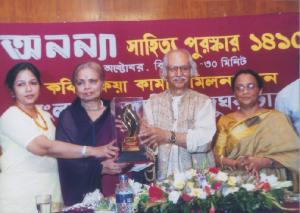
Professor Kabir Chowdhury and Tasmima Hossain, editor and publisher of the Anannya, a fortnightly magazine for women, handing over the award to Razia Khan Amin. On the right is writer Selina Hossain. |

