Joydevpur,
30km north of Dhaka city, was the headquarters of the famous zaminders
of Bhawal, who had the tradition of doing things in a grand style.
The first chief of Bhawal was Fazal Ghaz, whose descendant received
a jaigir of 22 Parganas in Eastern Bengal from Emperor
Akbar. The estate remained in the family of the Ghazi who settled
at Kaliganj till the time of Daulat Ghazi, who received the first
settlement in 1645.
Daulat Ghazi failed to carry out proper supervision
over his affairs; his revenues were not paid regularly and it is
alleged that the Mughal authorities deprived him of the zaminderi
and settled it with his Hindu servants. His zamindari has been passing
through the hands of Hindu zaminders who were originally the Dewans
of Daulat Ghazi. The first Hindu raja of Bhawal was Kush Dhhaja
Ray who settled here in 1738. After him the Bhawal estate has been
owned by his descendants for long and a number of monumental buildings
like palaces, temples, schools and dispensaries have been made.
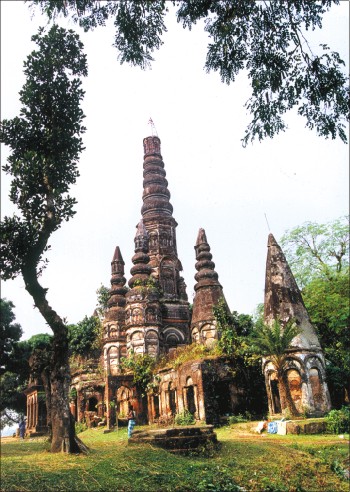
Not far from the Bhawal Rajbari on the southern
bank of Chilai River, there is a group of six temples at Shashanghat,
said to be made by the Bhawal Rajas. The largest and oldest of them
is the temple of Raja Kali Narayana Roy, most probably built in
the late 19th century. Kali Narayana was a great zaminder of Bhawal.
The temple is about 28ft square building with a seven foot wide
portico on the east. It is divided in nine sections, interconnected
by archways, with the middle one having only one opening on the
east. It is the garbhagriha of the temple, housing a pedestal of
Sivalinga.
It
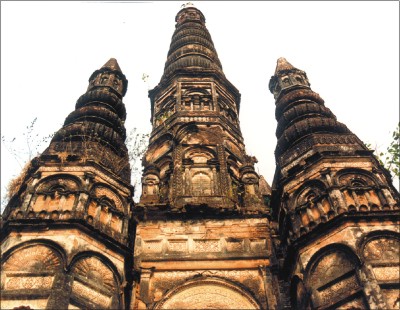
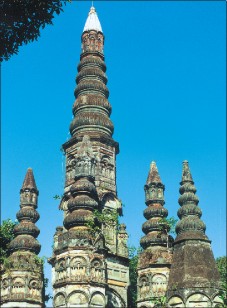
is a pancha-ratna type temple. Its ratnas are composed
of several tapering domes with a sharp spire top. Its central spire
has five narrow domes and the corner spires have three. The plan
of the first storey of the temple recalls the Muslim tomb architecture.
To divide the tomb in nine sections was a popular Mughal tradition.
The tomb of Bibi Pari in Dhaka and the tomb of Niamatullah Wali
in Chapainawabganj are arranged in nine sections. In India, the
tomb of Itmadudaulah of Agra was erected in the same style. The
fluted arch of the temple, ribbed domes and the merlon designs came
from the Mughal tradition.
The most striking feature is found in the
outlook of the temple of Kali Narayana, which resembles the Buddhist
temple pagoda, the sacred building of the Arakani Maghs. From the
north of the raja Kali Narayana's temple, the first temple is an
octagonal spire, measuring 4 feet 2 inches of each side. This is
the smallest and simplest temple of this compound.
The second temple from the north is said
to be made in memory of Kali Narayans's wife. It is a rectangular
temple measuring 22x12 feet with a spire, composed of decreasing
domes and a pointed tower. The temple is divided in six chambers,
interconnected by archways. There is a pedestal of Sivalinga in
the middle chamber of the western part of the temple.
The next adjoining southern temple is an
octagonal structure with a pointed tower. Each side of the octagon
measures 12.5 feet. The temple has an octagonal garbhagriha in the
centre of 8.5-foot wide verandah. The western half of the octagon
is a chamber, while the eastern half of the temple is surrounded
by a colonnade.
In
the south stands another temple, with its rectangular chamber divided
in three sections. On the eastern side is a verandah and on the
western part are two rooms. Its northern one was used as garbhagriha.
There is still a pedestal of Sivalinga. On top of this room is another
room built in a pancha ratna style. The ratnas of the four
sides are small and attached to the main spire.
The third and the last temple is a structure
built on a high plinth of 20.5 feet square, made of sand stone.
The garbhagriha of the temple has been made in the centre of the
square. A colonnade surrounds three sides of this room, while the
fourth (west) side of it is a chamber. The temple has an inscription
above the arch opening of the garbhagriha. The language of the inscription
is Bangla. According to the inscription, Srimati Surujbala Devi
installed a Raneswarsiva in memory of her husband Kumar Ranendra
Narayan.
The
Department of Archaeology does not protect the temples. Lack of
proper care has left them dilapidated. If taken care of, it could
turn out to be an attractive tourist spot for people from home and
abroad.
........................................................................
Story & photo : Babu Ahmed