BAU roundtable on India's river-link project told
Bangladesh will lose 80 pc surface water
Star National Desk
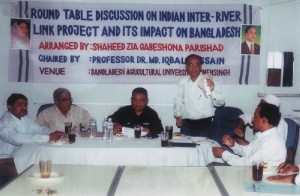
Experts at a roundtable at Bangladesh Agricultural University in Mymensingh said Bangladesh will turn into a desert if India implements its river-link project.Renowned hydrologists, agronomists, geologists and farm specialists highlighted the impact of the project on environment, soil, ecology, cropping systems and the livestock. They called for creating public awareness and forging a national unity irrespective of political affiliations to campaign abroad to compel India not to unilaterally divert waters of international rivers. Hydrologist Prof Dr L R Khan of the department of Irrigation and Water Management presented the keynote paper. The discussants included Prof Dr Md Samsul Alam; Prof Dr SM Altaf Hossain of Agronomy department, farming system specialist; Prof Dr Md Shahjahan Ali of Agri-Chemistry department; Prof Dr Md Hasanuzzaman of Irrigation and Water Management; aquatic ecologist Prof Dr Md Abdul Wahab of Fisheries Management. Shaheed Zia Gobeshona Parishad organised the roundtable recently. It was presided over by Prof Dr Md Iqbal hossain, President of BAU Zia Gobeshona Parishad. Prof LR Khan said the Ganes/Padma basin contributes 15 per cent of the surface water resources in Bangladesh while the Brahmaputra/Jamuna basin accounts for 65 per cent. In total, 80 per cent of the surface water come through the two international river systems originating from the Himalyays and passing through Nepal, Bhutan, and India. The Brahmaputra contains 1520 trillion cubic metres (TCM) of water (65 per cent of the total surface water of Bangladesh). If India implements its project, 1340 TCM water (approximately 90 percent) will be diverted, which means Bangladesh will loose about 60 per cent of its surface water. Prof Dr SM Altaf Hossain pointed out that underground water will also dry up, destroying the flora and fauna including cereal crops, vegetables, fruits, fisheries and livestock. Salinity will increase in the coastal regions and crop production will be heavily affected. Prof Dr Md Shahjahan Ali, a renowned agricultural chemist, said withdrawal of water will increase contamination of the underground water with heavy metals. Arsenic contamination has already posed a serious problem, he said. Prof Dr Md Abdus Samad of Animal Science department said livestock will be seriously affected because the ecology will be damaged. Dr Md Bahanur Rahman, general secretary of BAU Teachers Council expressed his concern that Bangladesh will be turned into a desert if India implement the anti-environmental project. Prof Moinuddin Ahmed of Plant Pathology department cited an example of Mekong Delta River Treaty as a successful agreement on peaceful sharing of international river water. Any project involving international rivers should be solved multilaterally. The roundtable was attended by, among others, Prof Dr Muhammad Shahidul Haq of Fisheries Management Department, Prof Dr Ismail Hossain of Plant Pathology Department, teachers and students of BAU and journalists. The discussants called for raising the issue in different international forums and forming a task force comprising experts, civil society representatives and political leaders to suggest the government steps to handle the situation. They urged the Indian authorities to stop execution of the project.
|