Art
A statement: subtle and eloquent
Mahbubur Rahman's "Spell of Weeping" at Alliance Francaise
Fayza Haq
Mahbubur Rahman, of "Britto" fame, explaining his recent installation work at Alliance Francaise gallery, said, "I feel that the fine art oriented students at Chittagong University are, of late, caught up in a quandary, and the authorities have failed to take any steps to remove this nightmarish and claustrophobic situation. I have depicted a blind man with a white cane and sun-glasses, groping through a labyrinth of hanging students, which are represented by cardboard figures with pasted on faces. As he meanders with mysterious music and a poignant video show in the backdrop, he gets nowhere. The photographs pasted on the figures are actual ones of students studying at the Chittagong University."Asked how he had conceived the idea of his work, Rahman said, "In summer this year I visited Chittagong and I've always had contacts of artists there, ranging from the young to the senior ones. What affected most was what the young students had to say to me as I've enormous rapport with them and I look forward to their fresh impressions and uncomplicated expression of opinions; again they're willing to learn from my experience as I'm from them. As I moved through numerous sections of these students, I heard the same lament and protest: Chittagong Government Arts College and the Fine Arts Department were merged to form a Fine Arts Institute in the Chittagong University. What had been expressed in my work were the students' vocal impressions and expressions of their frustration arising from their hopeless situation." This situation, Rahman said, has been lingering on for four years. More than the problem of session jams, he said, the surrounding atmosphere of the students was utterly stifling and claustrophobic. "I'm not touching the point of the academic training but rather the prevailing atmosphere. They don't enjoy studio facilities and again the prospect of commuting to and for the university is a major task: it's the distance that's killing. This results in irregular students' attendance. They cannot work outdoors at will even though this is vital for the development of their styles and skills. Again, there aren't adequate rooms in the students' hostel. There are no separate dorms for the male or female students." Adding to these laments, he said that the fundamentalists in Chittagong are creating havoc in the sensitive minds of the young artists in the making: they frown upon the very existence various elements of fine arts. The mullahs, we are told, are like the Biblical Pharisees. The Art College had no Masters' course to offer, he said. The achievement by CU has not been a positive one, we learn. "When they've got the permission to build and shift anew the admissions have been closed as there's a new institute in the offing. As a consequence of the closure of the admission at the Arts College: this was followed by a gap in the process of the making of the Fine Arts Institute. There are many internal problems and red-tapism in the running of the training centres for the Fine Arts students. I don't claim to understand all the nitty-gritty details. The process had finalized and at the same time the admissions at the Arts College had been closed as it's now the Fine Arts Institute, CU. For four years the Arts College had been closed: four batches of students have suffered as a consequence: the number of students at the Fine Arts Institute CU are limited in number, around 35 in all. When one enters the campus of the Fine Arts, CU, Rahman said, one got the impression of a "deserted funeral pyre". The necessary elements of high hopes and spirits are now totally missing, he said. The Fine Arts Institute, CU students have vocally protested against the crisis and as a consequence their careers have been marred and they've drifted elsewhere, he added. "The building up of frustration due to the loss of hope had been the subject of many of my discussions with the Fine Arts students of CU," said Rahman. "Even the teachers contributed to this bitter protestation and I found this shocking. At that time, incidentally, I was arranging a new media performance art and installation at the Shilpakala Academy, Chittagong. Incidentally, we'd shown 9 different film shows of the common cinema genres and along with that went video and installation works in the gallery outside and auditorium. I'd worked on the same issue there too." Asked if it had been difficult to present such a problem-riddled scenario for art lovers (as the various connecting elements were entities on their own), Rahman said, "I found the work so absorbing that it all came naturally to me. I got the audience response that I wanted. Just before my show there had been an international photographic exhibition going on at the premises but this did not overshadow my show. There had been different angles of the artist's own face shown in a state of agony, despair and hopelessness, with water dripping on him slowly but surely, like the well-known water torture; a branch had been included in the lens focus as the artist's repeated video shots with the hanging visages. The show at the Chittagong Art College had been depicted in the open vis-à-vis the gallery here at Alliance Francaise, Dhaka. The performance at Shilpakala Academy had been run simultaneously. "I had, earlier, at Chittagong, taken out my own blood through a syringe, after I'd splashed water on my face. My different video clips formed the video work seen at Dhaka. Meanwhile, I, at Alliance Francaise, went about with my act of almost groping all through, making my way between the suspended cardboard images. Speakers were placed in place of the belly-buttons of the figures made of board. In setting together the wiring for the lighting I'd got the help of my 'Britto' friends, Piplu, Srabon, Fernando, Lipi, Rana etc. My own image bore a candle instead of a light, to set me apart. For the performance at Chittagong I'd enlisted the support of my friends Dhrubo, Robi, Ronny, Ashraf, Ashiq and others, who, incidentally were students. For my Chittagong effort I'd had the patronage of the late artists, Rashid Chowdhury Smriti Parishad. Although lacking in family support, Rahman, 37, has won international acclaims, during three Asian Biennales at Dhaka in 1991, 1995, 1999 (gold medal) and gaining residency workshop facilities at Irish Museum of Modern Art. He has numerous won laurels at home too. His wife Tayaba Begum Lipi, is also a well-known post modern artist.
|
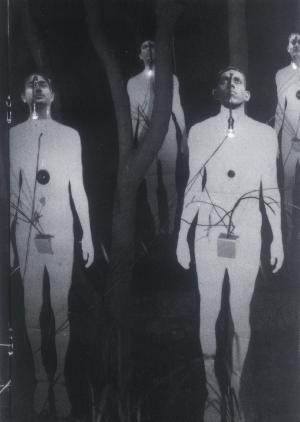
A scene from Mahbubur Rahman's "Spell of Weeping" |

