Khan
Muhammad Mridha Mosque
Majestic Mughal era mosque at Lalbagh
Approaching
the Azimpur Sheik Shaheb Bazaar road and reaching the Atishkhana
mahala near Lalbagh fort, eyes transfix on a 12 foot high boundary
wall - the openings which are designed in pure geometrical order
and symmetrical manner, in contrast to the congested and unplanned
commercial cum residential area in the heart of old Dhaka city.
Getting in close contact to the well-designed boundary wall, a pretty
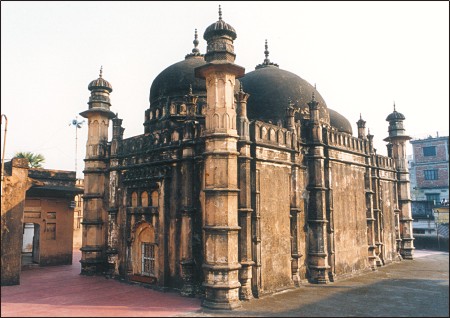
endearing mosque comes into view within its enclosed area. Locally
known as the Mosque of Khan Muhammad Mridha it was built in 1706
A.D./1116 A.H. - according to an inscription placed in its frontal
façade. The mosque derives its name from that of the builder
Khan Muhammad Mridha, who constructed it in at the order of Quazi
Ebadullah, who was probably the chief Quazi of the then Mughal Dhaka
under the Deputy Governor Farrukshah.
 The
establishment of the mughal sovereignty in Bengal and transfer of
the capital to Dhaka ushered in a new era of peace and prosperity
in the subah of Bengal. They started to erect a Fort, Mosque Katra,
Idgah. The present old Dhaka city was then the centre of all such
building activities. The vicinity of this mosque is very close to
the Lalbagh fort mosque that reveals a high-density population in
this Atishkhana area during the mughal rule. Hence they erected
a mosque on a high podium 16 feet above the ground level so as to
enable easy identification from the surrounding dense urban settlement.
The resemblance of this category of a high podium mosque is also
observed in two other mosques in Dhaka for instance Dewan Bazar
mosque and Musa Khan mosque. The Tahkhana or the substructure of
the podium has a continuous verandah all around and all the internal
small rooms are connected from this circulation area. This Tahkhana
is covered by vaulted roof.
The
establishment of the mughal sovereignty in Bengal and transfer of
the capital to Dhaka ushered in a new era of peace and prosperity
in the subah of Bengal. They started to erect a Fort, Mosque Katra,
Idgah. The present old Dhaka city was then the centre of all such
building activities. The vicinity of this mosque is very close to
the Lalbagh fort mosque that reveals a high-density population in
this Atishkhana area during the mughal rule. Hence they erected
a mosque on a high podium 16 feet above the ground level so as to
enable easy identification from the surrounding dense urban settlement.
The resemblance of this category of a high podium mosque is also
observed in two other mosques in Dhaka for instance Dewan Bazar
mosque and Musa Khan mosque. The Tahkhana or the substructure of
the podium has a continuous verandah all around and all the internal
small rooms are connected from this circulation area. This Tahkhana
is covered by vaulted roof.
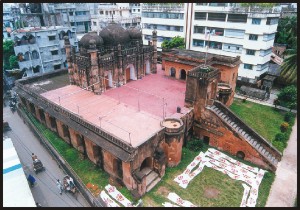
A
9 foot wide single flight of steps leads to the roof of the platform
through a gatehouse from the ground, where the main prayer hall
is to be found. The high plinth or platform gives a majestic look
to the Khan Muhammad Mridha mosque. Black basalt stone are used
on the steps joined by metallic clamps. In the eastern side of this
shan or platform, there are two octagonal projected spaces, may
be for gathering or discussion in small groups before or after the
daily prayers.
 The
main sanctuary or prayer hall is smaller than the platform, which
has also a huzrakhana on the northern side. This mosque has the
usual oblong plan, measuring 48 feet in length and 24 feet in width
externally. There are three arched entrance doorways in the eastern
wall and correspondingly, the western qibla wall contains three
mihrabs niches, the central one being larger than the flanking ones.
The northern and southern walls contained one opening each, which
have been closed by a perforated screen made of stone.
The
main sanctuary or prayer hall is smaller than the platform, which
has also a huzrakhana on the northern side. This mosque has the
usual oblong plan, measuring 48 feet in length and 24 feet in width
externally. There are three arched entrance doorways in the eastern
wall and correspondingly, the western qibla wall contains three
mihrabs niches, the central one being larger than the flanking ones.
The northern and southern walls contained one opening each, which
have been closed by a perforated screen made of stone.
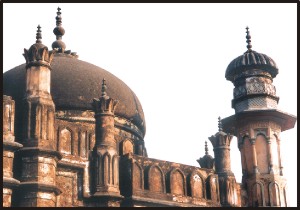
The
interior is divided into three bays by two lateral arches; an onion
shaped dome covers each bay. The domes, though squat, stand on high
shoulders, and as usual the central dome is bigger than the side
ones. The reduction in the size of the side domes is achieved by
an intermediary stage of pendentives - a technique all together
different from those in the earlier mosques. The high shoulder of
this onion shaped dome is relieved with blind merlon in plasterwork.
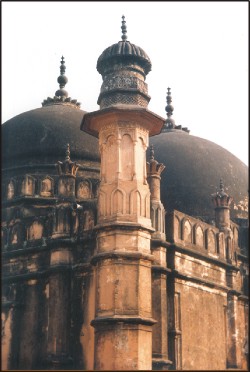
There
are four corner turrets or minarets at each corner, elaborately
heightened above the parapet and terminated by a ribbed cupola.
The subsidiary pilaster minarets border each entrance and the projection
of the mihrab at the back of the western wall. These pilasters were
originally terminated by pinnacles, but now are missing. All outside
facades show profuse paneling, and ornamental merlons are seen at
different stages of the parapet.
 The
political linkup of Bengal with northern India led to the inter
flow of architectural trends and migration of different professionals
and experts. These professionals brought architectural and technical
know-how and experience from their homeland, but they had to depend
upon the local craftsman and material. Due to the absence of red
sand stone in Bengal, the mughal builders in Bengal used red powdered
bricks with lime stone mixture in the outside plaster work to give
the essence of red sand stone architecture of the imperial Delhi
kingdom. But this Mridha mosque is the only exception in Bengal
that most of the external walls were faced with imported red sand
stone.
The
political linkup of Bengal with northern India led to the inter
flow of architectural trends and migration of different professionals
and experts. These professionals brought architectural and technical
know-how and experience from their homeland, but they had to depend
upon the local craftsman and material. Due to the absence of red
sand stone in Bengal, the mughal builders in Bengal used red powdered
bricks with lime stone mixture in the outside plaster work to give
the essence of red sand stone architecture of the imperial Delhi
kingdom. But this Mridha mosque is the only exception in Bengal
that most of the external walls were faced with imported red sand
stone.
Although
it is a listed ancient site of the Archaeological department, the
local masjid committee seems to be responsible for its maintenance
causing hindrance to visitors entering the main mosque beyond the
fixed scheduled time of daily five times prayer. As such the visitors
do not get the chance all the time to enter into this best preserved
Mughal mosque. It should be kept open to visitors round the clock.
...........................................................................
Story: Dr. Abu Sayeed M. Ahmed
Head, Department of ArchitectureThe University of Asia Pacific.
Photo: Syed Zakir Hossain