Eidul-fitr special
Eid-ul-Fitr: Festival with a difference
Syed Ashraf Ali
Eid in Arabic means 'joy' and 'fitr' stands for 'return to normalcy'. Eid-ul-Fitr in every nook and corner of the Muslim world is celebrated as a day of joy and happiness, fun and frolic, pleasure and gaiety. But it was an Eid-ul-Fitr and yet the great Cliph Omar bin Khattab (RA) was weeping like a child the man whose "walking stick", in the words of Emerson", struck more terror into those who saw it than another man's sword," was weeping and trembling like a lamb ready for slaughter. No ordinary man was Caliph Omar. A giant among men with unbelievable courage, indemitable spirit, unshakeable conviction and incomparable dedication as he was, no earthly fear or danger could cow down Omar. Many a battle had he fought, many a crisis had he faced, many a storm had he weathered, many a danger had he tided over, but never had this colossus among men faltered or wavered, never even for a moment had he felt nervous or shaky, not to speak of weeping or trembling in fear. Omar was the undisputed leader of a vast empire and yet, in the words of the same Emerson, "His diet was barley bread, his sauce was salt; and oftentime, by way of abstinence, he ate his bread without salt. His drink was water. His palace was built of mud; when he left Medina to go to the conquest of Jerusalem, he rode on a red camel with a wooden platter hanging at its saddle, with a bottle of water and two sacks, one holding barley and the other dried fruit." That is not all. Even the Khatamun Nabiyeen Hazrat Muhammad (peace be upon him) according to many a reliable authority, claimed that if there were any Prophet after him, it would be Omar bin Khattab (RA). But even such illustrious man was weeping on the auspicious day of joy and happiness. What was it that he was afraid of? He was weeping simply because he was not sure whether his Siyam in the preceding holy month of Ramadan had been accpeted by Allah, because he was not sure whether he would be able to avail himself of the glorious and coveted chance of receiving Divine Mercy and Reward directly from Benign Providence, because he was one of the few who knew well that the job of Eid-ul-Fitr is not meant for one and all it is meant only for those who have practised Siyam inthe true spirit of Islam through Taqwa and Tarawwi during the auspicious month of Ramadhan. Eid-ul-Fitr indeed is no ordinary festival. The joy it brings is a joy with a difference, a joy meant for only a handful of persons persons who have undertaken the arbuous task of practising restraint and abstinence in the right kiln of Islam. For those who did not bother to practice Siyam in the month of Ramadan, the new moon of Shawal augmenting the advent of Eid-ul-Fitr brings no joy or happiness at all in the eyes of Islam. To them Eid-ul-Fitr is a day of lamentation, a day of sorrow and not certainly a day of 'return to normalcy'. 'Eid-ul-Fitr indeed is a festival with a difference. It may be mentioned in this connection that Siyam does not merely mean fasting from dawn to dusk. Al-Siyam is something more significant, something more difficult, comprising much wider dimensions than mere fasting. The word "Ramzan" is derived from the world "Ramz" which means "to burn", "to scorch", the root meaning of "Ramzan" means excessiveness of heat. Fasting in Islam means to refrain and abstain, from dawn till sunset, from various things forbidden by Islamic law. In the eyes of Islam, Al-Siyam stands for an institution for the moral uplift and spiritual elevation of the human soul. It helps us overcme lust and greed and hatred and thereby sets us at the mouth of the road leading to perfection to be achieved not through self-torture, not through mere abstention from food and drink and sex, but through Taqwa and Tarawwi, contemplation and acts of charity, total restraint on and abstinence from all evil acts and thoughts, all unholy dreams and desires. Such a noble act of piety militates against extravagances like sumptuous Iftar parties or colossal wastage in the name of religion. any ostentation of this kind certainly negates the core spirit of Islam which is basically one of abnegation of temptation and yet an abundance of spiritual fulfilment. Taqwa, essentially, is a function of the heart and a voluntary effort comprising the elements of caution, alertness and fear of Allah. The holy Prophet (pbuh) used to point to his chest saying, "Here is the seat of Taqwa". Al-Siyam indeed is a glorious opportunity unparalleled by any act of piety or worship. According to a Qudsi Hadith (utternances attributed to Allah outside the Holy Quran), the Most Gracious and the Most Merciful Allah says "Every man's work belongs to him. A good deed in repaid from ten-fold to seven hundred times. Fasting belongs to Me and I repay." The very sighting of the much-awaited new moon in the month of Shawwal, bringing to an end the month-long period of fasting during Ramadan, therefore, brings for the Muslims the coveted and unique opportunity to offer heart-felt gratitude to Allah for kindly permitting them to receive Divine Mercy and Blessing directly from Him. It is this promise of joy and happiness on the 1st of Shawwal, the tenth month in the Arabic calendar, augmentating the advent of "return to normalcy" together with an auspicious day of thanks-giving, which is known as Eid-ul-Fitr. What is more, the month of Ramadan is not only Shahrun Azimun, but it is also described by the holy Prophet (pbuh) as Shahrun Muassa or the month of fellow-feeling, the month in which each and every Mulsim should feel and work for the welfare of his or her friends and relatives and neighbours. For Islam is not a religion only guaranteeing the betterment and uplift of an individual's private and personal life. Nor is it a religion comprising some dogmas, rituals and customs. It is an organised, desciplined, scientific and complete way of life which guides men according to the dictates of Almighty Allah and the teachings of his holy Prophet (pbuh). If that be the true picture of Eid-ul-Fitr, there is nothing surprising that even a salt of the earth like Caliph Omar could be found weeping on an Eid-ul-Fitr, because he knew not whether he would be able to receive the much-awaited and coveted Mercy and Blessing directly from the Almighty. For him there simply could be no charm or joy or happiness on an Eid-ul-Fitr if he had failed to avail himself of the rare opportunity of receiving reward directly from Benign Providence. If a towering personality like Omar was not sure of his right to enjoy the 'joy' of Eid-ul-Fitr, can ordinary persons like you and me be sure and sanguine that Eid-ul-Fitr brings for us a day of pleasure and joy and happiness? Where Omar trembles, can lesser mortals like us remain unnerved? Eid-ul-Fitr indeed is no ordinary festival. It is a festival with a difference. It has a definite purpose, a norm to convey, a lesson to teach. None of us can afford to celebrate this extraordinary occasion through extravagance and prodigality, through unbridled fun and frolic, through gaudy and expensive dresses, through spectacular functions and feasts. There can indeed be no Eid-ul-Fitr or any festival in Islam if we forget the unity of mankind under one banner, the universal brotherhood of man, with no distinction between black and white, rich and poor, wise and ignorant, king and slave. There can be no Eid if we cannot forget the artificial differences between the haves and the have-nots. What is more, there can be no Eid if we fail to feed the hungry destitute, if we fail to cater to the needs of the poverty-stricken multitude. There simply can be no Eid if genuine attempts are not made to feed each and every hungry mouth, to clothe each and every nude, to ensure that the poor and helpless relatives and neighbours and friends are not left unhonoured and unsung. Syed Ashraf Ali is former Director General, Islamic Foundation, Bangladesh.
|
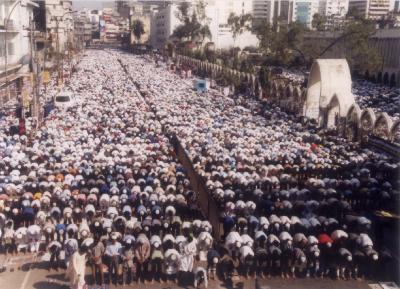
Eid jamat at Baitul Mukarram. PHOTO: STAR |

