Chamber music
Melody makers from the land of Mozart
Members of the Linos Ensemble speak their minds
Fayza Haq
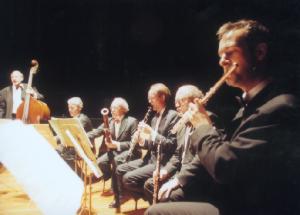
Dressed in stark black, with only a touch of vermilion in the pianist's costumes and the whites of their shirts, the Linos Ensemble, organised by the Goethe Institut, soothed the nerves of Dhaka concert enthusiasts. The venue was Osmani Memorial Hall and it was not just the expatriates who enjoyed Mozart, Schubert, Francaix and Muller-Siemens pieces that were presented there recently. Even children under ten listened with rapt attention to the five presentations (including the encore). The gentle, wondrous compositions brought in pristine concert music notes from the 18th century Germany and France to the modern times. The programme included "Variations on a Lander by Franz Schubert" by Detlev Muller-Siemens, "Quintet in A 'The Trout' op. 11ph.", "Piano Quintet in E flat, KV452" by Wolfgang Amadeus Mozart, and "Dixtuor" by Jean Francaix. Konstanze Eickhorst (pianist) and Jorg Linowitzki (bass player) speak to The Daily Star, sitting at a local hotel.The Daily Star: What brought the group, "Ensemble Linos", together and what instruments did you play? Konstanze Eickhorst: It is the oboe player, Klaus Becker, who is the founder of the ensemble: some of the members who played with the ensemble at the first time were studying together, meeting with youth orchestras, because it was 25 years ago that the group was formed. We had recently a big celebration in Cologne in March this year to mark our beginning. The foundation members used to know each other from studying or playing together. They eventually got together to play chamber music in Germany, other parts of Europe and overseas, as in this occasion, in important cities of the subcontinent. Jorg Linowitzki: We all come from different parts of Germany; some of us met in youth competitions; we decided to play together. There are eleven of us here tonight at Dhaka. We play the string quintet, violin, viola, cello, double bass, and wind instruments that include flute, oboe, clarinet bassoon, French horn and the piano. TDS: Was music in everyone's family; did your parents ever object to taking up music as your careers? JL: In most cases, no. However, the parents of the performers were always very interested in music and so allowed us to study music. Germany has a very old tradition of music that goes back to the middle ages and beyond. Today in our country we have over a hundred orchestras and 23 universities for music and many music schools. TDS: What was your incentive to take up music as your professions? JL : The idea of playing chamber music together with a wonderful repertoire formed the group. With the eleven in the ensemble with our various instruments we can produce nearly any kind of western chamber music. We sometimes get a trumpet or trombone to play with us so that we get further variations in our symphonies. There are not a lot of big chamber music groups such as we are. It is not easy for us to get together as we are a large group; we are working in periods; we live all over Germany. We aren't just playing together: we get together as friends to enjoy each other's company. TDS: Do you think that western and eastern notes can be combined in a satisfactory fusion -- is yes, was are the examples that you can site? KE: We are interested in eastern music and would love to know more about it. We have very little time and cannot fit in workshops or even meet musicians from the subcontinent in our present tour: exchange of arts would be interesting and exciting. We came here to present our western music, which is dear to our hearts, and maybe find an audience that loves it too. JL: When we'd gone to China, we had workshops, where we talked to students of music: maybe sometimes we'll come back to the subcontinent and talk to the musicians from this region too, hopefully. We've heard music of the subcontinent, with the sitar, sarodh, tabla etc. and have been exposed to the fusion of Ravi Shankar and the Beatles, which we find wonderful. TDS: Can you say something about your present tour? JL: We began in Mumbai, went to New Delhi, Kolkata and after Dhaka we'll to Chennai, Colombo and Karachi, and then we'll go back. We arrived yesterday, saw the parliament building and a part of the capital city, apart from playing this evening, and our flight tomorrow is a very early one. TDS: Do you care for pop, rock, metal, rap, jazz or the blues? KE: When there is good music like jazz or the songs of the Beatles one naturally laps up such music. The songs of Madonna or Michael Jackson or even Elton John are not quite our type of music: in them something is missing for us. They lack the soul pitch, in a way, although there are thousands who love them. TDS: Would you say that German chamber music is a thing apart? KE: I wouldn't say that it is something so different from music from other parts of Europe but I think it was the centre of music at the time of Bach, Mozart, Beethoven and Schubert. We were lucky to have such genius in our country. The French have their Debussy and Ravel. TDS: Isn't all the travelling in your tours disruptive for your personal lives? KE: We once made a decision in the ensemble that we'll not have a concert tour for more than two and a half week because of our family lives. The number of times a year that we hold our tours depend on demand. Our normal concert life is mostly confined to Germany. We often go to Europe and our international tours are only from time to time. TDS: Apart from the subcontinent where all has the ensemble been to and who pays for the trips? JL: We went to several countries in Europe such as Austria, France, Spain, Italy, the Netherlands etc. We had a long trip of China; we went to Indonesia, Vietnam, the Philippines. This trip is organized by the Goethe Institut, who we believe are doing a good job all over the world. The concert goers pay for tickets otherwise. TDS: Do you feel that you're a success because your listeners are expatriates or members of the upper echelons of society in the subcontinent? JL: I don't know who comes to the concerts but I believe that they like to be there. I know some people prefer to listen to pop and rock music and melodies of such streams. I believe that even in Bangladesh there are ardent enthusiasts of chamber music: the hall was full. We'd like to reach our to the average run of the mill person too but we don't get the time or opportunity. TDS: You combine teaching with performing; is this out of compulsion or do you enjoy this? KE: We need the combination. We're better teachers when we know how life is on stage. We're better performers when we get the time to discuss with our students how to get things ready for the stage. TDS: What kind of life is that of a musician in the west: do you get enough patronage and can you make a comfortable living? KE: In Germany we're privileged and happy in our jobs in our generation. Our students will have more trouble getting good jobs because the state of Germany tends to have less and less money. JL: We made our hobby our jobs: what could be better? TDS: What is your advice to the students of music -- is it luck, practice or talent that makes you " tick"? KE: It is a combination of all three that makes you a sure success: talent is not enough -- you must practice like mad.
|