Performing art
Bharatnatyam
Its revival and recent changes
Prema Humayun
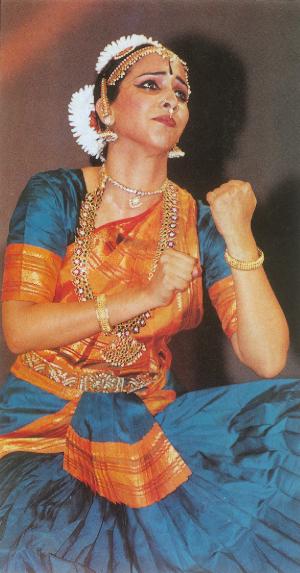
Bharatnatyam is the oldest of all classical dances that evolved over many centuries in the temples of Southern India where the dance was performed as a religious act for the lord Siva. Bharatnatyam is an acronym of bha (bhava) for expression, ra (raga) for melody, and ta (tala) for rhythm, while natyam stands for drama. The music of Bharatnatyam is based on Karnatic classical music. Usually there are one or two vocalists and the contents of the songs used for this dance have their origins in the Hindu mythology, literature and religious philosophy. Bharatnatyam was formally performed by a caste of female dancers called Devadasis (like Geishas in Japan), who were the sole performers of this classical dance. This dance was performed to show the devotion of mankind towards the lord Shiva. Under the British rule and by the end of 19th century, this dance suffered for many reasons. Political instability and the loss of patronage from various kings played a crucial role causing a serious setback for Bharatnatyam as a whole. In 1947, an Act was passed to limit the temple dance and it was no longer performed by devadasis. A new Music Academy was established and a Bharatnatyam performance by a devadasi was arranged and the acceptance of this dance on the part of the academy gave the art a new respectable status and it was like a revival of the Bharatnatyam dance. In place of the temple or royal court of former times, Bharatnatyam started to be performed in the theatre, concert hall, or auditorium by dancers from respectable families instead of devadasi's daughters. Bharatnatyam also experienced some major changes in its composition. In recent times, minor modifications in the Bharatnatyam dance have taken place by inserting new motif and theme. Today, many dancers offer real flowers to the deity on stage, whereas the devadasi's offering was through symbols only. Before the material worn was dazzling and the design of the blouse worn was half Victorian which was later altered to a more Indian style and subtle colors were preferred. The trend of puja or touching the feet on stage to pay homage to their teachers is also a recent one. Even though drama and dance were the integral part of Bharatnatyam as prescribed by Bharata (the author of Natya Shasra), the dramatic representation is not a primary function of this dance today. The exact date and authorship of the Natya Shastra are both in dispute as various schools of thought have their own opinion. Earlier, Bharatnatyam was solely performed in the temples as an act of worshiping gods, but now it has traveled to the stage to entertain the audience. The essential part of the revival of Bharatnatyam was the transformation of the performers from devadasi (servants of gods) system to scholars and females dancers from different Hindu castes. Although Bharatnatyam dance has been firmly reinstated, gurus and dancers are faced with the task of extending and enlarging the classical repertoire to include subjects which will be relevant and meaningful to the modern audience. Experiment and innovation have become essential for the survival of this dance. Currently, to cater to the demands of the local audience, some dances have been choreographed using regional poetic lyrics. New changes have been brought by innovative teachers and choreographers by adding lyrics in different languages and incorporating ballet and yoga to satisfy the audience. In Bengal, researchers have attempted to interpret Bharatnatyam through Tagore's songs aiming to make a cultural bridge between South and East and for a broader national integration. These changes are supported by Natya Shastra which encourages creativity and new expressions as long as the spiritualism is kept in the dance. All these changes have given a new dimension to this ancient art, at the same time new developments are taking place everyday. The author has completed her Bachelor's in Music from York University, Canada. She is currently studying for a BFA in music from the same university.
|