Exhibition
Mixing memories with desire
Bengal Foundation's Asian Art exhibit at the National Art Gallery, Shilpakala Academy
Fayza Haq
The four-days workshop by Bengal Foundation in winter last year found permanence in the fortnight long exhibition at the National Art Gallery of the Shilpakala Academy. Scintillating with colours, brave in style and forms, the art pieces, mostly on canvas and paper, captivated the minds of the stream of viewers at the recent opening. It was a veritable feast for art enthusiasts and presented art works of the Rajendrapur workshop comprising of 78 local and foreign contemporary artists before Dhaka viewers to drink in deep of the fruits of fine arts. A video projected on a large screen added to the enjoyment. It was a bringing together of works of Asian, African, Middle Eastern artists as a prelude to the Asian Art Biennale, to be held in early January next year. Talking to some of the artists whose works were on display, one gathered the depth of nostalgia, joie de vivre and pleasure of camaraderie that had been the byproducts of the workshop held by Bengal Foundation. Again, for the first time, Dhaka viewers got a good opportunity to sample the fare of famous artists of more than our own country. Ranjit Das, said on the occasion, " I think the workshop's paintings being displayed recalls the experience that we had working with foreign artists. Pictures bear a universal language so that we had no barriers of communication. I had painted three pictures in acrylic on canvas ; I think that our rubbing shoulders with Indian artists like Sunil Das, Jotin Das and Bihon Chowdhury had been a superb experience for us. To be with Kibria, Safiuddin and other senior artists like Mahmudul Haque and Abdus Shakoor, whose works can be seen here, too was an unparalleled joy -- our teachers were then like our friends." Das said that the young artists from Bangladesh and overseas too were great to be with, they had shared ideas and enjoyed various cultural functions too. Das has won awards at the Asian Biennale (1996) gold medal and an honourable mention earlier as well as a National prize. Asked what he thought of the Asian Biennale, Das added that if this is continued, the future generation will benefit immensely from gathering information about contemporary art work, and will naturally be inspired to work better, having broader horizons to follow. Dwelling on whether the Asian Biennale is improving with days or just including more artists from more countries, Das said that new waves of ideas came with each event, every two years, and the quality of the Biennales was unquestionably admirable. Abdus Sattar, the head of the Fine Arts Institute said, " I had painted four paintings on one night during the workshop and as I work on form, I had brought in circles in my work. However, one large painting had contained the three female faces which you see here today, the images being impressionistic, with soft strokes and muted colours. The best artists of a country are included in such an international display as the one this evening, and the same artists' works will be included in the Asian Biennale, next year, as they are the crème de la crè me of each country's artistic culling. The Indian artists had brought in their figurative works which are nonpareil indeed in Asia. However, our abstract works were superb too". Asked if we were lagging behind the Indian artists, as they had more fine arts institutions and many more trained artists as a consequence, Sattar said that we should not compare and contrast on that level ; and that as a country we were definitely progressive in the cultural field, specially fine arts, as our standard of work was on par with that of our neighbours. The eminent artist, Aminul Islam, said about the exhibit, " All the paintings are known to me as I've worked with the artists in the camp, a year back. I've done other workshops too, as in Jaipur in 1991 and with students, on other occasions." As the one arranged by Bengal Foundation had contained more artists, from more diverse countries, it naturally had more flavour, Islam said. He felt that the works of Indian artists, along with other from the Middle East, like Bahar Binbinani, Darius Saidi and Christe Nassi were impressive indeed. Asked to comment on our local women artists, who had participated in the workshop and later, in the culminating exhibit, Islam said that he admired Farida Zaman, Nasreen Begum and Rokeya Sultana's works in particular, as they were undoubtedly hard-working, sincere, and unusually talented. Talking about their performance as students, Islam said that they had all been persevering and promising, specially Nasreen Begum. The well-known artist, Mahmudul Haque, said, "In a workshop it is not clear whether one can achieve the completeness that one always aims at but seeing the framed works in the gallery, one feels that the painting and print endeavors had definite finesse. It is amazing how four days' efforts can culminate in such a fine display: I too have two painting included. Feelings, mood and the idyllic environment all went into molding the art works. My own colours and brush strokes sing with the buoyancy this evening of the experience of few short unforgettable days." The getting together with artists with different viewpoints was definitely useful for the local artists for expanding their own outlook, Haque added. From the Oriental Art Department, Nasreen Begum, said, " I find the works at the display very unusual and selective." Talking about her experience during the workshop, Nasreen said, that working in the wonderful countryside -- with flowers, bushes, trees, lakes, butterflies and birds for company -- was an experience quite different from being cooped up in the cement jungles of Dhaka, where you barely get to see the moon, and get smoke and smog in your nostrils all day. Also, she said, like most other artists on the spot, that the coming together and exchange of opinions and viewpoints had been very informative and inspiring. Nasreen insisted that the experience had brought in a new flavour to her work. Asked how she felt about the women artists' works from overseas, she said that most women whose works are included in selective displays such as the one at Shilpakala Academy, were always dedicated and tended to work twice as hard as men, to get ahead in the competitive flow of life. The reputed folk-art painter, Abdus Shakoor, the senior artist Rokeya Sultana, with hosts of national and international accolades trailing behind her, and Mukhlesur Rahman, who did the coveted award in the last Asian Biennnale, also expressed views of euphoria and amazement at the final products of their Bengal Foundation workshop venture. Let's hope Shilpakala Academy's next ambitious venture in mid- winter will be as much a confluence of cultural exchanges and more -- considering their aim, scope and government backing.
|
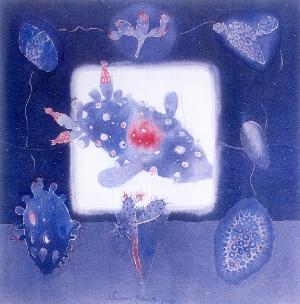
Nasreen Begum (Bangladesh) |

