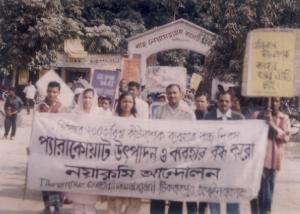
Ban toxic pesticides, demands rally
Chemical pesticides kill 2,20,000 a year worldwide: WHO
A Correspondent, C'Nawabganj
Farmers joined by cross-sections of people marched the streets of Chapainawabganj town and held a rally protesting use of chemical pesticide and fetiliser in agriculture. At least 20,000 people die in the world due to poisonous effects of chemical pesticides and about two lakh commit suicide by taking those in a year, the rally was told quoting WHO statistics. Several hundred processionists including teachers, lawyers, and students carrying banners and festoons marched the streets chanting various slogans. Starting from the Biswa Road intersection, they marched up to the municipality building and held a rally on its premises. The programme was organised by the local unit of UBINIG in observance of the 'International No Pesticide Use Day' on Wednesday. The rally was dressed by, among others, local Coordinator of UBINIG Md Shamsul Haque, Prof Md Habibur Rahman, Advocate Tariqul Islam, UBINIG researcher Md Khandakar Saifur Rahman Suman, farmer Ataur Rahman and student Fatima Khatun. Quoting from a WHO report, Shamsul Haque said four pesticides among the 'Dirty Dozen', banned in other countries, are "widely used in Bangladesh through the Department of Agriculture Extension". These do not really increase agricultural output but destroy soil fertility, environment and bio-diversity. Fish resources have depleted mainly due to their use. Many farmers in Bangladesh have now realised this and are using organic fertiliser like cow dung and compost fertiliser and are getting better results, he said. Around 1.5 lakh farmers are now growing crops without using chemical pesticide and fertiliser in different areas of the country under UNIBIG's supervision, he said. Pesticides produced from leaves of different plants and trees including 'Neem' are now being used in many countries now, he said. But the government is giving little attention to popularise organic fertiliser and gradually reduce use of chemical pesticide and chemical fertiliser, he alleged. He mentioned that highly poisonous pesticides which are very destructive for land and bio-diversity are being smuggled freely from across the border. Other speakers called for building up a movement to popularise use of organic fertiliser and to ban pesticide. UBINIG, set up in 1981, is campaigning against use of chemical pesticide and fertiliser in agriculture to protect the environment and bio-diversity.
|