Art
Dynamic display from "Opar Bangla"
Habibur Rahman's "Parable of existence" at "Chitrak"
Fayza Haq
Habibur Rahman, who is now settled in Kolkata, began his remarkable solo at "Chitrak" recently. An award winner at the "Birla Academy of Fine Arts and Culture" in 1997, he has progressed from his "Homeless" series to bring in lyricism and folk elements in his pictures within pictures, with details bringing in more motifs with each curl, line or dot.Habib said, "I've exhibited here in Dhaka, as I have my friends and relatives here. I've come to exhibit here in order to have an exchange of ideas and opinions. The artists in West Bengal don't work in a style that is altogether different from that of the painters and printmakers of Bangladesh; there are more artists there and so the competition is more steep: I'd say this applies to every field and not just art. I stay at Kolkata because of personal reasons. I'm married to an Indian Japanese language interpreter and artist Bela Purohit. Of course, sometimes I feel homesick there." Asked if his paintings followed the West Bengal tradition rather than the vast expanse of semi-abstractions that one comes across in Bangladesh among his contemporaries, Habib said, "My teacher Mohammed Kibria has done innumerable abstracts and it is my admiration for his work that has egged me on. I had graduated in printmaking from DU, before doing my masters in printmaking from Maharaja Sayajirao University, Baroda. In my works in the present exhibition you see my various stream of thoughts at different times. A work bears the title 'Image within image' and this expresses situations when there might be a telephone call when I'm wrapped in deep thought with some friend: there might be someone playing a cassette of CD nearby and the notes might be distracting me. To feel more than one sensation at one time leads on to breaking of one image and the presenting of another. Some pictures bear the titles 'Story of our times' and these bear narratives of today and the time before." Dwelling on his penchant for detailed figurative works with human faces, flowers, birds, beasts and other elements from nature and indoor life, Habib said, "From my youth I was greatly attracted to nature and this strong feeling within me is something I can't ever abandon. People are there surrounding me but that can't make me forget that there is the undeniable charm of nature, flora and fauna, around too. Sometimes I've been inspired by fragments of songs or poetry too but these elements are not in any illustrative form." Had he indulged in calligraphy too as he had included many inscriptions in his words? To this Habib said, " I've included a few lines of poetry or songs or some comments about the picture itself but this is not a large part of my work as you would find in Abdus Sahkoor's folk-work based paintings, or art works which maybe pure calligraphy. Sometimes I might have included even fragments of conversational pieces which might stir me." Talking about the elements of surrealism in his works, Habib said, "In the process of telling a tale, I bring in important and symbolic pieces and juxtapose them, willy-nilly, with a dream-like effect. As for going in for total abstraction, that does not appeal to me. Surrounded by soil, air and water, I cannot paint something I can't see or feel and which projects something which might be ambiguous to my viewers." Asked which artist had inspired him in particular, Habib said, "I like artists like Zainul Abedin, Qamrul Hassan, Safiuddin Ahmed, my teacher, Mohammed Kibria. In India, I like Jyoti Bhatt, Ghulam Mohammed Sheikh, Bhupen Kakker, Bikash Bhattacharjee and Ganesh Pyne. Sometimes it's their composition, at times it's their choice and use of colours and at times it's the manner in which the texture and lines have been included that stir my feelings and emotions. Talking about the manner in which his friends and old colleagues had welcomed his sojourn in his native land, Habib said, "My classmates had included Shishir Bhattacharya; Nissar Hussain was immediately senior to me. Fareha Zeba and Juiss are also my close friends from university days in Dhaka. I belonged to a Dhaka art group here, called 'Shomae'." Egged on compare the works of his group in Bangladesh those who belong to the mid 40s range -- with those of the counterparts in West Bengal, Habib said, "I think the Bangladeshi artists have forged ahead and are doing better than the West Bengal artists because their eagerness to learn from the progressive world is more. Zainul Abedin had brought with him the tradition of the Bengal School in the late 50s in Bangladesh. The painters and print makers have more exchange and interaction with the world outside as with their counterparts in USA, Europe and Japan. The Bangladeshis, in brief, are more progressive and global in their outlook." "I like the work of Safiuddin Ahmed, in particular", Habib said, discussing his teachers in Bangladesh, "as it is lyrical and because he excels in the print media, in which I've my basic education. In order to reach the perfection that Safiuddin had projected, we too were compelled to concentrate and strive. As for Mohammed Kibria, he is a giant too among us and some people may profess to like him because of his stature. His technique of painting images within images is an art that he taught us. A few lines might present a drama or a fiction piece or a poem. I also admire Quamrul Hassan's works as regards the country life of Bangladesh, which is a continuation of Jamani Rai's genre." Touching on the reason of why he had gone into print making at the outset, Habib said, "I can't make prints now as it something too expensive for me. When I'd gone into the field at the outset it was because I'd wanted to give my works to numerous people which is more feasible in the print world. Later, the plate-making, use of ink and press and other factors of pint making did not suit me as much as the direct handling of paints and pastels on paper or canvas." "The colours that I've used are mostly brown, mustard, vermilion, and shades of olive set off by white and black in my work. The choice of my colours depended on my subjects and the manner in which I wished to delineate them. There are 74 pieces here at 'Chitrak', including mixed-media, pen and ink drawing based works and water-colour. It took me a year to complete my collection, although there are a few pieces from earlier times too," Habib concluded about his exhibit. Habibur Rahman has had four solos in Dhaka and Barodha, and has participated in more than 20 major joint ventures. He has had three awards including the ones from "All India Fine Arts & Culture, Kolkata" in 1987 and Best Award in print-making from the Fine Arts Institute, DU, in 1982.
|
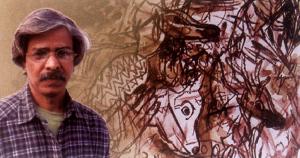
Habibur Rahman seen against his work |

