Spreading knowledge for development
Charlotte Jacquemart
Looking for the most recent data on women's rights? Then head off for the Community Development Library (CDL), situated on road no 14A in Dhanmondi, in the city.The CDL, an NGO, has active liaison with about 1000 other NGOs, research institutes and government agencies involved in development work. The staff of the CDL collects books, magazines, research papers and articles on 51 topics of development issues like human and women's rights, minorities, land, law or ecology. The major donors of the CDL, founded in 1980, are HEKS-Switzerland, Unicef and Misereor-Germany. CDL's library budget was around Tk 3,3 million for three years. "Knowledge is an important tool for social, political and economic development. Therefore we have to make sure that everyone involved in development work is aware of the other's experiences," said Mofizur Rahman, the program co-ordinator of the CDL. The Dhanmondi library, is the only one out of 27 centres run by the CDL, that is open six days a week. "We consider ourselves a network of development information and communication," explains Rahman. The other centres of CDL are located in Bogra, Khulna, Thakurgaon, Dinajpur, Ulipur, Kushtia, Faridpur, Gaibandha, Ramgoti, Sandwip, Hatija, Dashmina, Khepupara, Homna, Islampur, Gurudaspur, Nalitabari, Noria, Shahajadpur, Ishwardi, Louhojang, Monohorpur, Darshana, Charfassion, Talimnagore, Sylhet. Many of these areas are remote, some only accessible by boat. Very often, the CDL centre is the only available resource for knowledge for the locals. In the year 2002, 4,28,770 people have frequented the 26 rural centres of CDL. There are plans to build up more centres at Rangamati, Modhupur, Mymensingh, Rangpur and Chakaria. The CDL in Dhaka has two sections, the reference and the reading section. Around 30,000 books and research reports and more than 3000 videotapes are available here. To borrow a book or a film, one has to be a member of the centre. The annual membership is Tk 100, while a Tk 200 has to be deposited as security. Books, periodicals and newspapers are accessible to everyone. CDL collects news clips from ten Bangla and English, newspapers on development topics. The CDL has also a wide collection of old magazines like Bickitra and Robbar, which are not so freely available. The Star City correspondent found a dozen people in the library when he visited it on Saturday. "Under normal circumstances we have up to 150 people frequenting the Dhaka centre every day," explains Rahman. "We not only have NGO workers, but also students and journalists among our regular visitors," adds Roselyne Palma, head of the reference section. CDL acts as a publisher too. So far about 90 titles of books and research papers on developing issues have been published. The most recent one is "Children's Boundary, exploring struggle, and local contexts of Child Rights". CDL believes that information and knowledge are the crucial links missing between ignorance and enlightenment, poverty and prosperity, between de-humanised state and empowerment. "There is a gap of knowledge between people, organisations and society. We try to provide information to bridge this gap," concludes Rahman.
|
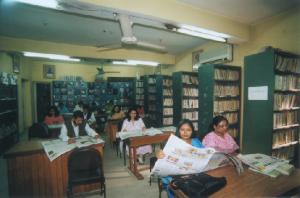
The library room at Community Development Library in Dhanmondi. PHOTO: Syed Zakir Hossain |

