Women bear the brunt of arsenic contamination
Syeda Nazma Ahmed Kona
Arsenic is a toxic heavy metal found in nature. In human it can cause serious health hazard if ingested in toxic amounts. Adverse health effects include diseases of vital organs including lungs, heart, kidney, brain, and cancers of skin and urinary bladder. Vast majority of tube-well water in Bangladesh has been found to be contaminated with more than permissible level of arsenic i.e. 50 mg/litre or more. Within the last 5 years, arsenic contamination of underground drinking water has been detected in 59 out of the 64 districts in Bangladesh exposing millions of people to the risks of arsenic poisoning. However, because of lack of reliable information, the real magnitude of the problem is difficult to estimate. Although arsenic has been detected in underground water in recent years, many experts suspect that the contamination has been occurring for more than 20-25 years but remained undetected due to lack of studies. In the neighbouring state of West Bengal in India, arsenic has been detected during early 1980s. The definite cause of arsenic pollution of underground water in Bangladesh has not yet been determined, although specific studies have been undertaken by the Department of Public Health Engineering and the British Geological Survey. Most authorities believe that the condition occurred due to long term geo-chemical changes in the subsoil aquifers which released elemental arsenic from its core compound called arsenopyrites. Aeration of subsoil water due to sinking of hand pumps may also be related to release of arsenic in water due to oxidation-reduction process. Some authorities believe it is due to chemical changes occurring during sediment and rock formation in the eastern slopes of sub-Himalayan regions. Nothing conclusive has yet been proven. In human, when exposed to arsenic, it takes long time for the clinical manifestations to appear depending on the dose and duration of ingestion of arsenic through drinking water. It may take 5-15 years for the skin changes to appear. Generally high concentrations will enhance and low concentrations will delay the appearances of signs and symptoms of arsenic poisoning. After drinking, arsenic is rapidly absorbed into the blood circulation and distributed throughout the body affecting developing child in the uterus of the pregnant women. Arsenic also comes to breast milk of the lactating mothers and can adversely affect the breast-fed children. There is no curative drug treatment for chronic arsenic poisoning, although some benefit has been shown by treatment with antioxidant vitamins in Bangladesh which needs further confirmation. Early signs of chronic arsenic poisoning appear in the skin which is characterised by changes in skin colour, such as dark and white spots (melanosis) specially on the palm and soles of feet. Roughness of skin with folicular changes (keratosis) may appear anywhere on the body surface. Besides these, there may be generalised weakness, difficulty in breathing, diabetes, high blood pressure, and other non-specific symptoms found in most patients with chronic arsenic poisoning. Since arsenic poisoning is relatively a new disease in Bangladesh, most people even the physicians are not familiar with the condition. Lack of public and medical awareness about the causes and consequences of the disease led to confusion. Many people believe that the skin condition is contagious or is an expression of leprosy. In fact, arsenic poisoning is not leprosy, neither it is transmitted by person to person contact. People develop arsenic poisoning only by drinking contaminated water or from other environmental sources such as contaminated air. In a survey carried out by the Bangladesh Arsenic Control Society in Charghat Thana in Rajshahi district, it was observed that women affected with arsenic poisoning are being socially discriminated in the community, young girls are facing difficulties in attending schools, women are ostracised, and there are instances of divorce, broken family, and social injustice. Because of the skin changes, working women are discriminated in their working environments and many have to leave their jobs leading to economic hardship and social disruption. It is difficult to arrange a marriage for girls known or suspected to be affected with arsenic. Since more women than men are exposed to water through their domestic and household activities such as washing, cooking and cleaning, women are at special risk of coming in contact with contaminated water and developing arsenic poisoning. Unlike men, most rural women remain at home and they are less likely to drink water from outside sources. All these factors make our rural women more risky for developing arsenic poisoning. For these reasons, women need to be especially aware about arsenic poisoning and how to reduce its risks to women health. It is noticeable that arsenic does not only enter human body through drinking but also through skin contact with contaminated water during washing, cooking, and cleaning activities. Pregnant women and lactating mothers need to be educated that arsenic can affect their child in the womb and also the breast-fed child. Boiling contaminated tub-well water does not remove arsenic but adequate heating can destroy most disease producing germs in water from any source. Arsenic can not be detected by changes in colour, taste, or clarity of water, arsenic can only be detected by testing a water sample in the laboratory. So if you are in doubt, take a sample of your tube-well water to a testing laboratory. Different areas of Bangladesh have different levels of arsenic in its ground water, but generally shallow tube-wells of 50-100 feet deep are mostly contaminated, deep tube-wells are less likely to be contaminated. Rain water is a natural source of arsenic free water, it is also clean from germs of diseases; it can be a useful source of safe drinking water if properly collected and used. Water from rivers, lakes, and ponds are less likely to be contaminated with arsenic but these are contaminated with germs, therefore water from these sources must be sufficiently heated before drinking or used for cooking. Water from the contaminated tube-well should not be used for drinking as well as cooking. Water from the contaminated tube-well should not be used for drinking as well as cooking, it should be avoided for washing food and bathing also because arsenic can enter the human skin through external contact. Different types of domestic water filters are now available commercially, these can be used to purify arsenic contaminated water at home. Moreover, the government and the NGOs are developing large-scale community water supply projects; these include rainwater harvesting, construction of underground reservoirs, slow and filters, and chemical treatment. Arsenic contamination is a vast problem of national priority. Because of its nature; it needs support from multiple disciplines including doctors, social workers, engineers, geologists, geo-chemists, and laboratory analysts. Commitments of government and policy makers are essential for a successful campaign against arsenic pollution in Bangladesh.
|
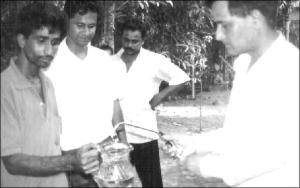
Tube-well water must be checked that whether they are contaminated by arsenic |

