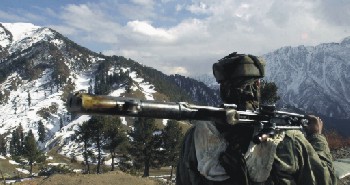
Declare a draw in Kashmir
Rashed Chowdhury
Washington, D.C.As Praful Bidwai pointed out in his insightful editorial on December 9, "Pakistan and India must learn to live with each other." Nothing would be more conducive to stability in the region than a peaceful working relationship between the two neighbours. However, in their fifty-five year history as separate states, India and Pakistan have unfortunately not learned to coexist peacefully. The issue of Kashmir divides them as deeply as it did in 1948. At some point, however, the two countries ought to face up to the choice that has been before them this half-century. Either continue to wrangle over Kashmir and treat each other as enemies, or let the territory decide its own future and consign the problem to the past. The Kashmir dispute has been one of the deadliest and most futile ones in recent memory. All three sides lose lives on a regular basis in a conflict that is much more about India and Pakistan's domestic and international image than it is about the fate of the people of Kashmir. While India and Pakistan score political points with their nationalist constituencies by continuing the armed standoff, it is the Kashmiri people who bear the brunt of military activity that often turns deadly. Yet the Kashmir problem also hurts ordinary Indians and Pakistanis from Karachi to Kolkata. It is this territorial dispute that keeps their two countries locked in a permanent face-off. Resources that could have been used for education, health care or infrastructure projects instead end up being consumed by the insatiable military apparatus. While the builders of nuclear weapons on both sides are lauded as national heroes, much of the populace remains mired in poverty. The political establishment of both countries has invested so much money and rhetoric into the dispute that neither side can allow the other to win. Negotiations have never taken off in the region because they are seen as a zero-sum game. Neither side wants the other to gain anything, for fear that it might lose itself. There is, however, a solution that would allow both sides to gain, and to put the conflict behind them. And that is an independent Kashmir. Instead of either side winning, they would declare a draw, allowing the Kashmiri people self-determination. However, any soccer fan can tell you that after the excitement of a long and hard-fought match, a draw is a letdown. But is there an alternative? India and Pakistan fought two of their wars over Kashmir, and both ended in stalemate. Neither side is capable of decisively defeating the other in the mountainous region. To continue the soccer analogy, a victory and a draw are not the only two possible outcomes. There is a third one; its name is sudden death. With both sides armed with nuclear weapons, this outcome cannot be completely discounted. But Kashmir is important to India's secular identity and Pakistan's image of itself as the home of the Subcontinent's Muslims. Why should either side voluntarily give it up, especially since both have lost thousands of lives over it? The answer is simple. By jointly forsaking their claims to Kashmir, India and Pakistan would gain peace, security and unprecedented economic opportunity in one fell swoop. In this scenario, the Indian and Pakistani armies would relax their hold over the two sides of Kashmir, and the Line of Control would become an open border for a period of five years. Once travel, communication and trade ties between the two parts of Kashmir had been restored, a referendum would be held, giving the Kashmiri people a choice between acceding to India, joining Pakistan, or becoming independent. Should they choose independence, the new country would be forbidden from acceding to Pakistan, would maintain only a minimal army, and would be prevented from joining military alliances without the approval of both India and Pakistan. This model has worked in the past: the Soviet army left Austria in 1955 after imposing similar conditions. These provisions would give Kashmir freedom over its internal affairs while eliminating Indian, Pakistani or Chinese fears about an independent Kashmir being a security threat to them. A peaceful Kashmir would be able to enjoy a substantial income from tourism, making it as economically viable as Nepal. Meanwhile, India and Pakistan would achieve something that is impossible to gain through war: they would both win. Their similar histories, cultures, and languages would encourage normalised ties, primarily in the economic field. If the lessons of France and Germany are anything to go by, India and Pakistan would become a combined engine of South Asian economic growth. The Kashmir conflict places all of South Asia in a nuclear shadow. Thus, a lasting peace between India and Pakistan would be a victory for the entire region, from Dhaka to Colombo, and Kabul to Kathmandu. Rashed Chowdhury is a Junior Fellow at the Carnegie Endowment for International Peace in Washington, DC.
|