
Dhaka
Monday December 15, 2003. E-mail: starheritage@thedailystar.net
Dhaka
Monday December 15, 2003. E-mail: starheritage@thedailystar.net
Reliving the liberation legacy in terracottaThe morning mist rose to unveil a new rising sun on a winter morn of December '71. It was the end of a long struggle of protests, resistance, movements and the ultimate nine-month fight for our freedom and the dawn of victory against an iron-clad tyranny that held the soft soils of our motherland in its blackened grip.To commemorate and reveal in silent symbolic expressions the movements and the struggles that had taken shape through the aspiration of a freedom-loving race like us, edifices, monuments, sculptures or murals have been presented in different parts of our country time to time. The Central Shahid Minar, the Aparajeyo Bangla sculpture of Dhaka University premises are symbols in the memory of the language martyrs or the valiant freedom fighters of the War of Independence of 1971.
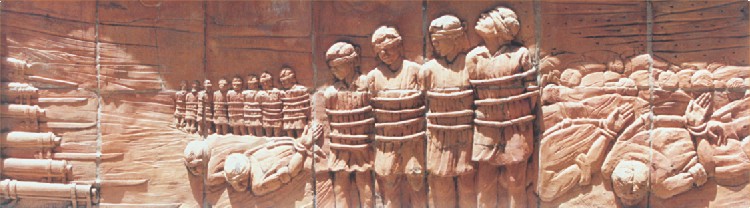
Another such symbolic epitaph stands boldly under the sky of Dhaka University premises on a small oasis of green and freshness amidst the academic and residential buildings and in front of the Vice Chancellor's residence. A composition of rectangular slabs in concrete set amidst a proposed landscaped court, this epitaph with a combination of terracotta mural and concrete graphical sculpture was established on the eve of the 24th anniversary of Independence of Bangladesh. Dedicated to the Teachers, Officers, Students and Staff of the Dhaka University, who had given up their lives during the Liberation War, the epics that lead to our independence has been meticulously resonated in this commemorating structure.The four steps lead from the road on to the island where a Rain tree stands 'bold and beautiful' with its generously stretched out branches as a witness of time and events. At the first crack of gunfire on the night of 25th March 1971, the Rain tree and its companions could only shed invisible tears. Tears for innocent lives when they witnessed the unparalleled massacre of the Pakistanis; fire blackened buildings, walls with bullet holes, piles of corpses, stench of blood and fear all around.
Today the trees stand still witnessing what time has given to this country. To complement them with the Epitaph below two black metallic stands of illumination are placed that would focus their light on the memorial when dusk creeps in. The soil here bears the sea of blood and tears and so do the trees and grass and this epitaph of massacre has turned into a memoir that speak of that unbearable pain that once shook the earth below.The concrete slabs of the epitaph with its mosaic finishing are embedded with plates of terracotta mural plaques on one side and with black plates on which names of the martyrs are inscribed in white on the other. As one approaches, the first slab that greets him is adorned with a few lines from Tagore's song which speaks of remembrance of those immortal souls beyond the ocean of death who left their supreme imprints on this very earth.On the opposite side of this slab, the meaning of this dedication is inscribed. The epitaph on the other hand ends with another plaque in which words of our national poet Kazi Nazrul Islam are embedded. The lines ask us to remember the supreme sacrifices of those souls who have left this earth prematurely so that we, the living, may stand with pride on a soil free and sovereign. The other slabs contain the list of names of the martyrs of Dhaka University in alphabetical order carrying with them the hushed silent voices of the once living now blended within the concrete slabs. The terracotta plaques on the other side of these slabs depict the inner essence of our legendary past full of protests, struggles, fights and freedom.
Embedded in 8 plates of either 8' x 2' or the smaller plates of 4' x 2', the first of the saga expresses the green, verdant refreshing scenes from villages of Bengal. Consecutively the following plates express in silence the chains that wrapped our entity of exploitation and torture for long years. The historic language movement marking the first sprouting of intense nationalist feeling of the Bangladeshis and forging ahead the country's cultural identity and triggering off heroic movements, the bold voices of protests of the 69 movements culminating to the great uproar of March 7, 1971.Then comes the plaque that expresses the genocide and attack of 25th March which has been symbolised by charging bayonets and blazing fire that threaten our emblem of sacredness, the Flag.
The Final Plates depict the last encounter, the war of independence, epics that tell of the freedom fighters that were willing to die for honour and freedom and the spirit of which had engrossed the souls of the patriots of this country.And finally the long cherished dream of freedom that has been symbolised by a new sun, the smiling Ruposhi Bangla and people carrying the Flag of a new born country.This epitaph designed by Architect Masih Uddin Shaker and implemented by Artist Abu Sayeed Talukder supported generously by Artist Rafiqun Nabi and Architect Abdul Mohaimen, had to suffer the confusion and indecision of bureaucratic conflicts. However it ultimately took its shape and now stands to bow to all those, whose blood lies in the very soil where we stand.Following the long tradition of using terracotta another Mural work titled "Bijoy Ekattor" by Shyamal Chowdhury has been set in the central premises of the Agricultural University of Mymensingh facing the residence of the Vice Chancellor on one side and the Zainul Abedin auditorium at the other end.The sculptor won a competition and thus this composition which included a sculpture placed on a high plinth along with the façade walls adorned with mural work. The underlying concept of the sculpture comprising of three human figures at three different heights includes a bold, courageous female - symbol of our motherland.
At the first level she summons to all for revolution, the second is the figure of a student with arms symbolising the freedom fighter and the last one is that of a peasant carrying the Bangladeshi Flag symbolising victory of the people where the agrarian community dominates. Another aspect of using the peasant figure is to relate with the agricultural university where this monument resides. The monument is 36 feet in height from ground level, whereas the mural faç
ade of the plinth is 6 feet and the figures around 16.5 feet. The murals on the plinth facades are embedded with the continuous saga of the political movements blending with it the main tune of our fight for freedom and finally our victory.The first phase of the terracotta Mural starting from the ever-existent beauty of Bengal portrays the language movement of Bangladesh. "The Amar Ekushey "- the mass revolt and movement of 1969, the historic mass gathering and speech of Bangabandhu on 7 March 1971 and finally the fateful night of 25th March 1971. The second phase of the Mural comprises plaques on Mujibnagar Government, the Liberation War, scenes during the war and finally the victory on December16, 1971.Of all plastic mediums, Terracotta or burnt clay is the most ancient that has been used in pottery, statues, structures and even in built forms in almost all cultures and is no exception even in Bangladesh.Hence considering the long, rich heritage and tradition and our emotion with the very soil of our country the use of terracotta in the above Epitaph or Monument is beyond question. To get a taste of the richness and excellence of terracotta use, we may look at the walls of the Kantaji Temple built in the 18th century or even traces of terracotta from the 800 AD Somapura Vihara, Paharpur.
With the use of latest technologies, this medium can today be an icon of our artwork in all aspects. But due to lack of adequate care and protection these terracotta works encounter the threats of insecurity and unwanted vandalism. Tomorrow may always bring another surprise, but who knows when these commemorating epitaphs would themselves be only a memory of hard work and emotion blended with skill and craftsmanship to express our legendary past.Can we stop those sacred souls who with the dawn of each day would surge to feel the air of a free country of honour and pride earned against a high price?......................................................
Terracotta mural works in rememberance of martyrs of the Dhaka University.
Bijay Ekattar, terracotta mural works at the Mymensingh agricultural university campus......................................................
Story: Zakia Rahman, architect
Photo: Syed Zakir Hossain
(C) The Daily Star