Venture
Entering into a realm of unique darkness
Installation-based live show on visual impairment held in the city
Aziz Amirul
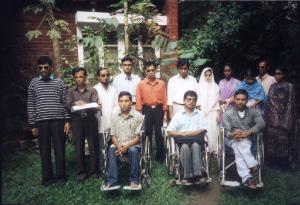
A baffled inner conscience repeatedly jolted the psyche of the visually abled visitors and reminded them of social duties towards the incapacitated during participation in brief tours within a make-shift installation of and by visually-impaired persons at a recently concluded exhibition at Dhrupad Gallery in the city.Entitled 'Seeing in the Dark', the weeklong show comprised of sessions conducted by members of Social Assistance and Rehabilitation for the Physically Vulnerable (SARPV-Bangladesh), a world partner of Health Link Worldwide UK. The show was organised with co-sponsorship from British Council and DFID (UK). With one's stepping into the installed world, the very first entity that engulfed, came in the form of absolute darkness, due to absence of any source of light around. A practically struggling and 'blinded' visitor made way through the pitch-dark paths of the makeshift urban installation with the help of a 'white cane'. Boarding and leaving a rickshaw, one of the easiest tasks otherwise for the visually competent person seemed one of the hardest jobs along with payment of fare. Soon, whistles of an advancing train buzzed in the ears as the guest neared a dummy rail track. Worries turned into uncanny fear as the person slowly crossed the tracks with wobbling feet. While following the ground trail, the visitor reached a city park. A bubbling nature all around with chirping of birds and children's laughter provided an ideal mood to the visitor's thoughts who took a corner seat. Soon the person received a shudder in the soul overhearing a piece of conversation between two visually impaired girls, one who was narrating her sad tale of being physically molested by her very own uncle yet found no justice from the conservative society ruled by fundamental principles and self-declared ethics. To bring a quick end to this seemingly terrible episode of temporary make-believe visual impairment, the visiting guest advanced towards a market place. It seemed to be an increasingly complex task to buy some daily amenities from the installed department-cum-kitchen store. Finally, an approximately fifteen minute tour came to an end with a sigh of relief from a keyed up yet moved visitor of the show. 'It seemed to me like hours as I struggled to move and carry out the instructed activities inside the tour area with impersonation of visual impairment,' said a visiting Chittagong University student. Yasmeen, a housewife following the installation tour thanked the Almighty for providing her with perfect sight and physique. 'We, the physically competent, always complain of various inadequacies in our lives and forget the Creator's natural gifts including our ability to watch the wonders of the world.' Such a least publicised exhibition would hardly reveal problems and demands of the physically impaired before the conventional society, one that provides basic facilities only to the well-to-do citizens free of any physical disability, felt Jibon William Gomes, the chief coordinator of the show. 'We could fully match incompetence with any physically-abled person provided we were given the right environment and facilities. It is not our fate that turned us impaired, rather it is the man-made environment that is greatly responsible,' Jibon added. Golam Mawla, a graduating student in agriculture, complained in an aggrieved tone of his initial failure to get admission in the faculty despite receiving good grades in the preliminary tests. 'In the eyes of the commoner I am a social burden and my only fault is that I suffer from partial paralysis as a result of childhood illness.' Most of the members of SARPV-Bangladesh felt that it is not for them that they suffer from impairment but the flaw lies in the traditional imperfections of our society dominated by superstition, viciousness and hatred. 'Today, through this exhibition, we feel much relieved to be able to let the able-bodied feel our innermost pang and emotional upheaval,' said an organising member who believed that the show's uniqueness was in the fact that it had nothing to show visually rather let the healthy visitor feel through one's inner eyes the life-style of a visually-impaired person. The author is a free lance writer
|