Gaddafi's gambit
The dawn of overdue prudence
Esam Sohail writes from Kansas, USA
One does not have to like Libyan leader Colonel Muammar Gaddafi to give credit where credit is due. His recent and somewhat surprising decision to unconditionally dismantle his weapons of mass destruction (WMD) is welcome news for the region and the world. Equally importantly, it is another piece of glad tidings for the people of Libya and foreign expatriates there both of whom have suffered immensely in the last twenty plus years largely due to the imprudence of the Tripoli leadership.When Gaddafi came to power in a 1969 coup, he was considered a smart, young, idealistic officer who promised to bring his backward desert country into the twentieth century. The first few years of his revolution saw credible progress with regular parliamentary elections, sharp rise in per capita income and purchasing power, and a growing social security infrastructure staffed largely by expatriate health and educational professionals. Paid for Libyan petroleum, one of the cleanest in the world, Libyan prosperity was evident in the humblest streets clogged by expensive French cars, department stores bulging with consumer goods, and in the millions remitted by Arab and South Asian expatriate workers. Libyans vacationed in Italy, went to shop for furniture in Germany, and studied in the United States. Then things suddenly began to change around the tenth anniversary of Gaddafi's revolution as the Colonel decided on being a global player. He ended up more of a pariah than a player. By the mid-eighties, Gaddafi had fought losing border wars with Egypt and Chad and been bombed by NATO for providing training camps to all kinds of terrorist groups and fringe elements (including the famous Farooq-Rashid duo of the August 15 tragedy). His agents had murdered a British policewoman in London, blown a couple of airliners in Europe, and kidnapped his own outspoken foreign minister Dr. Masnour Khikhia from Cairo. Libyan mercenaries were caught fighting in civil wars in all corners of Africa. Never mind the Americans and Europeans, most Arabs and Africans had enough of Libyan adventurism, to the point that the late Anwar Sadat publicly called Gaddafi al wald majnoon (the mad boy). At an African summit, Sudan's Islamist President Jafar Nimeri further underscored Sadat's point. The idiosyncrasies of their ruler were costing ordinary Libyans, an easy-going, affable bunch, dearly. Prohibited by Gaddafi's detractors from travelling to most of their vacation spots anymore, Libyans found little comfort at home where Gaddafi's frequently changing 'Arab socialism' had destroyed the mercantile class, ruined the very limited arable land, and left his people to shop at empty state-run superstores. Where once stores could not get rid of the latest Japanese electronics and fancy European toys, now there was rationing of essentials like butter and rice. Having spent most of his treasury in bankrolling the IRA and intra-African civil wars, Gaddafi countered the seething economic discontent by resorting to increasingly absolutist rule that brooked no opposition and was particularly ferocious with the minority Berbers and the traditional Sufi zawia lodges. Not even in Arab history has so much promise for so many been bargained away so quickly for so little. Prudence has the amazing capacity, however, of dawning on the most unpredictable minds. Since late nineties Muammar Gaddafi has apparently taken a long, hard look at the plight of his people and his own future in a very changed world. Domestically, he has reluctantly allowed the merchants to open back their shops, journalists to modestly criticise the regime, and ordinary citizens to have access to telephones and even the Internet (for most of Gaddafi's rule, private homes could not have telephones!). Internationally, Tripoli has managed to have the crippling UN sanctions lifted after handing over terrorists it had been sheltering. Furthermore, Gaddafi has smoothed out his erstwhile rocky relations with his Arab and African brethren by promising not to intervene in their internal affairs. The results of Gaddafi's belated pragmatism are showing already. Libya, rich with ancient Roman ruins dotted along its gorgeous coastline, is being promoted as a tourism destination by some European operators while Libyan tourists, students, and athletes are being slowly welcomed back in places like France and Britain. Ordinary Libyans, until recently burdened with plenty of dinars that chased non-existent consumer goods, are able to browse the markets again, albeit in a limited fashion. The recent accord on the Libyan WMD programme is another wrung in the ladder of Gaddafi's belated efforts to re-join the international community. It is specially a big step towards the possibility of the lifting of American sanctions on Libya, sanctions that have been terrible for the cash-producing Libyan oil sector that long depended on American imports, expertise and technology. Substituting American know-how with second rate Canadian and Russian counterparts did not particularly help the bottomline in Tripoli's National Oil Company. Whether Gaddafi's recent efforts to reach out to the world will help him personally or not is irrelevant in terms of the big picture. What is important is that these initiatives are showing encouraging results in the lives of the five million ordinary Libyans. There is reason to be hopeful that Libya's oil wealth, until recently either sequestered or squandered on dubious extraneous causes, will again be available for building a better life for the average Libyan family. Young Libyans, with only two domestic universities of questionable quality to choose from, will be able once more to pursue higher education elsewhere. Expatriates of African and Asian countries, including thousands of Bangladeshis, who have built Libya's health, education, and housing network may have a slightly easier time travelling to and remitting from the North African country. In other words, it is possible that should Colonel Gaddafi's present commonsense continue as policy, Libyans and their foreign guest workers will have slightly less inconvenient lives. That is good news from a country that usually does not generate such in abundance. Esam Sohail, a banker by profession, is a former college instructor of international affairs.
|
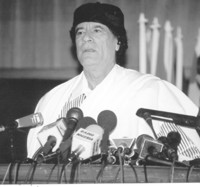
Muammar Gaddafi |

