Photography
In quest of depicting the depths of mankind
Anwar Hossain talks about his recent exhibit at Alliance Francaise
Fayza Haq
Asked why he had gone into photography at the outset, Anwar Hossain, who had his recent exhibition at Alliance Francaise "A journal of two nationalities", said, "I wanted to go into painting but my family, being a conservative one, objected to it as in the sixties, in Bangladesh, the profession of a painter was not considered a laudable one. I had stood 5th in my school exams and my family wanted me to study something 'worthwhile' which would get me a name and bring in money to the coffers at home. By the time I was in 3rd year of Architecture I was old enough to carve out a career of my own with a Tk 30 second-hand camera, which removed the pain of not being able to paint. By now I was 24 and had enough guts to defy my teachers and the home front. The rest is history. My passion for painting and education in architecture catalyzed it. I got a scholarship to study cinematography at Pune in India, which taught photography on the side but by that time I was into photography, and my education in India encouraged me go into the cinematic side of my career." Talking about his preference for black and white images rather than coloured ones, Anwar said that globally the more serious people prefer black and white as it brings in simplicity; in black and white one sees only the content form whereas colours may distract one and deviates the eye from the theme quite often. The recent exhibition contained coloured pictures along with black and white photos to depict Bangladesh alongside France. Anwar said, "My wife has green eyes fleck with red and they remind me of the Bangladeshi flag. France and Bangladesh have two very different cultures and values. In this exhibit there are more coloured images: perhaps this is because my life is brighter than before, with the company of my wife and two sons." Anwar had concentrated on portraits and here again he had gone in for simplification. "One eliminates, the body and the long shots, and one goes closer to the subject until one can't cut off any more." Anwar said, "This gives one a powerful image of the essence and content. I've tried to bring in a lot of varieties such as my wife's picture enveloped in clouds and beside her is the portrait of an old Bangladeshi villager from Shilaideho, wearing an Air France T-shirt, and so the connection between the two images. There is always a link between the photos framed together." Similarly the old Bangladeshi lady photographed in 1981 is juxtaposed with the image of an old inhabitant in an old home in France. The portrait of the actress Naila Azad Nupur was taken in 1981 in Rangamati, when she was a model, and it depicts her bathing and scattering jets of water. Now living in USA, she turned up in France, and Anwar photographed her decades later in 2003, along with the hands of one of Rodin's sculpture pieces. In another frame are two torsos of women, one in France with a toy guitar hanging along with the hair and the other from Bangladesh, bearing two flamboyant "shola" cockatoos against the bare body and flowing hair. Dwelling on what he searched for as he went about his work, Anwar said, "It has always been my quest to depict humanity, and the different aspects of life that one leads from birth to death. Once in a while, here and there, landscape is also brought in." Touching once again on why he had taken up the particular theme in his exhibit, Anwar said for the last ten years, he had been a person of two worlds, living in France and Bangladesh. Leaving his family, he has to come very often to Bangladesh to do his filming. When he's at work in Bangladesh, he naturally misses his family in France. In his display he wanted to bring the two worlds together. Asked if photographs are valued as they should in the market, Anwar said, "I'd rather value a good photograph than a bad painting; I might treasure a good rickshaw painting which speaks of culture, and is raw and basic, rather than a hypocritical painting. However, in the west, it is quite some time that photography has been accepted as an important and strong medium." Touching on his favourite photographers, he named Amanul Haque and Naibuddin Ahmed; among the new generation he admired Saifuddin Chandan. In India, his choice was Sunil Jana and Ragu Rai, and in Europe he loved Henri Cartier Bresson (who captured various incidents in the same image) and Sebastio Salgado originating in Brazil but now living in France (whose portrait had been cleverly juxtaposed in the display). For Anwar the most committed photographer was Eugene Smith, from USA, (who brought out into public the incident of mercury poisoning in Japan). Recounting the films that he has made, Anwar said that they included Surjo Digol Bari, Purohskar, Emiler Goenda Bahini, Onno Jibon, and with Tanwir Mukkamal, Sujor Mia, Chitr Nodir Pare, Hulia, Nodir Nam Modhumati, and more recently Lal Shalu and Lalon. Anwar said that for instant satisfaction her preferred still photography, which ultimately end up in a book or an exhibition, but cinema provides a family when you work together with others. "A film is produced after a lot of procedures and pain: if it works out it gives immense pleasure. As for books, I've made four of them so far, the first one being The Bangladeshi image, A journey through Bangladesh (in colour), Dhaka portrait in colour and black and white, Women (with pictures of 29 countries in black and white) and more recently, A voyage through Bangladesh. Anwar has over 60 international awards for his photography and about a dozen awards in cinematography in Bangladesh.
|
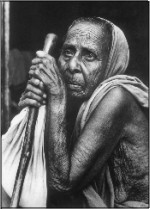
Great Expectations, Dhaka, 1971. |

