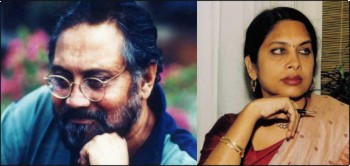
Celebrity couple
"The spirit of activism was strongly imbibed in us"
Aly Zaker and Sara Zaker talk to Fayza Haq of The Daily Star
Aly Zaker, a well-known theatre personality, and his wife Sara, give their assessment of themes, techniques and equipment of local plays.The Daily Star: Has there been a change in the themes of the plays? How much of the themes are social activism and political statements and how much entertainment? Aly Zaker : If we look at the past of the theatre practitioners we will see in our past has a strong bearing on activism. Not one single theatre person who started his/her journey in theatre after '71 was ever detached from the immediate past of freedom movement. The spirit of activism was strongly imbibed in us. The same cannot be said about the young lot who are joining the forces of theatre today. They are there to make a profession in theatre and related fields. One could expect a good portion of the plays would, in that case, not be political or based on activism. But I presume the roots of the "activism based theatre practice" has gone deep which is why till today one would see that the plays are mostly socially if not politically charged. Besides, we must not lose sight of the fact that the stage is a mirror of the society. Therefore, the characters reflect whatever happens in the society as, of course, interpreted by the artist/s. TDS:How do the Bangladeshi plays rate vis-à-vis the Kolkata ones? A Z: The language of both countries is Bangla and the class differences/ struggles within the two societies of Bangladesh and West Bengal are similar yet the plays and dramatic presentations of Bangladesh and Kolkata are different because they are made and presented in two vastly different socio-political environments. One cannot sweepingly compare the two genres of plays. Especially if one has to rate the two it becomes an even more difficult a task. We may dare add a rather general comment if we have to, which is that the plays of Bangladesh are either verse based or narrative and plays of West Bengal are more likely to be archetypal social dramas. This is a general comparison and the exceptions in either case are there. Also plays of Bangladesh tend to be more in the colloquial language or dialects. TDS: What are the new techniques and equipment in plays What are they doing to match those of the advanced world? AZ: Technically we are not at all equipped the way the advanced world is. Having said that the plays in Bangladesh never quite relied on the technical excellence. It has always been an actor director dependent practice. In fact a recent practice, in some isolated cases, of huge stage constructions have caused considerable logistic problems because of lack of storage facilities. We have to remember we are in the practice of a poor man's theatre because of lack of money in theatre per se. If we had had the necessary equipment of light, sound and stage construction, we would, in all probability, have done a technology savvy job. Many technically skilled people have more than necessary experience and ability here. TDS: What kind of plays are hits and which ones don't work in Bangladesh? Sara Zaker: The plays that are well-made, work. And ones that are sloppy, do not work. Many theatre people say that the lack of a star cast does not spell success. This, unfortunately is not true .We have seen plays work--plays which did not have a single star cast. Once the audience is in the auditorium she/ he does not look for the star. They want to enjoy a good, well-acted, well-made play. TDS: Has there been much use of the recent theatre festivals in town? SZ: One does always judge the festivals for its use. Theatre groups with much effort and voluntary hard work organise festivals. These efforts speak for the energy that runs the show. Having said that, we wish the theatre groups who organize these festivals would design a theme for their festivals. With an overarching theme the audience would be exposed to a variety of performances and would be able to compare and analyze. It does not seem that organisers of festivals are always keen to think in this line. TDS: What kind of changes would you have liked to see in the theatre scene? SZ: A change in terms of thought and practice of the Art. A versatility. Stronger women voice. TDS: What are the kind of roles that and Sara and you have been playing and is this what you want to do? SZ: We have been doing our bit in acting, direction and organising activities. But we have not been able to make theatre our only focus which is why, personally, we feel frustrated. It has been some time that we have not made a difference with a new play. It is time we did that. TDS: How do you interact with one another as professionals and as a couple? SZ:The two entities are different. One does not interfere with the other. I cannot, as a spouse, have any advantage, for example, as an actor when I am acting under the direction of my spouse. In fact the personal relationship should be left outside once we enter work.
|