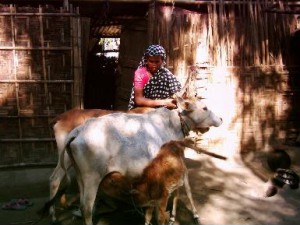
Life of poor woman made easy by civil society effort
EAM Asaduzzaman, Nilphamari
Mamata Begum of Ghonpara village under Sadar upazila, was one of the many poverty-stricken women in Nilphamari district. She was the eldest among five brothers and sisters. Her father was a day-labourer and he became paralysed when she was only eight years old. Ever since she had to earn a living by selling grass to the town dwellers who used it as fodder for their cattle. Every day she would walk four miles to Nilphamari town, with the bundle of grass on her head. At the end of the day it would bring her only Tk 15/20 with which she bought rice.At the age of 15 she was married off with the financial help of the villagers. With dreams in her eyes, Mamata entered into her husband's house at Darwani village next to her own village. But it wasn't long when she realised that poverty had followed her even there. Her dreams were shattered. Moreover, her rickshawpuller husband had an illicit relationship with another woman at the same village. He would give away whatever he earned to that woman. When Mamata came to know this, she protested. But from then on her husband began to beat her; her in-laws also joined him. Thus began a tragic and miserable chapter of Mamata's life. After giving birth to a boy, she expected that her husband's attitude would change, but it was in vain. One day she caught her husband red handed with the woman in her own hut. Her furious husband beat her so mercilessly that she became senseless. Her in-laws did not show any sympathy either. After learning of her state, Mamata's mother and her uncle took her back to their home at Ghonpara. She never returned to her husband's house and divorced him. She was passing her days with her only son in great hardship. She was earning a negligible amount by selling her labour in fields or as domestic help. Then one day, BRAC workers came to her village and listed her name along with 47 other poor women and her life changed dramatically. Because from then on she was included in the BRAC's CFPRTUP programme (Challenging the Frontiers of Poverty Reduction-Targeting the Ultra Poor). After a three day long training, BRAC allocated her two cows worth Tk 7,800 as her asset on September 22, 2002. BRAC officials told her that she did not have to pay a single taka for the cattle. BRAC officials also vaccinated her cows to prevent them from diseases and 18 months close follow up by a Doctor of Veterinary Medicine (DVM). BRAC strongly emphasises community mobilisation to aid STUP members in combating their poverty. Such efforts encourage community to become more aware of the ultra poor's problems, give correct solutions to their problems, mobilise local resources and offer support to local service providers, NGOs, Government departments and others offering services to the ultra poor. Therefore Gram Shahayak Committee (a support group) was initiated and formed in STUP programme areas. It is an instrument that caters to community mobilisation efforts and builds a social safety net for the ultra poor. Without any incentive they are helping ultra poor. The main objectives of a Gram Shahayak Committee is to ensure health services for the TUP beneficiaries when they are sick, arrange food for them if they are hungry, resolve their problems and take necessary actions when they are exploited or oppressed, ensure children's admission and attendance in school, install hygienic latrines for the TUP beneficiaries, provide safe drinking water for the TUP beneficiaries, repair the houses of TUP members, help those TUP members who are affected by natural disasters. This committee is formed in village under the STUP programme. It consists of seven members, including two members from Palli Shamaj. The Programme Officer (PO) of BRAC facilitates formation of the committee by personally communicating with the community members. It is elected for five years. Whatever decisions the committee makes, it is made in monthly meetings with the consent of two thirds of the members. To ensure safe drinking water for the TUP members, the 60 Shahayak committees in the same number of villages of Nilphamari district till June 2003 installed 433 tubewells. They also installed 950 slab latrines in the villages. The committee also gave Tk 17,763 as financial assistance to the ultra poor in the district. One such Shahayak committee comprising seven members of the civil society was formed at Mamata's village, Ghonpara as well. A local doctor Alauddin Mia was made the President and a small trader Saju Ahmed Babu was made Secretary and a farmer Noor Mohammad was made the Cashier, while Programme Officer Roknuzzaman remained in the committee as simply a member. The Shahayak Committee came to Mamata's rescue when she needed their help the most. She used to keep her two cows in her broken thatched house at night. There were thieves living in Shipaitari village of the neighbouring Charaikhala union. Naturally they came to know about Mamata's cows. On the night of December 15, 2002, the thieves stole one of her cows. Without wasting any time, Mamata immediately informed the matter to the Secretary of the Shahayak Committee, Saju Ahmed Babu who assured to help as much as possible. He met other members of the Shahayak Committee and went to Chairman Mahbubar Rahman Shah of Charaikhola union to ask whether he could help in recovering the cow. The chairman obliged and asked two 'Chowkidars' to go to the house of the identified thieves at Shipaitari village. After a thorough search they found Mamata's cow at a bamboo cluster. But they couldn't catch the thieves since they had fled the scene by then. Mamata was elated when her cow was handed back to her. She was grateful to the Shahayak Committee for their efforts in recovering her cow. "To uphold the moral values and religious teachings we stand beside the ill-fated poor women of the locality," said Saju Ahmed Babu, Secretary of the Shahayak Committee. Good days have returned Mamata's life. Two months ago one of her cows gave birth to a calf. Now she gets four kilograms of milk everyday. She sells the milk at the local market and gets Tk 45-50 per day. Her income will increase more when the other cow gives birth to another calf. The Shahayak Committee Secretary leased two decimals of land to her to cultivate Nepier grass which would help her solve the fodder problem. Now Mamata is a happy woman content with life. She does not depend on other's charity to fend for herself and her son anymore. She says she will never forget the timely action and great service of the Shahayak Committee.
|