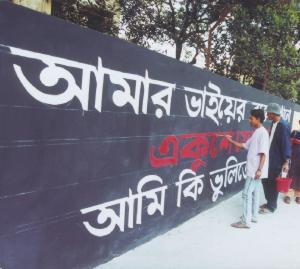
Ekusher chinta
Mohammad Zaman, Cary, North Carolina
The ripples of Ekushey were not heart-felt in my sleepy town (bazaar to be precise). My first experience was rather tangential through unauthorised reading of my brother's daily memoir. On Ekushey his writings were brimful with a nondescript defiance. It was exhilarating with a twist of Kafkaesque distortion as if our national psyche was bobbing through a chimerical haze of uncertain identity. It was late sixties. My father, who actively fought for Pakistan, was still nascent with Pakistani nationalism. My brother, notwithstanding his deference to the Pakistani national flag, was bubbling with a defiant difference. A generational fault was immensely palpable. The inter-wing disparity, hegemonic attitude of khaki-clad Urdu-speaking juggernaut and many other maladies of the Field Marshall (Ayub Khan) eventually transformed that strain to its tectonic proportion leading to a nine-month-long struggle for independence in 1971. In 1971, we emerged as a new nation dedicated to the proposition that we are Bangali, that we are bound together by a single language, that we share a common cultural heritage. Such was the promise of Ekushey and eventually of its natural extension the Liberation War. Islam came to Bangla on the wings of tolerant Sufism. Cross-religion reverence for "Mazaar Culture" grew out of the inclusive benevolence of the Sufi Saints. Thus we notice a splendid panoply of religiosity at Shah Jalal or at Bayezid Bustami. With diminishing influence of tolerant Sufi philosophy, we see a hardening of religious chrysalis trying to filter out the traditional commonality and sharing of religious/spiritual practices. This smouldering process started under the auspicious grace of the British Raj and continued to progress. The Language Movement of 1952 and its eventual culmination in the Liberation War of 1971 temporarily halted the process. This was a pleasant hiatus! Unfortunate post-liberation political mistakes, however honest they may be, gave a sad opening for the defeated "Right" to regroup and later, despite a narrow following (about 10%), rise to prominence because of inherent weakness of the mainstream political parties. The promise of 1952 was none other than a secular BANGALI national identity. Fifty-two years later, as we look backward we still see another uneasy dichotomy in our national psyche. We still are groping in a haze of uncertain national identity. An Iranian is an Iranian, a Palestinian is a Palestinian, an Indian is an Indian this is plain and simple! There are no ifs or buts! But a Bangladeshi still remains, at best, a hesitant Bangali. Politicians are just playing politics. Intellectuals are divided or are collecting dividends. In the mean time, ambivalence reigns...
|